Dictionary: SEN Officer · MOE
Bullied, or left out? Two different problems
MOE draws a line between hurtful behaviour and school bullying. Hurtful behaviour includes one-off unkind comments and physical fights. Bullying means “persistent and intentional hurtful acts”, and it can be verbal, social, physical or cyber, which means online.
Being left out can sit on either side of that line. The National Autistic Society, a UK autism charity, lists “ignoring or leaving out” among the things bullying can involve. But a child can also spend recess alone with no one being cruel at all.
Schoolbag, an online magazine published by MOE, gives an example from group work. A student keeps cutting off a teammate’s ideas, and the teammate feels shut out. Whether that is bullying depends on whether it was done on purpose.
| Question | Left out, with no one being cruel | Bullied |
|---|---|---|
| What you may see | Alone at recess, no one to sit with, no names of friends | Names called, things taken or broken, pushing, being shut out on purpose, unkind messages online |
| How MOE sees it | Not bullying, as long as no one is doing it on purpose | Bullying, once it is repeated and done on purpose |
| Who leads the help | The SEN Officer, with the form teacher | The form teacher and the school’s discipline process, with the counsellor and the SEN Officer |
| What to ask for | Peer support, such as Circle of Friends, where a few classmates look out for your child | A safety plan (how the school will keep your child safe), updates on the bullying, and support for your child |
You do not need to know which one it is before you speak to the school. Tell them what you have seen. Finding out what happened, and why, is the school’s job: MOE says schools talk to all the students involved “to establish facts”.
Signs to watch for when your child cannot tell you
Autistic children can be more at risk of bullying because they communicate and get along with others in different ways, the National Autistic Society says. They may not realise they are being bullied. And they may find it harder to tell you or the school about it.
So look for changes. MOE’s Lead School Counsellor, Shirley Sim, calls a sudden change in behaviour “the most important warning sign of bullying”. Watch for:
- Not wanting to go to school, or new reasons to stay home.
- Clothes, bags, books or stationery coming home damaged or missing.
- Bruises, cuts or scratches with no clear story behind them.
- Coming home without money they had, or asking for more.
- More stimming than usual, or a different kind. Stimming means repeated movements or behaviour, such as hand flapping.
- Changes in sleep or eating, more anxiety, or outbursts at home.
- Getting upset more easily than usual over small things.
- Friends they used to mention, suddenly gone.
- Coming home late, or by a different route.
- Doing to a brother or sister what may have been done to them.
None of these proves bullying on its own. What matters is a change from your child’s usual, and especially one that follows school days.
The school is meant to be watching too. In May 2026, MOE told Parliament that when a student with SEN has been hurt, trained school staff will “look out for signs of distress that may not be immediately visible or explicitly communicated”. You can ask the form teacher what the school has noticed.
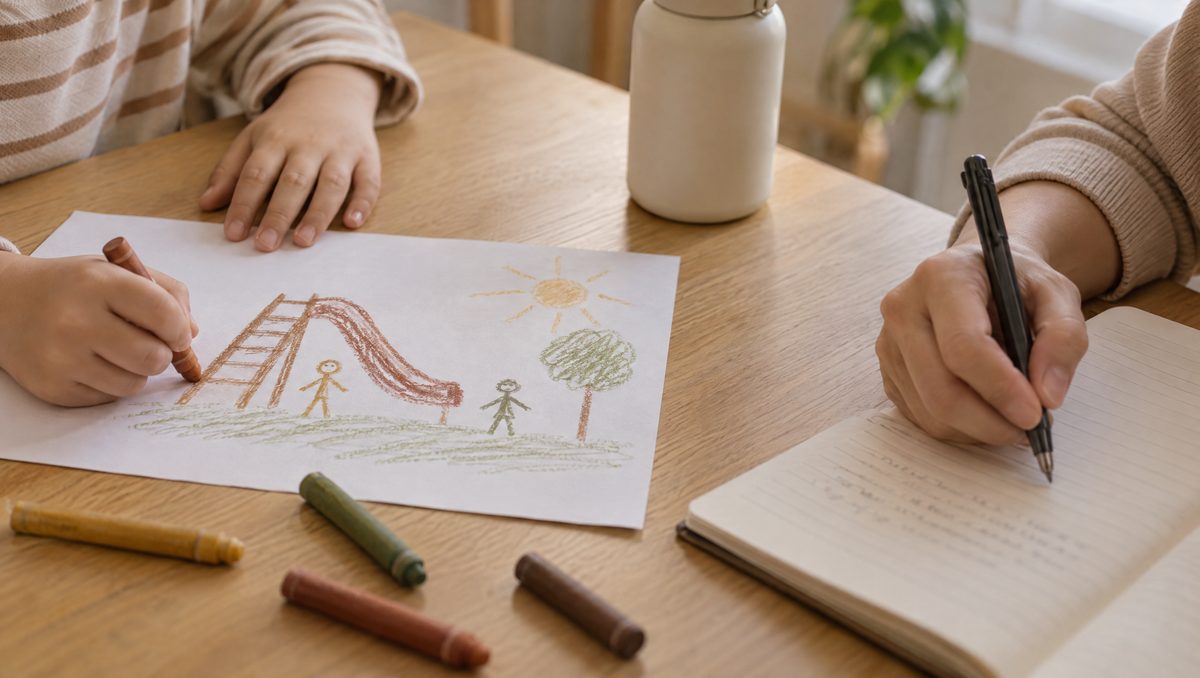
Getting your child’s side. Some autistic children find it easier to write or draw what happened than to talk about it face to face, the National Autistic Society notes. It suggests a diary, an email, or a box where your child leaves questions and you write back.
Go gently. Shirley Sim’s advice is to set aside distractions, sit at your child’s level, and listen without jumping straight to solutions. A line like “It sounds like that was really hard for you” helps a child feel heard.
If your child communicates with pictures or a device, our guide to helping a non-speaking autistic child communicate covers the tools that give them the words.
Keep a short written record
Before you speak to the school, write down what you have seen. A record keeps the first meeting about facts, and it shows a pattern that one incident cannot. The National Autistic Society suggests noting who was involved, what happened, and what the school did about it.
For each entry, write down:
- the date, and the time if you know it
- what you saw, or what your child said, wrote or drew
- who was involved, if you know
- whom you told, and what they said they would do
- how your child was that evening and the next morning
The National Autistic Society also suggests asking brothers and sisters whether they have seen anything, and noting what they say.
After every meeting, send the teacher a short email that sets out what you agreed. Everyone then has the same picture, and you have a date to come back to.
Who to tell at school, in order
MOE asks parents who hear about bullying to report it to the school and work with the school to support their child. The question is who, and what to ask them for. Here is the order we would follow.
First, if your child can take part, ask how they feel about the school stepping in. Shirley Sim suggests a line like “How would you feel if I spoke with your teacher so we can support you together?”
- The form teacher. Email or ask for a short meeting, and bring your record. Ask what the teacher has seen, what will keep your child safe this week, and whether the SEN Officer can join you.
- The SEN Officer and the school counsellor. Ask for one named adult your child can go to, a plan for recess and other free time, and whether Circle of Friends would suit your child.
- The Discipline Master or the student management team, the staff who handle discipline, when it is bullying: done on purpose, and again and again. Ask what the school has found, what it will do, and when you will next hear.
- The school leaders, such as the principal, when you are worried about how the school is handling the bullying. Ask for a meeting, and bring your record and your emails.
- MOE, when talking to the school has not settled it. Use MOE’s feedback channels or its hotline.
Why the form teacher first. MOE’s Lead School Counsellor advises parents to reach out to the child’s teacher when safety is a concern. We start with the form teacher because they are the adult closest to your child’s school day.
Why the SEN Officer so early. SEN Officers give in-class support, and one-to-one or small-group skills training, to students with special educational needs. As of November 2024, MOE says every primary school has at least two and every secondary school at least one. Our SG Autism Dictionary entry on the SEN Officer explains the role.
School counsellors, MOE says, work with the students involved to manage their feelings and mend relationships. In some secondary schools, students report bullying to the Discipline Master, and if it keeps on, it goes to the student management team. Ask the form teacher who handles discipline in your child’s school.
When to go above the school. If you have concerns about how the bullying is being handled, MOE asks parents to raise them with the school first, then use MOE’s online and offline feedback channels. MOE’s hotline is 6872 2220, open Monday to Friday, 8.30am to 5.30pm, as of October 2026. MOE says reports are “treated sensitively and confidentially”.
If your child is hurt or in danger, skip the order. MOE says urgent cases should go straight to teachers and school leaders, so that action is prompt.
What the school should do after you report
In April 2026, MOE published the results of its Comprehensive Action Review Against Bullying. That was a review of how schools prevent and handle bullying.
Schools get clearer guidelines on handling each bullying case, “including communication timelines, safety planning, disciplinary measures, counselling and restorative actions”. Restorative actions help the students involved repair the harm and the friendship.
MOE’s page on what schools do, updated in April 2026, says schools will:
- put “immediate safety measures” in place for all students involved, with an individual safety plan for the child who was hurt
- talk to all the students involved to find out what happened; “some cases may be resolved within days, whilst others may require more time”
- use discipline, counselling and restorative actions, with stricter discipline for serious misconduct
- keep in touch with parents “throughout the entire process”
A safety plan can include keeping the students apart, removing hurtful posts online and arranging peer support, MOE told Parliament in May 2026.
A child who needs more help with their feelings may be referred to the school counsellor, the SEN Officer or a REACH team. MOE says this happens “particularly when persistent distress is identified”, which means when the child stays upset over time. REACH stands for Response, Early intervention and Assessment in Community mental Health.
For students with SEN, MOE added that schools “will first address the immediate safety concerns”. So when you meet the school, ask three things: what the safety plan is, who is on it, and when you will next hear.
You may not be told everything about the other child. MOE says schools handle bullying cases sensitively, to give the students involved space and privacy to learn from their mistakes.
What is still coming. Every school is to have its own anti-bullying policy, built on MOE’s guidelines, by the end of 2026. Ask whether your child’s school has one yet, and for a copy.
From 2027, each school will have an online reporting platform for students and parents. MOE says urgent cases should still go straight to teachers and school leaders, not through the platform.
If it happens online. MOE said the Online Safety Commission would be running by the end of June 2026, to help victims of online harms such as harassment and doxxing, which means posting someone’s personal details to target them. Schools will guide students to report to it.
Circle of Friends: the friendship help you can ask for by name
Circle of Friends is a way of building friendships around one student. MOE describes it as an intervention “which involves peers supporting a classmate with Special Educational Needs (SEN) who have social and behavioural challenges, guided by the school’s SEN Officer”. In plain words, a few classmates agree to look out for your child, and the SEN Officer guides them.
It is listed on MOE’s support pages for both primary and secondary schools. Since 2021, every school has had staff trained to run it. Not every school runs it, though: MOE says that depends “on the needs of the individual students”.
In 2023, MOE looked at how it works in a small number of primary and secondary schools. Students with SEN who needed the support showed “social and behavioural improvement”, and the classmates who took part showed more responsibility, empathy and acceptance. Those results cover students with SEN as one group, not autistic students on their own.
You can ask for it by name. A good question for the SEN Officer: “Would Circle of Friends suit my child, and if not, what peer support can the school give instead?”
Every school also has a peer support system, where students learn to look out for classmates who do not have strong support from friends. Some wear a Peer Support Leader badge. Ask the form teacher whether a peer support leader can keep an eye on your child at recess.
Helping with friendships at home
School is where the bullying happens, but home is where your child practises what to do next.
Give your child words to say, and practise them. Punggol Green Primary School teaches its students a script: “Stop, I feel (emotion) when you (action)”, said politely and firmly, then walk away and find a trusted adult. Schoolbag suggests trying it out at home in different tones of voice until your child is confident. If your child does better with the words ready, write the script on a card.
Agree where to go. Talk through where your child can walk away to in the places they usually are: at school, at the playground, at the bus stop.
Do not tell them to hit back. A school counsellor who is also an educational psychologist, a specialist in how children learn and behave, warned in Schoolbag that fighting back can make the other child retaliate harder, and leave your child feeling worse about themselves.
Explain the difference between friendly and unkind. The National Autistic Society suggests helping your child tell friendly behaviour from bullying: behaviour that hurts someone in body or feelings is bullying. A social story can explain this from your child’s point of view. A social story is a short, simple story about one situation and what to do in it.
Say that they do not have to be friends with everyone. The same guide says autistic children may not realise this, and it is worth saying out loud.
Build them up. Praise specific work or a good day at school. The National Autistic Society suggests an achievement book or board, with photos and pieces of work, kept where your child can find it.
Give them people outside school. A group of children with similar experiences can help a child feel less alone, the same guide notes.
If school days end in meltdowns at home, our calm framework for meltdowns may help with the evenings while the school works on the cause.
What to do next
One step: write down what you have seen, with dates, and email the form teacher to ask for a meeting with the SEN Officer there. Ask for a plan that keeps your child safe, and a date to review it.
Read the slides as words
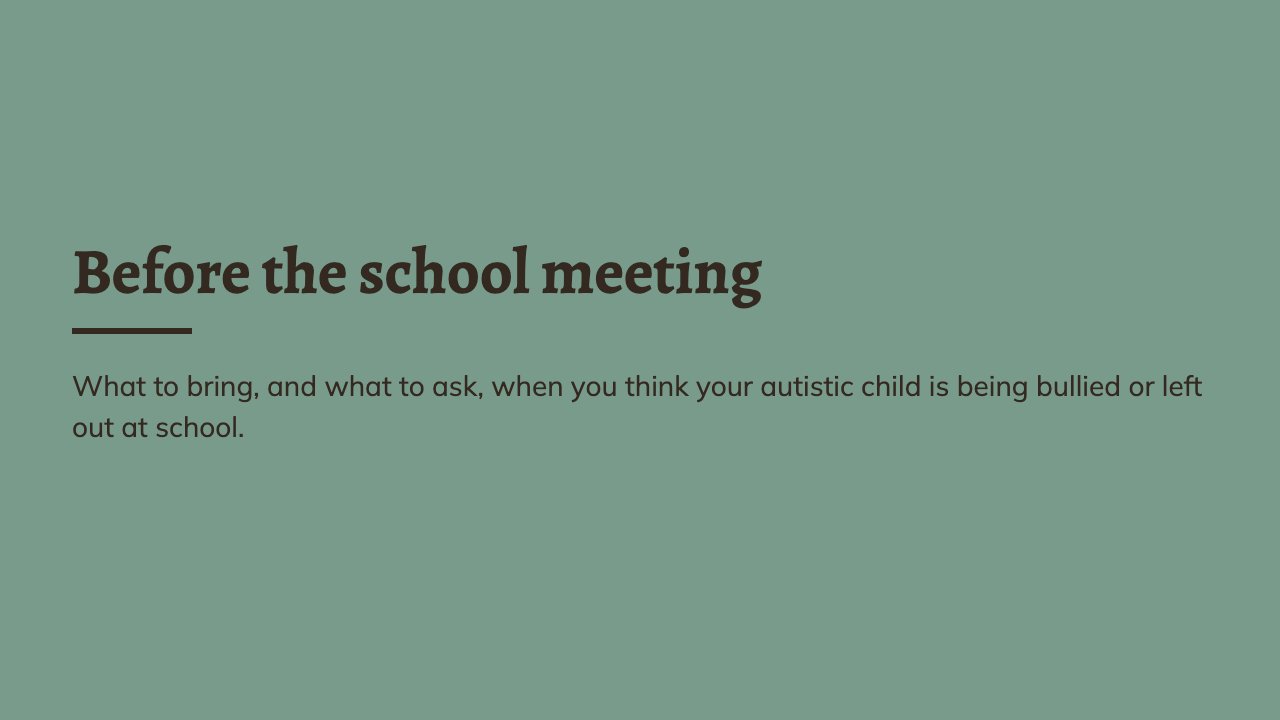
- Before the school meeting: What to bring, and what to ask, when you think your autistic child is being bullied or left out at school.
- Bring your record: The date, and the time if you know it; What you saw, or what your child said, wrote or drew; Who was involved, if you know; Whom you told, and what they said they would do; How your child was that evening and the next morning
- Ask the form teacher: What have you seen?; What will keep my child safe this week?; Can the SEN Officer join us?
- Ask the SEN Officer and the counsellor: One named adult my child can go to; A plan for recess and other free time; Would Circle of Friends suit my child?; If not, what peer support can the school give instead?
- If the hurt is on purpose and keeps happening: Ask whoever handles discipline in the school:; What has the school found?; What will it do?; When will I next hear?
- Ask about the safety plan: What is in it?; Who is on it?; When will we look at it again?
- After the meeting: Email the teacher what you agreed; Write down the date of the next update; If your child is hurt or in danger, go straight to a teacher or school leader that day
- If it is still not settled: Raise it with the school leaders, such as the principal; Then use MOE's feedback channels, or call MOE's hotline on 6872 2220
For the wider picture of how mainstream schools support autistic children, from SEN Officers to exam arrangements, see our guide to autism support in mainstream schools in Singapore.
If you would like these guides as we write them, the newsletter form is at the foot of this page.
Common questions
My child says nothing is wrong, but I can see changes. Should I still tell the school?
Yes. Autistic children may not realise they are being bullied, or may find it hard to say so.
Tell the form teacher what you have seen and ask what the school has noticed. For a student with special educational needs who has been hurt, MOE says trained school staff look out for signs of distress that may not be visible or put into words.
How long will the school take to look into the bullying?
MOE says some cases may be resolved within days, while others need more time, depending on how complex they are. In the meantime, schools are to put immediate safety measures in place and keep parents informed. Ask when you will next hear, and note the date.
Can I report to MOE instead of the school?
Yes. MOE says parents can report an incident to the school directly or through MOE’s hotline, 6872 2220 (as of October 2026). Starting with the school still makes sense, because the safety plan is the school’s to make.
From 2027, each school will also have an online reporting platform, for cases that are not urgent.
What if my autistic child is the one accused of hurting someone?
That is a different situation, and it deserves its own guide. In short, MOE says that for students with SEN who have hurt others, the consequences are “educative, restorative, and focused on helping the student learn and behave appropriately”.
How common is bullying in Singapore schools?
MOE told Parliament in May 2026 that over the past five years, schools averaged three bullying incidents per 1,000 primary school students and eight per 1,000 secondary school students a year. So for every 1,000 primary school students, schools dealt with about three bullying cases a year.
MOE has said such counts are one reference point only, since some children turn to friends or try to sort things out on their own. The figures cover all students, not autistic students on their own.