
Dictionary: SG Enable · SPED · ARC · Sheltered workshop · Day activity centre
Read the route as words
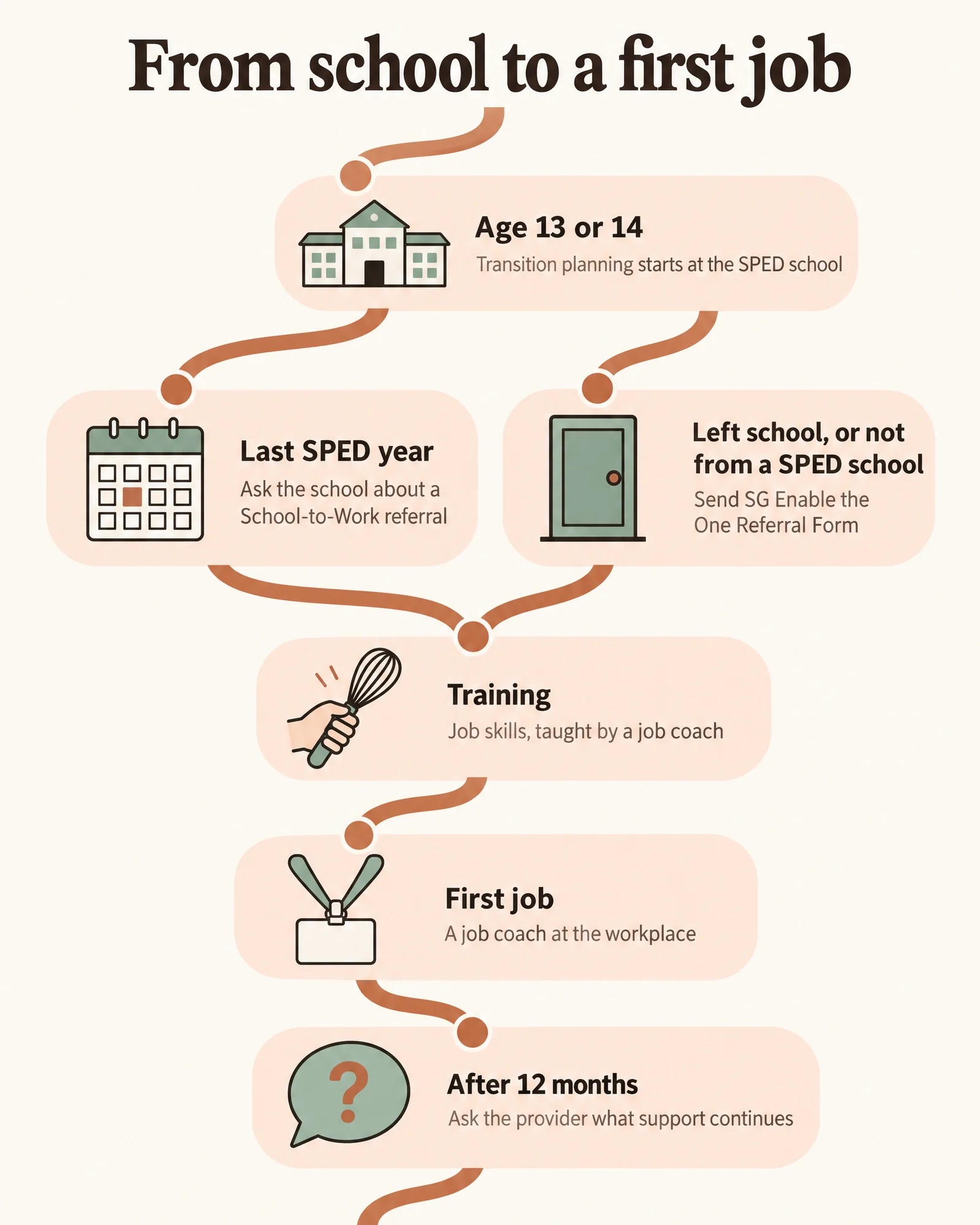
From school to a first job
- Age 13 or 14: transition planning starts at the SPED school
- Last SPED year: ask the school about a School-to-Work referral
- Left school, or not from a SPED school: send SG Enable the One Referral Form
- Training: job skills, taught by a job coach
- First job: a job coach at the workplace
- After 12 months: ask the provider what support continues
What jobs do autistic adults do in Singapore?
The Autism Resource Centre (Singapore), or ARC, is a charity that serves autistic people throughout their lives. It runs the Employability and Employment Centre (E2C), a job centre for autistic people. Our guide to ARC and what it runs covers its other services.
ARC says its job matching is based on each person’s “abilities, strengths, and preferences”. The common roles it lists are:
- food and beverage (F&B) work behind the scenes, such as food preparation
- warehouse and logistics support
- office and administrative support
- digitising documents and managing data
- data entry and checking
- quality assurance, which means checking work against a standard
ARC adds that some autistic people have strengths in art and design, music, computing and maths. In its words, jobs with routine tasks, clear procedures, accuracy, structure, or numbers and facts are “well suited to individuals on the autism spectrum”. That is a starting point, not a limit: the match is made to your child, not to the label.
The Ministry of Education (MOE) gives a wider picture for all SPED school leavers, autistic or not. About 500 students leave SPED schools each year. Of those who left from 2022 to 2024, about half were in a job, an internship or further study within six months. Those with jobs found them in retail, horticulture and hospitality.
The Enabling Guide, SG Enable’s website of disability help, describes two kinds of paid work for persons with disabilities. Both happen in an ordinary workplace, and the difference is how much help comes with the job. Our walk-through of the Enabling Guide shows how to find the right page for your child’s age.
| Setting | What it means |
|---|---|
| Mainstream (open) employment | A job in an ordinary workplace, with job support and adjustments where needed. |
| Supported employment | A job in an ordinary workplace too, with more job support, such as a job coach, and more adjustments. |
| Sheltered workshop | Job training and activities for adults who may not yet be ready for open employment. Some move on to a job later. |
You may look for a figure on how many autistic adults in Singapore have jobs. There is no official one. The Ministry of Manpower (MOM) says it does not break its disability job figures down by type of disability, because the numbers are too small to be reliable year to year.
The last SPED years: start planning early
The Enabling Guide says planning for life after school “begins many years before graduation, when the student is 13-14 years old”. SPED schools run a transition planning process with the student and the family.
MOE says schools work with families to write an Individual Transition Plan for each SPED student, a plan to reach their goals after school. The school looks at your child’s interests, preferences, strengths and readiness for work.
Each SPED school runs this in its own way. So ask your child’s school early how it works there, and when you will be asked to take part. Our guide to the SPED years covers the school years that lead up to this.
The vocational track
Some SPED students take a vocational track, a course that trains for a kind of work. Metta School and APSN Delta Senior School offer vocational education that leads to WSQ and NITEC certificates, which are national certificates in work skills. A NITEC is a course taken at the Institute of Technical Education (ITE), and the Enabling Guide says these certificates help improve a student’s chances of a job.
The School-to-Work (S2W) Transition Programme
S2W is run by MOE, the Ministry of Social and Family Development (MSF) and SG Enable, with the SPED schools that take part. It helps SPED school leavers move into work. Each student gets a training pathway fitted to them, and the Enabling Guide says every pathway is “geared towards employment as the eventual outcome”. It can include internships, where your child works for a set time at a real workplace with a job coach watching over them.
Here is what a parent needs to know:
- It is for SPED leavers who can work. MOE says it is for students on a customised SPED curriculum, a course of study other than the national one, who “demonstrate potential for employment”.
- The school applies, not you. The participating SPED schools submit the applications.
- Selection starts in the last year of SPED school. So the conversation with the school needs to happen before that year begins.
- It lasts up to two years, in the Enabling Guide’s words, for fresh SPED graduates.
Not every SPED school takes part, because the programme names “participating” schools. If your child’s school does not, ask what it offers instead, and plan the One Referral Form described further down this page for the month your child leaves.
- At 13 or 14, ask the school how its transition planning works and when you will meet.
- In the middle years, ask what kinds of work your child is trying at school, and which ones suit them.
- In the year before the last, ask whether the school takes part in S2W and how it picks students.
- In the last year, ask the school’s transition or vocational team about a School-to-Work referral.
- If S2W is not the right fit, ask the school to help you prepare the One Referral Form for when your child leaves.
More change is coming. On 2 October 2026, MOE said SPED students will get more chances to practise work skills in real settings and to try different types of work, and that transition planning will be strengthened in all SPED schools, with families. MOE will bring these in step by step from 2027.
Not from a SPED school? The other ways in
Yes, your child can reach supported employment without a SPED school. The routes below start from a mainstream school, from a polytechnic or university (an institute of higher learning, or IHL), or from home after leaving school.
Autism is one of the disabilities SG Enable supports in its adult services. Many of the employment programmes it runs are for Singapore Citizens and Permanent Residents (PRs).
| Where your child is now | The route | Who starts it |
|---|---|---|
| In the last years of a SPED school | School-to-Work (S2W) Transition Programme | The SPED school |
| At a polytechnic or university | The school’s Special Educational Needs (SEN) Support Office, and SG Enable’s IHL-to-Work programmes | Your child, with the SEN Support Office or SG Enable |
| Left school, any school | Job Placement and Job Support through SG Enable | You or your child, with the One Referral Form |
| 16 or older, not in a SPED school or programme | ARC’s E2C, directly | You, or a school, agency or psychologist that refers |
| In a sheltered workshop | SG Enable’s Sheltered Workshop-to-Work programme | Ask the workshop’s agency |
At a polytechnic or university. The Enabling Guide says every IHL has a SEN Support Office, the office that supports students with special educational needs, or something like it. Your child can ask that office, or SG Enable directly, for help to prepare for work. SG Enable’s IHL-to-Work programmes are free for Citizens and PRs. MOE also says IHLs run pre-internship and employment workshops and job matching for students with special educational needs.
Left school, from any school. Download SG Enable’s One Referral Form from the Enabling Guide and email it to employment@sgenable.sg. You can also go in person to SG Enable’s Information and Career Centre at the Enabling Village, an SG Enable community space. SG Enable then refers your child to a partner agency, subject to that agency’s own rules on who it takes.
Straight to ARC’s E2C. E2C takes Citizens and PRs aged 16 and above with a main diagnosis of autism spectrum disorder (ASD) who are not in a SPED school or programme at the time. You can contact ARC yourself, or a school, a social service agency, SG Enable or a psychologist can refer your child.
After school: job placement and job support
Job Placement and Job Support (JPJS) is SG Enable’s name for the help that finds a job and then keeps a person in it. SG Enable runs it through partner agencies the government funds, including social service agencies it appoints.
The Enabling Guide names four of them: APSN, ARC, the Movement for the Intellectually Disabled of Singapore (MINDS) and SPD. APSN runs special education, job training and job support for people with a mild intellectual disability, and SPD runs employment support and training among its disability services. Other agencies, such as Enabling Business Hub, take part too.
The Enabling Guide lists what this help can include:
- finding out your child’s strengths, job interests and skills, and any training they need
- finding job openings and linking your child with employers who hire inclusively
- checking the job’s tasks and the workplace, to see that both suit your child
- working with the employer to change the job or the workplace where needed
- a job coach at the workplace, to help your child settle in
SG Enable also funds training courses made for persons with disabilities, and the Enabling Guide says they cost little because they are subsidised. Your child can look for openings on SG Enable’s Inclusive Jobs Portal too, which lists jobs from employers who hire inclusively.
What it looks like at ARC’s E2C
E2C is the autism-focused partner, so its steps show what supported employment looks like in practice. ARC describes five stages:
- Pre-assessment. You and your child meet an E2C case manager, the staff member who guides your child through the assessments, to see whether the programme fits. ARC says both the client and a parent or guardian must be at this meeting.
- Assessment. The case manager looks at your child’s strengths, interests and learning needs, including at real worksites. ARC may ask the family, the school and doctors for information too.
- Training. Job coaches train your child in job skills and in skills such as communication, grooming, focus and speed. ARC says this “may take between 10 to 40 weeks” before a job is recommended, depending on the person.
- Placement. When your child is ready, E2C matches them to a job. A job coach helps from the application and the interview to the signing of the contract.
- Support. The job coach comes to the workplace, coaches your child to meet the job’s expectations and acts as a go-between with colleagues.
What a job coach does, and how long support lasts
ARC lists what its job coaches do. They learn the job tasks and teach them step by step. They explain the workplace rules, help your child talk with supervisors and colleagues, and explain autism to the employer and co-workers when needed. If problems come up, they help sort them out between your child, the employer and the family. Then, where possible, they step back as your child becomes more independent.

How long that help lasts is the part parents most need to pin down:
- Government-funded job support runs for up to 12 months. The Enabling Guide says SG Enable’s partner agencies give job matching and job coaching “for up to 12 months”.
- After that, it depends on the provider. ARC says its support “is individualised”: how long it lasts depends on the job, your child’s needs and their progress. Some clients need longer-term support, and others need only a little. ARC’s E2C page says it is committed to the long-term support a client needs to stay in work.
Many placements do hold through the first months. In March 2025, MOM said about 630 persons with disabilities are placed into jobs each year through SG Enable’s Open Door Programme, which helps employers hire, train and settle in workers with disabilities, and more than 80% of them are still employed at least six months later. That figure covers all disabilities, not autism alone, and six months is not a whole career.
Keeping a job is now on the government’s list too. MSF says the Taskforce on Assurance for Families with Persons with Disabilities, announced in December 2025, will study more support for employers and for persons with disabilities in the workplace.
What the employer gets, in plain words
The government pays part of the cost when an employer hires your child. You do not apply for any of this, but knowing it helps when an employer asks what support exists.
The Enabling Employment Credit (EEC). This is a wage offset: the government pays the employer back part of your child’s salary each month. As of November 2026:
- It covers residents with disabilities who earn less than S$4,000 a month.
- It pays up to 20% of the salary, capped at S$400 a month.
- It goes up to S$800 a month for the first nine months, if your child had not been working for at least six months before the job.
- Employers do not apply. MSF says they are enrolled automatically through the CPF (Central Provident Fund) contributions they pay for the employee.
- MOM has extended it to 2028.
The Open Door Programme (ODP). This is a government programme of MSF and Workforce Singapore, run by SG Enable, with grants and services for employers. As of November 2026, SG Enable says the details on its page hold from 1 April 2025 to 31 March 2028. The parts a parent may hear about:
- Job Redesign Grant. Up to 90% of the cost of changing a job or a workplace, such as new equipment, capped at S$20,000 per employee with a disability.
- Training Grant. Up to 95% of the course fee when the employer sends an employee with a disability to a course SG Enable supports.
- Recruitment and Job Support Services. Help to place your child and support them in the job, with advice from job coaches and therapists.
- Employer Development Grant. Up to S$40,000 per employer for things such as appointing an existing staff member as an in-house job coach.
Two of the Job Redesign Grant’s rules touch your family. The employee must have proof of a permanent disability, such as autism: SG Enable accepts a recent doctor’s memo or the membership card of a disability agency it recognises. The contract must also run for at least one year. So keep a recent doctor’s memo on file once your child starts looking for work.
E2C also says its job coaches support the employee at no cost to the employer.
All of this sits under a national goal: 40% of residents with disabilities aged 15 to 64 in work by 2030, up from 34.7%, about one in three, in 2024 to 2025. Our guide to the Enabling Masterplan 2030, Singapore’s plan for a more inclusive society by 2030, explains that goal and where it comes from.
Questions to ask about keeping the job
Getting the job is the step everyone plans for. Keeping it needs a plan too. Ask these before the job starts, and write down what the provider says:
- How long will the job coach come to the workplace, and how often?
- What happens after the first 12 months? Does support stop, or do you keep going?
- How will the coach step back, and who decides when?
- If something changes at work later, such as a new supervisor, new tasks or a new shift, who does my child call?
- Can the coach come back if problems start after support has ended?
- How will you keep us updated, and what would you like us to tell you from home?
- How long is the contract, and what happens when it ends?
Whatever the provider says, a clear answer tells you when you may need to step in, and who to call.
If the job ends, or work is not the next step yet
A job that ends is not the end of supported employment. Your child can go back to the provider, or approach SG Enable again with the One Referral Form.
If you think your child was treated unfairly because of their disability, while looking for work or at work, they can report it to the Tripartite Alliance for Fair and Progressive Employment Practices (TAFEP). The government, the unions and employers set up TAFEP to promote fair hiring and fair treatment at work. Every employee in Singapore, including those with disabilities, has entitlements such as salary paid on time and paid medical leave.
For some young adults, open or supported employment is not the right next step yet. MOE says SPED leavers with higher support needs may go on to sheltered workshops and day activity centres. A sheltered workshop gives job training to adults who may not yet be ready for open employment, and SG Enable’s Sheltered Workshop-to-Work programme helps some of them move into a job later. Our guide to adult disability services in Singapore explains those options.
Your next step
If your child is in the final SPED year, ask the school’s transition or vocational team about a School-to-Work referral this term. If your child has already left school, start at the training and employment page of the Enabling Guide, download the One Referral Form, and send it to SG Enable for job placement and job support.
For the rest of life after school, from transition planning to day centres and support at 18, read our guide to autism after 18 in Singapore.
Questions parents ask
Can my child get job help if they did not go to a SPED school?
Yes. A student at a polytechnic or university can ask the school’s SEN Support Office or SG Enable for help to prepare for work. After leaving any school, your child can send SG Enable the One Referral Form for job placement and job support. ARC’s E2C also takes autistic Citizens and PRs aged 16 and above who are not in a SPED school or programme.
When should my child start the School-to-Work programme?
Selection for S2W starts in the last year of SPED school, and the school submits the application. Ask about it before that year begins. Transition planning in SPED schools starts much earlier, at about 13 or 14.
Does my child need an autism diagnosis for supported employment?
It depends on the route. ARC’s E2C asks for a main diagnosis of autism spectrum disorder. SG Enable’s partner agencies each have their own rules on who they take. For the employer’s Job Redesign Grant, SG Enable asks for proof of the disability, such as a recent doctor’s memo.
Does the employer have to apply for the Enabling Employment Credit?
No. MSF says employers of residents with disabilities who earn less than S$4,000 a month are enrolled automatically, through their CPF contributions for that employee.
How many autistic adults in Singapore have jobs?
There is no official figure. MOM does not break its disability job figures down by type of disability. MSF’s figure for all residents with disabilities aged 15 to 64 was 34.7% in work for 2024 to 2025.