Dictionary: SNSS · SNTC · LPA · Deputyship
Now the part that decides whether it works for you. SNSS changes the shape of the money. It does not change who the law allows to receive it. If your child is 18 or over and lacks mental capacity, a legal test, not a judgement about how good they are with money, someone still has to be legally appointed before CPF Board releases anything. That is either a donee, the person your child named in a Lasting Power of Attorney (LPA) to act for them, or a deputy appointed by the court. SNSS belongs beside that plan, not instead of it.
That is a heavy thing to read first, and it is better to have it now than at the counter. The first step is a certification from the Special Needs Trust Company (SNTC), and the number to call is further down.
What is SNSS, in plain words?
It is not a trust. It is a type of CPF nomination.
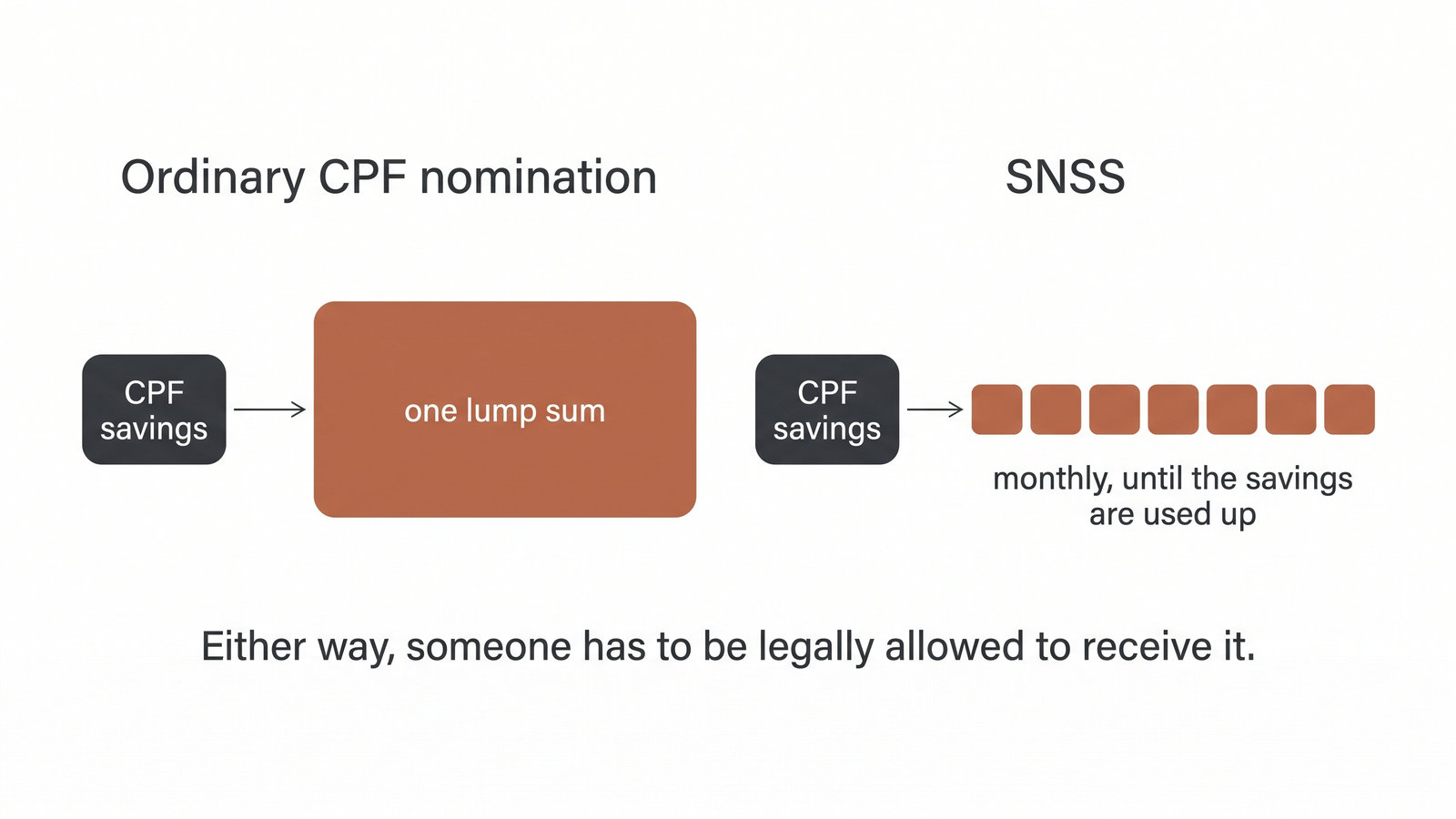
A CPF nomination is the form that tells CPF Board who receives your CPF savings when you die. The ordinary version pays your nominees in cash, in one go. The SNSS version pays a nominated child by the month instead. CPF Board puts it plainly: SNSS “differs from CPF cash nomination which provides a lump sum payment”.
CPF Board and SG Enable both describe the arrangement, and they describe it differently. CPF Board’s scheme page calls SNTC “the appointed scheme administrator”. SG Enable’s Enabling Guide says the scheme “is administered by SG Enable, acting for and on behalf of SNTC”, and describes SNTC as a fully owned subsidiary of SG Enable. Neither wording changes what you do: start with the SNTC certification, finish at a CPF Service Centre.
Why can’t you just put CPF savings in your will?
Because they are not yours to will. CPF Board’s nomination page says it in one line: “CPF savings cannot be included in your will because they do not form your estate.”
A will that sends everything into a trust for your child does not reach the savings sitting in your CPF accounts. The nomination form is the lever on those, and SNSS is a version of that form.
One caveat, from the same page, because “CPF money” is looser than it sounds. A nomination covers the savings in your Ordinary, Special, MediSave and Retirement Accounts, your CPF LIFE premium balance, which is the money behind your own monthly retirement payouts, and any discounted Singtel shares. It does not cover a property bought using your CPF savings, a payout from the Dependants’ Protection Scheme, or investments made under the CPF Investment Scheme. CPF Board lists those three separately.
Two more things from the same page.
Marriage cancels an existing CPF nomination. Divorce does not. CPF Board’s words: “Upon marriage, any existing CPF nomination will be revoked.” So if you set this up years ago and have since remarried, you may have no nomination at all right now, because the revocation is automatic.
With no nomination, the wait is long. CPF savings go to the Public Trustee’s Office, which distributes them under intestacy law or, for a Muslim member, under a Muslim Inheritance Certificate. CPF Board says it can take up to six months just to work out which family members are eligible to claim.
Does your child qualify?
That question is settled by SNTC’s certification, not by anything CPF Board publishes on the scheme page.
CPF Board’s scheme page states no eligibility criteria. What it states is the step: “Get a certification from the SNTC. You’ll be issued an eligibility letter upon confirmation of the nominated Persons with Special Needs’ eligibility.” The Enabling Guide, SG Enable’s disability support portal, gives SNSS one paragraph inside a page about financial planning, and that paragraph does not state who qualifies either. Its own schemes index links SNSS to that paragraph rather than to a page of its own.
So if you want a yes or a no, the people to ask are the people who issue the letter.
That matters if you have read a short checklist somewhere and quietly concluded your child is out. Whatever that checklist said, it is not what CPF Board publishes on the scheme page, because CPF Board publishes no checklist there at all. If your child is autistic and in a mainstream school, or has a diagnosis that does not look like the examples you have seen, you have not been told no by either of those pages. You have read somebody else’s summary.
Ask before you rule your family out. CPF Board gives SNTC’s phone as 6278 9598 and its email as enquiries@sntc.org.sg.
How much does it pay, and how long does it last?
You choose the monthly amount when you apply. CPF Board sets two limits on that choice: “The minimum payout will be S$250 per month, with a minimum duration of at least one year.” So the smallest arrangement the scheme allows runs at S$250 a month for twelve months. Figures as of August 2026; CPF’s scheme page carries its own date stamp of 5 August 2024.
After that the arithmetic is yours. The Enabling Guide says the child receives monthly payouts “until the savings are exhausted”, so the figure you pick sets the runway. S$250 a month uses S$3,000 a year. S$500 a month uses S$6,000 a year and halves how long the money lasts. There is no right answer, and the tension is real: a larger monthly sum is more use to your child now and runs out sooner.
Two things under CPF Board’s “Things to note” change the size of the pot.
You can switch off your own CPF LIFE payouts. CPF LIFE, short for CPF Lifelong Income For the Elderly, pays you a monthly income for as long as you live. In CPF Board’s words: “If you have signed up for CPF LIFE and have made an SNSS nomination, you can choose not to receive your monthly CPF LIFE payouts. By doing so, you can retain the funds in your Retirement Account (RA) for your child.” Your Retirement Account is the CPF account CPF LIFE premiums are paid from. That is a real option with a real price, because it is your own retirement income you would be living without.
Top-ups to your child’s own CPF account are a separate thing. If you have been putting money into your child’s CPF account, that money stays where it is: CPF Board says the top-ups “will be set aside specifically for your child’s retirement needs” and “will not be disbursed under the SNSS”. Doing both is doing two different things, and neither one substitutes for the other.
Who does CPF Board actually pay?
CPF Board sets out four situations, and the money goes to a different place in each.
| Your child’s situation at the point of disbursement | Who CPF Board pays |
|---|---|
| Under 18 | The legal guardian, or the court-appointed deputy if the child has one |
| 18 or over, and has the mental capacity to handle financial affairs | Your child’s own bank account |
| 18 or over, lacks mental capacity, with a valid LPA | The donee named in the LPA |
| 18 or over, lacks mental capacity, no LPA | The court-appointed deputy, once a third party has applied to the court to be appointed |
Read that last row again. CPF Board’s own wording is that “a third party may apply to the court to be appointed as the SNSS nominee’s deputy, and the CPF Board will make payment to the court-appointed deputy when he/she applies on behalf of the person with disabilities”. CPF Board names no other payee for that situation, so until that appointment exists there is no one for it to pay.
So SNSS does not remove the court step. Money that arrives monthly still needs a person the law permits to receive it, and if your adult child lacks mental capacity and has no LPA, that person has to be appointed by the court before a cent moves.
Which is why setting up SNSS and stopping is half the job. The other half is deputyship, or an LPA if your child is able to make one. One thing worth keeping straight: CPF Board’s payout rules turn on 18, while who may legally act for your child changes at 21, and that second question has its own page on what happens at 21.
How do you set it up?
Four steps, in this order.
- Get the certification from SNTC. CPF Board’s instruction: “Get a certification from the SNTC. You’ll be issued an eligibility letter upon confirmation of the nominated Persons with Special Needs’ eligibility.” Phone 6278 9598, email enquiries@sntc.org.sg, both as published by CPF Board.
- Book a CPF Service Centre appointment. CPF Board is specific: “A SNSS nomination can only be made at CPF Service Centres. Please book an appointment at least one working day before visiting us.” The nomination itself can only be made in person.
- Fill in the form at the counter. CPF Board says its “Customer Service Executives will assist you with completing the form at the counter”, so you are not decoding it alone.
- Review it when your family changes. CPF Board asks you to review your nomination regularly, and names marriage, a birth, a divorce and the death of a nominee as the moments to do it. A marriage is the urgent one, for the reason above.
CPF Board, on what it costs: “Making a CPF nomination is free. Your nominees will not be required to pay any charges to claim your CPF savings when you pass on.”
SNSS or a Special Needs Trust?
They are not competing. They carry different money.
SNSS moves CPF savings and nothing else. A Special Needs Trust can take money a CPF nomination cannot: the Ministry of Social and Family Development (MSF) names property proceeds gifted by will, insurance policy nominations and top-ups at any time, and puts the entry point at a minimum sum of S$5,000 to set up an SNTC trust account, as of August 2026.
How the two fit together with everything else you might leave behind is laid out in leaving money to your special needs child, and the trust has its own page at Special Needs Trust. Once the CPF side is settled, the rest of the plan sits in future care planning.
Questions parents ask
Is SNSS a trust?
No. It is a type of CPF nomination, which is the form telling CPF Board who receives your CPF savings when you die. A Special Needs Trust is a separate arrangement, set up through SNTC with a minimum sum of S$5,000 as of August 2026, and it can take money a CPF nomination cannot, including property proceeds gifted by will and insurance policy nominations.
How much does SNSS cost?
CPF Board says making a CPF nomination is free, and that nominees pay no charge to claim the savings when you pass on.
Can I leave my CPF savings in my will instead?
No. CPF Board’s nomination page says “CPF savings cannot be included in your will because they do not form your estate”, so the savings in your CPF accounts pass by nomination rather than by will. It does not cover everything, though. CPF Board puts a property bought using CPF savings, a Dependants’ Protection Scheme payout and CPF Investment Scheme holdings outside the nomination.
What is the minimum I can leave each month?
S$250 a month, for a minimum duration of at least one year, as of August 2026. You choose the figure above that floor when you apply.
How long will the payments last?
Until the savings are used up, in the Enabling Guide’s words. The monthly figure you choose decides the runway.
My child is in a mainstream school. Do they qualify?
The scheme page does not publish eligibility criteria, and neither does the Enabling Guide’s SNSS paragraph. Eligibility is confirmed by SNTC’s certification, so a checklist from a summary site is not the answer either way. Only SNTC’s letter is. Call SNTC on 6278 9598 and ask.
Does SNSS mean my family avoids a court application?
No. If your child is 18 or over, lacks mental capacity and has no valid LPA, CPF Board’s scheme page names only one route to payment: a court-appointed deputy, once a third party applies. SNSS changes how the money arrives, not who is allowed to receive it.
What happens to my CPF nomination if I remarry?
It is cancelled. CPF Board says any existing CPF nomination is revoked upon marriage, and it asks you to make a new one. Divorce does not have the same effect.
Can I use SNSS and a Special Needs Trust together?
Yes. They carry different money. SNSS moves CPF savings; an SNTC trust can also take insurance policy nominations and property proceeds gifted by will. Sequence and totals belong to the wider plan rather than to either one on its own.
Sources: CPF Board’s Special Needs Savings Scheme page (its own stamp reads “Last updated 05 Aug 2024”), its CPF nomination page and its CPF LIFE page; SG Enable’s Enabling Guide financial planning page and schemes index; and the Ministry of Social and Family Development’s page on trust and savings options for persons with disabilities. Pages read in August 2026. Figures and processes change, and government pages are the place to check them before you act.
This page explains a published government scheme. It is not legal or financial advice. For your family’s own circumstances, speak to SNTC, CPF Board or a qualified adviser.