Dictionary: ARC · Pathlight School · Social Stories · Visual schedule
Start with the government’s list
Inclusive Sport is a government website that connects people with disabilities and special needs to sport, fitness and play across Singapore. It is kept by the secretariat of the Disability Sports Master Plan, a plan launched in 2016 to open up sport to people with disabilities and refreshed in 2024.
Its autism page is the one to open. It lists providers with programmes for autistic people, each with an age range, a place and a contact.
It also has a contact form, and Inclusive Sport says it will review your enquiry and reply. That is worth using if nothing below fits your child.
Being on the list is a starting point, not a promise. The portal itself asks you to check with each provider whether your child is eligible and whether the activity suits them.
| Sport | Provider | Ages listed | Where |
|---|---|---|---|
| Athletics | ActiveSG Para Sport Academy | 6 and above | Yio Chu Kang Stadium, Clementi Stadium |
| Brazilian jiu-jitsu | GFTeam Singapore | 5 to 12 | Joo Chiat Road |
| Canoe | Singapore Canoe Federation | 7 and above | Paddle Lodge, MacRitchie Reservoir |
| Cycling | Cycle School SG | 4 and above (autism with no intellectual disability, or intellectual disability) | Jalan Membina |
| Cycling | Para Cycling Federation Singapore | 10 and above | Jurong West Sport Centre |
| Fitness | Jumping Singapore | 5 and above | Various locations |
| Fitness | BGA Inclusive Fitness Gym | 12 and above | Bishan Street 23 |
| Floor curling | Singapore Floor Curling Federation | 2 and above (autism with no intellectual disability) | Sessions arranged on request |
| Football | Special Olympics Singapore | 6 and above | Bendemeer Secondary School |
| Horse riding | Riding for the Disabled Association of Singapore (RDA) | 6 and above | Jalan Mashhor |
| Multi-sport play | Be Kind SG | 2 to 12 | Enabling Village, Lengkok Bahru |
| Multi-sport play | PlayBuddy | Children with disabilities (no age given) | No venue given; sign-up form only |
| Running | Runninghour | 6 and above | Multiple locations |
| Swimming | ActiveSG Para Sport Academy | 7 to 40 (autism with intellectual impairment) | Various locations islandwide |
| Swimming | Able Aquatic School | 4 and above | Tanah Merah Kechil Road |
| Swimming | Aquafins | 6 and above | Jalan Besar Sports Centre, Hougang Swimming Complex |
| Swimming | Art Aquatics | 6 and above | Hougang Avenue 4 |
| Swimming | Justswim Singapore | 3 and above | Admiralty Street |
| Swimming | Little Splashes Aquatics | 3 months to 100 years | Multiple outlets |
| Swimming | Special Olympics Singapore | 6 and above | Several pools, including Delta and Clementi swimming complexes |
| Swimming | Ultra Swim School | 6 and above | Yio Chu Kang Swimming Complex |
| Yoga | BlissYoga Wellbeing | 3 and above | Enabling Village, Lengkok Bahru |
The same page lists archery and a dragon boat team that both start at 13, and four more cycling, dragon boat and fitness providers that give no age at all. Ask those directly if your child is near the top of the range.
If your child is under 5, look first at the rows that start at 2, 3 or 4. At that age a class is not the only way to move. Free play counts too, and our guide to inclusive playgrounds says which places put a quiet or sensory space in writing.
Swimming
Swimming has the most choice on the list: eight providers, from private swim schools to Special Olympics Singapore and the ActiveSG Para Sport Academy. The Para Sport Academy is one of Sport Singapore’s ActiveSG academies, set up for people with disabilities.
The academy’s learn-to-swim classes have the clearest rules in writing. Its page, last updated June 2026, says a swimmer must be at least 7, an intellectual impairment means an IQ below 75, a caregiver must be at every session, and every new swimmer attends a trial before registering. It also asks that a swimmer can take instructions from the coach.
So autism alone does not meet the academy’s swimming criteria. For an autistic child with no intellectual disability, the private swim schools and Special Olympics Singapore on the list are the ones to ask instead.
Your own entry to the pool can be free. Inclusive Sport’s page on accessible ActiveSG pools (July 2026) says a caregiver of a swimmer with special needs may stay with them for the whole pool session on a complimentary basis, under the Caregiver Scheme. Ask the ActiveSG Sport Champions at the pool, and scan the QR code before you go in.
If your child may need a quiet break, ask the pool about it before the first lesson. The swimming complex at ActiveSG Sport Park @ Teck Ghee has a dedicated calm room. Inclusive Sport says every ActiveSG sport centre will have a calm room or an equivalent space by the end of 2030, but its page does not yet say which ones have opened.
Jiu-jitsu and running
For a child who likes rough-and-tumble play, GFTeam Singapore runs BJJ SuperKids, Brazilian jiu-jitsu for children with special needs. It meets on the first Saturday of every month, 10am to 10.45am, and takes at most four children a session. You book ahead through the GFTeam Singapore app or on WhatsApp.
Four children to a session is a useful yardstick. When another provider tells you its group size, you have something to compare it with.
For running, the ActiveSG Para Sport Academy’s track and field group trains on Tuesday evenings, 6pm to 8pm. Its row on the autism page names autism with no condition attached. The portal’s list of partners, though, describes the academy’s autism profile as autism with intellectual impairment, so ask the academy which rule applies before you go.
Runninghour posts its sessions and places on its own activities page, so start there.
Outdoors: horse riding and canoeing
The Riding for the Disabled Association of Singapore (RDA) has run sessions with its horses and ponies for children and adults with disabilities since 1982. The portal gives an email address and a phone number for enquiries about a place.
The Singapore Canoe Federation runs its canoe sessions on Saturday afternoons, 3.15pm to 5.45pm. Ask whether a child who cannot swim yet may join, and what they wear on the water.
Enrichment classes at the Autism Resource Centre
The Autism Resource Centre (ARC), the charity behind Pathlight School, has an Enrichment Activities Unit that runs sport and non-sport classes outside school hours. ARC says the classes are held in autism-friendly settings by qualified instructors.
Check who can join before you plan around them. ARC’s page (last updated July 2024) opens the classes to Pathlight students and their siblings, and to children of ARC members, aged 6 to 21.
Within that group, children with or without autism are welcome. If your family is not in that group, ask ARC how membership works.
As your child gets older
Some doors open later, and it helps to know which ones before your child asks.
Play-Ability is Sport Singapore’s own set of weekly tennis, basketball, badminton and swimming sessions for people with disabilities, run under its SportCares programmes. Its page gives an autism support group as one example of who can join, and it states no age.
The portal’s list of partners, though, gives SportCares’s range as 18 and above. Treat Play-Ability as an adult option for now, and ask SportCares before you count on it for a child.
Gyms mostly start later too. ActiveSG’s gym orientation for people with disabilities, a 30 to 45 minute session that shows a new user the layout and the machines, is for ages 18 and above. A caregiver can come along at no extra cost.
If your child loves a sport and one day wants to compete, know the rule early. Inclusive Sport says there is no separate Paralympic class for autism: an autistic athlete can compete at the Paralympic Games only with an intellectual disability that meets set medical thresholds.
The Singapore Disability Sports Council (SDSC) has run sport for people with disabilities in Singapore since 1973. It describes a pathway from first-time play to elite competition, and it is the body to ask when your child is ready for that step.
What to ask before a trial class
No list can tell you whether a coach will suit your child. A trial can, and the right questions before it save you a wasted Saturday. Ask them by message or phone before you book, and listen for plain, specific answers: a number, a room, a name.
About the class
- How many children does one coach take in a session?
- Is there a trial session, and what does it cost?
- What do you need from us to register: a diagnosis, a doctor’s report, anything else?
- What does a term cost, and what happens if the class does not work out after a few weeks?
About your child’s hour
- Where can my child go if it gets too loud or too much? Is there a quiet space nearby?
- What does the coach do when a child will not join in, or is overwhelmed?
- Has the coach taught autistic children before, and what training do they have?
- How busy and noisy is the venue at that hour?
About you
- Can I stay for the session, and where do I wait?
- Do I need to be in the water or on the mat with my child?
- How will you tell me how it went?
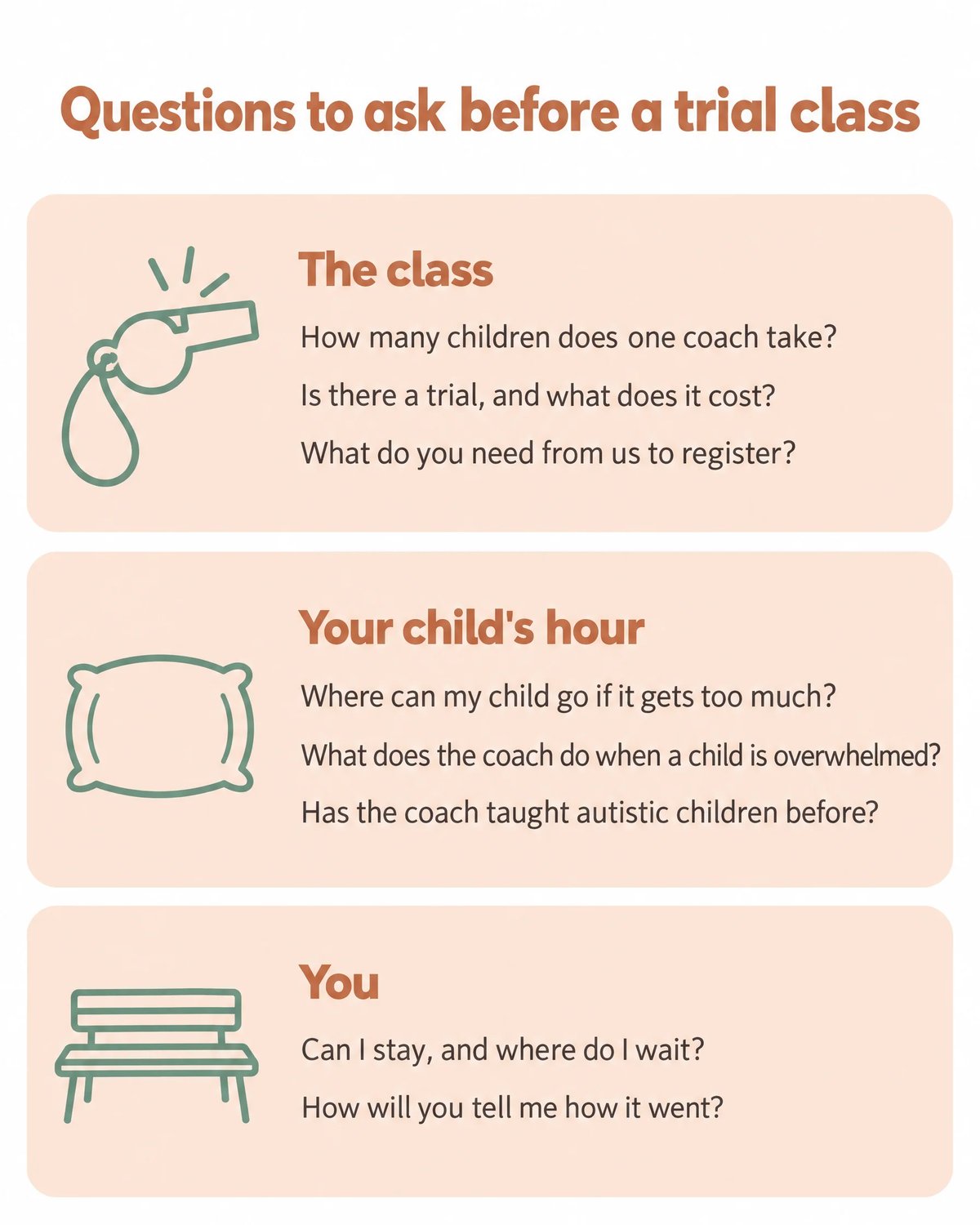
Read this as words instead
Questions to ask before a trial class
The class
- How many children does one coach take?
- Is there a trial, and what does it cost?
- What do you need from us to register?
Your child’s hour
- Where can my child go if it gets too much?
- What does the coach do when a child is overwhelmed?
- Has the coach taught autistic children before?
You
- Can I stay, and where do I wait?
- How will you tell me how it went?
If a coach answers the break question well, you have learned a lot. Our framework for meltdowns and our sensory strategies give you the words to explain what helps your child, in a sentence the coach can use.
Booking the first trial
- Open the autism page on the Inclusive Sport portal.
- Pick two or three programmes that take your child’s age and are near home or school.
- Message each one with the questions above, and ask for a trial.
- Show your child what the day will look like, with photos of the venue, a social story or a visual schedule.
- Go to the trial, stay close, and watch how the coach handles the hard moments.
- Decide afterwards, at home, not at the poolside or the mat.
Common questions
Are any of these activities free?
RDA’s own page says its sessions are free of charge. It is a charity, and it says it depends on public donations to keep them going.
The Inclusive Sport autism page shows no prices for the other providers, so ask each one what a session or a term costs. For your own entry as a caregiver at ActiveSG pools, see the swimming section above.
Can my autistic child join Special Olympics Singapore?
Possibly, so ask. Inclusive Sport’s autism page lists Special Olympics Singapore’s swimming and football for autistic children.
Special Olympics has its own rules, though: the portal says athletes must have “an intellectual disability, cognitive delay, or a closely related developmental disability” under the Special Olympics General Rules. Email Special Olympics Singapore at admin@specialolympics.org.sg and ask whether your child fits before you plan on it.
Does my child need a diagnosis or a report to join?
It depends on the provider. The ActiveSG Para Sport Academy asks swimmers to send documents such as a doctor’s report or a diagnosis, so it can check they meet its criteria.
The Inclusive Sport autism page does not say what the other providers ask for. Keep a copy of your child’s diagnosis report ready for the first message.
One trial, then decide
One trial tells you more than any list. Open the Inclusive Sport autism page, pick one programme near you, and send your questions before you book. For the days between classes, our page on Singapore’s inclusive playgrounds is the place to start.
Sources
- Inclusive Sport, Autism, last updated 22 August 2026. The providers, ages, places and schedules in the table and the sections, the contact form, and the Paralympic rule.
- Inclusive Sport, Intellectual Disabilities, last updated 22 August 2026. The Special Olympics eligibility wording.
- Inclusive Sport, About the portal, last updated 30 January 2026. Who keeps the portal, and its partners’ disability profiles and ages.
- Inclusive Sport, Home. What the portal is for, and the Disability Sports Master Plan dates.
- Inclusive Sport, Accessible ActiveSG Pools, last updated 20 July 2026. The Caregiver Scheme at pools and the calm room at Teck Ghee.
- Inclusive Sport, Calm Rooms, last updated 29 January 2026. The 2030 target.
- Inclusive Sport, Gym Orientation for Persons with Disabilities, last updated 22 September 2026. Age, length and caregiver entry.
- Sport Singapore, Play-Ability, last updated 22 May 2026. The sports and who can join.
- ActiveSG Circle, Para Swimming, last updated 12 June 2026. The academy’s swimming criteria, trial and documents.
- Autism Resource Centre (Singapore), Enrichment Activities Unit, last updated 31 July 2024. Who can join, and the ages.
- RDA Singapore, About. Since 1982, free of charge, and donations.
- Singapore Disability Sports Council, Home. Since 1973, and the pathway to competition.