
Dictionary: SG Enable · MSF · SPD
Can the ATF pay for a communication device?
Possibly. The rules leave room for one, and the decision rests with your child’s assessor and SG Enable.
The ATF pays for assistive technology devices: devices that “increase, maintain, or improve” what a person with a disability can do. The money can buy a new device, replace or upgrade one, or repair one.
The examples on the ATF’s list are all for moving, seeing or hearing: wheelchairs, grab bars, walking aids, commodes, electronic magnifiers, screen readers, hearing aids and cochlear implants. But the list opens with “Examples include but are not limited to”, so it is not a closed list.
Communication tools count as assistive technology for autism. For autistic people, the first kind of assistive technology the Enabling Guide lists is AAC. AAC stands for augmentative and alternative communication: any way to communicate that adds to speech or stands in for it. Our guide to helping a non-speaking autistic child communicate shows how AAC works day to day.
AAC runs from low tech, meaning paper and pictures, to high tech, meaning electronic:
- communication books, and the Picture Exchange Communication System (PECS), which uses picture cards
- communication software on a smartphone, widely available as apps
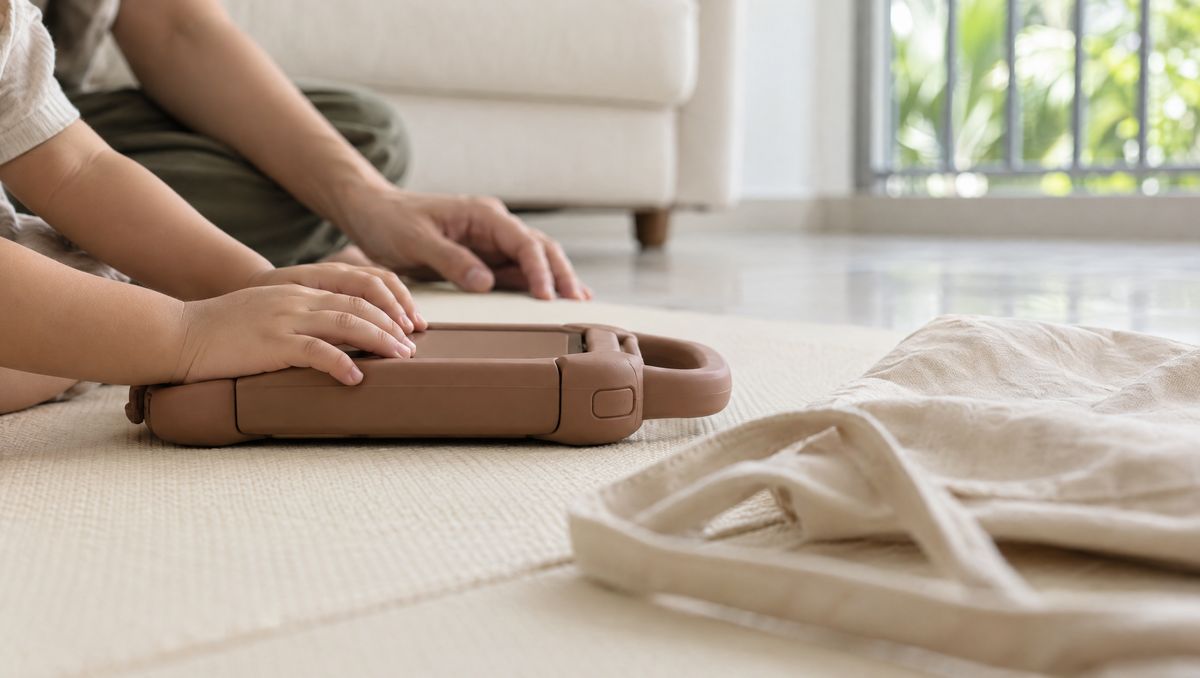
- standalone devices, usually rugged, made to last and easier to use
No tablet, app or speech device is named. The ATF’s published rules do not name one as something the ATF will pay for. They do not rule one out either.
So the answer for your child comes from two places. The assessor, such as a therapist, recommends a device, and the form has space to explain how it will help your child. SG Enable then makes the final decision.
The device also has to do at least one of the jobs the ATF lists. For a young child, the ones that fit are early intervention or education, therapy, and more independence in daily life. Early intervention means the therapy and learning support a child gets from birth to about six years old.
A tablet for everyday use is a different thing. A separate programme, DigitalAccess@Home, offers subsidised laptops or tablets and broadband to lower-income households, so they can get connected. It has its own rules, and it is not the ATF.
Does your child qualify?
Your child must meet all of these, as of October 2026:
- A Singapore Citizen or a Permanent Resident (PR). A PR child can apply, but at every income level where the ATF pays anything, it pays a smaller share for a PR than for a citizen. The table in the next section shows both.
- A permanent disability, and autism counts. It must be proven on one standard form, the Disability Verification Form, or DVF.
- An assessment by a qualified assessor, who decides whether your child needs a device and which type. The assessor is a trained professional, such as a therapist.
- A household income of S$4,800 or less a month per person. This line rose from S$2,600 in January 2026, a change the government announced in Budget 2025.
There is no lower age. The form asks for a birth certificate for a child under 15, and a parent or other authorised person signs for a child under 21.
The DVF, in plain words. For autism, the form is filled in by a registered paediatrician, psychiatrist, or clinical or educational psychologist. They can work in a public or private hospital, a social service agency or a private clinic, and their fees vary, so ask first.
Your child may not need a new one. A child who has been in a special education (SPED) school, or whose disability was already verified for an eligible disability scheme of the Ministry of Social and Family Development (MSF), does not need to submit the form. You can check your child’s status on the government’s SupportGoWhere website, logging in with your Singpass.
The income line, in plain words. Add up the gross monthly income of everyone in your household, meaning their pay before any deductions. Then divide by the number of people. A family of four earning S$12,000 a month in total has S$3,000 per person, which is under the line.
You do not have to work this out alone. The social worker at the hospital or agency helps you with the means test, the check of your household’s income. It uses the government’s Household Means Eligibility System, called HOMES.
A CHAS card, the card that gives subsidies at CHAS clinics, does not count as proof of income for the ATF.
If no one in the household earns an income, the test looks at your home instead. The annual value (AV) of the home at the address on your NRIC, your identity card, must be S$21,000 or less. The AV is the yearly rent that IRAS, Singapore’s tax authority, estimates your home could fetch if it were let out.
What your family still pays
The ATF pays a share of the device’s cost, and your family pays the rest. The share depends on your household income per person, and on whether your child is a citizen or a PR.
Take a device that costs S$3,000. At the 90% rate, the ATF pays S$2,700 and the family pays S$300. Here is the same S$3,000 device at every income level.
| Household income per person, each month | Citizen: ATF pays | Citizen: family pays | PR: ATF pays | PR: family pays |
|---|---|---|---|---|
| S$0, home AV S$21,000 or less | 90% | S$300 | 60% | S$1,200 |
| Up to S$1,500 | 90% | S$300 | 60% | S$1,200 |
| S$1,501 to S$2,600 | 75% | S$750 | 50% | S$1,500 |
| S$2,601 to S$3,600 | 40% | S$1,800 | 20% | S$2,400 |
| S$3,601 to S$4,800 | 20% | S$2,400 | 10% | S$2,700 |
| S$4,801 and above | 0% | S$3,000 | 0% | S$3,000 |
A household with no income but a home AV above S$21,000 gets no subsidy. The S$40,000 cap counts everything the ATF pays over your child’s whole life, across every device.
If the family’s share is still too much. A low-income family can also be considered for the Special Assistance Fund (SAF), a community fund from the National Council of Social Service (NCSS) that adds to the ATF. It is assessed in the same application, so you do not fill in a second form.
On the same form, the social worker can ask SG Enable for a bigger share than your income band gives, with reasons. The form also asks whether other ways to pay, such as instalments, could work.
Costs outside the device. The therapist’s charges and waiting times at the hospital or agency still apply, and so do the DVF fees if your child needs that form.
The ATF is one of several schemes that help with the costs of raising an autistic child. Our map of financial assistance for special needs in Singapore puts them side by side.
From the therapist’s recommendation to the device
You cannot send an ATF application to SG Enable yourself. It comes from a touchpoint, which means a public hospital or a social service agency (SSA). There, an assessor, such as a therapist, and an application admin, such as a social worker, do it for you.
One rule matters if your child sees a private therapist. A private clinic cannot apply for you, even if your child’s private therapist knows them best. SG Enable takes applications only from public hospitals and SSAs.
For a communication device, the therapist to start with is usually the speech therapist. In Singapore, choosing an AAC system and training the family to use it is part of a speech therapist’s registered work, the work their professional registration covers. Our guide to speech therapy and the other autism therapies explains what a speech therapist does with your child.
- Ask the therapist who already sees your child. That could be at a public hospital, or at an SSA such as SPD, which runs early intervention centres (SPD in our autism dictionary). Ask whether a communication device would help, and whether they will assess your child for the ATF.
- No therapist at a hospital or SSA? Pick one of two routes. Ask a polyclinic for a referral letter to a public hospital, where an assessor can see your child. Or book SPD’s therapists at Tech Able, the assistive technology centre SG Enable and SPD run together, by emailing the Assistive Technology Referral Form to SATC@spd.org.sg; assessment fees apply there.
- Check your child’s disability status first. Log in to SupportGoWhere with your Singpass. If the status is not verified, the touchpoint’s healthcare professional will guide you through the DVF.
- The assessment. The assessor decides whether your child needs a device and which type, and writes the recommendation on the form, with the cost and the vendor (the company selling the device). This is the moment to ask for a trial first (next section).
- The paperwork. The social worker helps with the means test, whose result must still be valid for at least 3 months when the form goes in. You sign the family’s part, the vendor gives a quotation showing the full cost, and the touchpoint sends it all to SG Enable.
- The decision. Once the form and every document are in, SG Enable takes up to 15 working days. It emails the result to the social worker, and you can also check the status on SG Enable’s E-Service Portal, its website for applications, with your Singpass.
- Buy only after approval. The touchpoint then sends SG Enable the vendor’s invoice and delivery order. The ATF’s share goes to the touchpoint or the vendor, never to you, and your family pays the rest.
The ATF page of the Enabling Guide links to the list of touchpoints. For anything this page does not answer, SG Enable’s line is 1800-8585-885.
Try a device before the ATF pays for one
Even the family’s share of a device is real money if your child does not take to it. A trial first is one way to lower that risk.
SPD’s Specialised Assistive Technology Centre, at Tech Able in the Enabling Village (20 Lengkok Bahru), runs an assistive technology loan library. You can borrow a device there for a small fee, to try one before buying it or while you wait for your own to arrive.
The same centre does assistive technology assessments and training on the devices, and can help with an ATF application where it applies. AAC is among the areas it covers. Consultations are by appointment, and the centre is open Monday to Friday, 9am to 5.30pm.
If the therapist recommends a device, we would ask one question before the form goes in: can my child try this one first, at home or in sessions?
What the ATF will not do
These are the limits to know before you start:
- It will not pay you back for a device you already bought, or a repair already done. Wait for the approval.
- It will not pay the money to you. It goes to the touchpoint or the vendor.
- It will not take an application from a private clinic or a private therapist.
- It will not pay for consumables, the things that get used up and bought again.
- It will not pay for medical devices for anyone under 60.
- It will not pay twice. Two schemes cannot both pay for the same device, and a case that another fund for the same purpose covers stays with that fund.
- It does not promise a particular device. SG Enable makes the final decision on every application.
What to do next
At your child’s next session, ask their speech therapist two questions. Would a communication device help my child? And will you assess my child for the Assistive Technology Fund?
If that therapist is at a private clinic, or your child has no therapist yet, use the second step in the list above: a polyclinic referral, or SPD at Tech Able.
If you would like these guides as we write them, the newsletter form is at the foot of this page.
Common questions
Can the ATF pay to repair or replace a device?
Yes. The ATF can buy, replace, upgrade or repair a device, and it covers repair and maintenance costs too.
Your child can apply more than once over their lifetime, as long as the total stays inside the S$40,000 cap. Only one application for the same kind of device can be open at a time. The Enabling Guide recommends a fresh assistive technology assessment no more than five years apart, because a person’s needs and abilities change over time.
Is the ATF the same as the Enabling Guide?
No. The Enabling Guide is SG Enable’s website of disability help in Singapore, and the ATF is one scheme on it. The ATF’s rules sit on its page there.
Our guide to using the Enabling Guide to find schemes shows how to find the other schemes that fit your child.
How do you check your application, or how much of the S$40,000 is left?
For the application, log in to SG Enable’s E-Service Portal with your Singpass, or ask your touchpoint.
For the balance, the touchpoint cannot check it for you. SG Enable asks you to email atf@sgenable.sg with your child’s name and NRIC number, sent in an encrypted format, meaning locked so that only SG Enable can open it.