
Dictionary: MSF · SG Enable · EIPIC · ECDA · SPED · SNTC
What the Enabling Masterplan 2030 is, in plain words
A masterplan, in this sense, is a long plan the government sets for one part of national life and then works through for years. EMP2030 is Singapore’s fourth for disability. The first ran from 2007 to 2011, and the third from 2017 to 2021.
MSF says the plan “was developed by, for, and with persons with disabilities and their caregivers”. It is written for persons with disabilities of every kind, not for one condition, so autism is one part of a much wider picture.
The plan holds 29 recommendations under three strategic themes, spread across 14 focal areas. A focal area is one part of life the plan sets goals for, such as schooling or transport. The table shows where a parent of an autistic child is most likely to meet each theme.
| Theme | Its focal areas | Where you are likely to meet it |
|---|---|---|
| 1. Lifelong learning, in MSF’s words “Strengthen Support For Lifelong Learning In A Fast-Changing Economy” | Early years; schooling years; beyond schooling years | Early intervention, school, training after school |
| 2. Living independently, in MSF’s words “Enable Persons with Disabilities to Live Independently” | Inclusive employment; inclusive living; assistive technology; caregiving support | Job support, living options and care planning after 18, and help for you as a caregiver |
| 3. Inclusive places and people, in MSF’s words “Create Inclusive Physical and Social Environments” | Communications; transport; public spaces; healthcare; sports; arts and heritage; communities | Polyclinic visits, transport, parks, libraries and sport |
Many agencies carry the plan out. Among them are the Ministry of Education (MOE) for schools, the Ministry of Health (MOH) for healthcare, and SG Enable, the disability agency that builds the Enabling Guide website and handles referrals to several early intervention programmes.
If you would rather watch than read, CNA made a short news report on the plan.
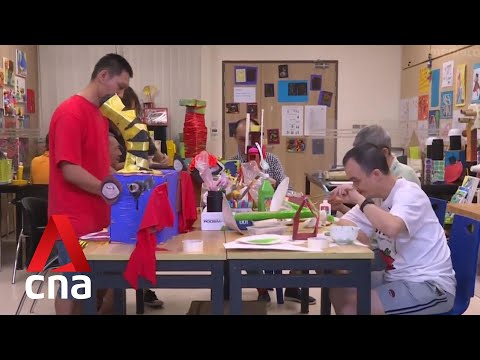
Watch on YouTube: Enabling Masterplan 2030 focuses on empowering PWDs to live independently, by CNA.
It covers the plan itself. For the 2026 changes, read on: each one is further down this page, with its date.
The goals it measures, and the 40% jobs goal
MSF says the plan “includes quantitative indicators and targets”, numbers it uses to check its progress. The one quoted most is about work: the employment rate of residents with disabilities aged 15 to 64. That is the share of them who have a job.
The goal is 40% by 2030. It is not a 2026 announcement. MSF already called it “the EMP2030 employment target” in September 2024.
| Period | Residents with disabilities aged 15 to 64 who have a job |
|---|---|
| 2018 to 2019 | 28.2% |
| 2022 to 2023 | 32.7% |
| 2024 to 2025 | 34.7% |
| Goal for 2030 | 40% |
The rate has been rising, and the gap that is left is the hard part. MSF’s latest figure, given to Parliament on 3 February 2026, is 34.7% for 2024 to 2025.
For a young child, 2030 can feel far away. The goal still matters to you now, because it drives the job programmes that will be there when your child leaves school. In September 2024, MSF said the steps one taskforce had recommended were expected to place an additional 4,500 persons with disabilities into jobs by 2030.
Before school: early intervention, from birth to 6
The plan’s first focal area is the early years. For an autistic child, that mostly means early intervention, often shortened to EI: therapy and learning support in the years before Primary 1.
EIPIC, the Early Intervention Programme for Infants and Children, is the main programme. It takes children from birth to six who have been assessed by a paediatrician to be “at risk of a developmental, intellectual, sensory or physical disability”. So a child can start before any formal diagnosis.
On the page of the Early Childhood Development Agency (ECDA), last updated on 21 April 2026, Singapore Citizen families pay S$5 to S$430 out of pocket, “depending on monthly household per capita income”. Out of pocket means what you pay after the subsidy. Per capita income is the household’s monthly income divided by the number of people living in it.
What EMP2030 has added here, in MSF’s yearly updates:
- 2024: 1,500 new places in government-supported EI centres, and EIPIC-Care, a new pilot to equip parents and other caregivers “to provide first line of early intervention (EI) support”.
- 2025: a wider Inclusive Support Programme (InSP).
The InSP brings early intervention into the preschool itself, for children aged three to six who need “medium levels of early intervention support”. ECDA first announced it as a pilot in March 2021, and its page now says the pilot is “being progressively expanded to more preschools”. The most a Singapore Citizen family pays for it ranges from S$10 to S$430 a month, by household income.
One change from this year to know about. New referrals to EIPIC-P, the version of EIPIC run by private centres, were suspended from 1 June 2026, and the Enabling Guide says referrals “will resume in Q4 2026 for enrolment from January 2027”. Q4 means October to December.
Our EIPIC guide covers who qualifies and how the referral works. EIPIC, DS-Plus and DS-LS compared shows which tier fits which child, and the EIPIC-P referral pause has what the suspension means if your child is enrolled or waiting.
The school years, from 7 to 18
From age seven, the plan’s second focal area takes over: the schooling years. Your child may be in a mainstream school with support, or in a SPED school, which is short for special education.
MSF’s 2024 update lists lower fees in 9 SPED schools, by up to 60%. The same update lists lower fee caps at Special Student Care Centres, which give subsidised care before and after school to students with special needs aged 7 to 18. For what each SPED school charges today, see our page on SPED school fees.
The newest moves came on 2 October 2026, when MOE set out its part of the taskforce’s work. MOE said “Families and caregivers worry about life after graduation”, and named two aims for students who can work: build work-ready skills, and make the move from school to work smoother.
- Work skills, earlier. In SPED schools, more chances to practise soft skills such as communication, self-regulation and adaptability “in authentic settings”, and to try different types of work. Self-regulation means a person calming and managing their own body and feelings.
- A bridge to ITE and the polytechnics. A transition support programme for students moving from SPED schools to ITE, the Institute of Technical Education, and the polytechnics, to help them adapt to “a new, mainstream environment”.
- Better guidance. Stronger education and career guidance in SPED schools, ITE and the polytechnics, so students and parents can choose pathways that match the student’s strengths.
- Planning with families. Stronger transition planning in all SPED schools, worked out with families, for each student’s goals after school.
MOE said it “will progressively implement these initiatives from 2027 onwards”.
If your child is in a mainstream school, the support comes through MOE’s school programmes rather than a SPED school. Our guide to autism support in mainstream schools covers what to ask for, and mainstream or SPED helps with that choice.
After 18: work, living and planning ahead
The third focal area is the years beyond school, and it is the stage MSF itself says needs more. At the plan’s 2024 update, Senior Parliamentary Secretary Eric Chua said: “More can be done, however, to support persons with disabilities who are 18 years and older.”
What the plan has added for this stage, in MSF’s own updates and announcements:
- Work. In 2025, a wider School-to-Work (S2W) Transition Programme, which helps students move from school into a job. Also in 2025, the Enabling Employment Credit was extended to 2028. That is support for employers who hire residents with disabilities earning less than S$4,000 a month.
- Living. The Enabled Living Programme (ELP), a pilot for up to 250 persons with disabilities from 2025 to 2028. It offers coaching in self-management, home management and community life to persons with low to moderate support needs, “so that they can continue living independently within the community”.
- Planning. On 2 October 2026, MOE said the stronger transition planning in SPED schools will lead into Future Care Planning after graduation. MOE will work with MSF and SG Enable “to ensure continuity in support and care planning from school to post-school services”.

In practice, the planning for life after 18 is meant to start in school, not at the school gate. Our guide to autism after 18 walks through the move itself, and adult disability services explains day centres, sheltered work and homes. The legal side, which changes at 21, has its own guide on deputyship.
Care, health and money
Health. On 2 October 2026, MOH set out three changes for polyclinics. It said it is “focusing on those with intellectual disabilities and autism, because these are some of the less visible disabilities”.
| When | What changes |
|---|---|
| From 2027 | All polyclinics: frontline staff trained in communication, such as giving patients more time and listening more |
| Start date not given | A Health Communication Passport, starting in selected polyclinics with SG Enable: a way for a patient to set out their healthcare needs and the support they need |
| By 2028 | At least one polyclinic in each healthcare cluster, the regional groups that run public healthcare, with fuller support: preparation before the visit, longer consultations and closer work with caregivers |
You do not have to wait for 2027 to ask your polyclinic for a longer appointment or a quieter place to wait. Asking early, when you book, gives the clinic time to plan.
Money. MSF’s 2025 update lists a dollar-for-dollar matching grant for trust accounts with SNTC, the Special Needs Trust Company. Dollar-for-dollar means each dollar put in is matched by another. Our page on the Special Needs Trust explains how those accounts work.
The bigger cost question belongs to the taskforce. One of its three areas is affordability: it will “study the financial costs borne by persons with disabilities and their families, and recommend ways to keep disability support services affordable”. When a fee change is published on a government page, this guide adds it here with its date.
The 2026 taskforce, date by date
The full name is the Taskforce on Assurance for Families with Persons with Disabilities. Assurance here means families being able to count on support at each stage of life.
It works beside the plan rather than replacing it. MSF says it “will complement the Enabling Masterplan 2030 (EMP2030) by adopting a life-course and family-centric perspective”. In plain words, it looks at a person’s whole life and at the family around them, not one service at a time.
Its five members come from several ministries, and it is chaired by Goh Pei Ming, Minister of State for Social and Family Development. It studies three areas: employment, community living (which includes access to healthcare and care planning), and affordability.
| Date | What happened | Said by |
|---|---|---|
| 4 December 2025 | Prime Minister Lawrence Wong announced the taskforce at the opening of Enabling Village Vista | MSF |
| January 2026 | The taskforce was set up | MOH, in a reply to Parliament |
| 9 September 2026 | MOH told Parliament it is reviewing how to make healthcare more accessible, starting with primary care, with more details through the taskforce by the end of 2026 | MOH |
| 2 October 2026 | Press conference: MOE’s school-to-work changes, from 2027, and MOH’s polyclinic changes, for 2027 and 2028 | MOE, MOH |
| 2026 | The year MSF gave, at the launch, for the taskforce’s recommendations | MSF |
The dates matter because the measures will keep changing. A school change said on 2 October 2026 to start “from 2027 onwards” may look different by the time your child reaches it, so check the date on any announcement before you plan around it.
Not the same plan: the Autism Enabling Masterplan
There is a second plan with almost the same name, and the two are easy to mix up. The Autism Enabling Masterplan is a charity’s plan, not the government’s. The Autism Resource Centre (ARC), a not-for-profit, wrote it, and its own history page dates the first release to January 2021.
It is about autism only, and it is meant to guide the work of “Singapore’s key autism service providers”. It holds 14 recommendations in 6 High Priority Areas: Quality Assurance for Autism Services, Planning for Life, Learning for Life, Work Continuum, Living Continuum, and Planning for Life (After Death).
The two plans cover some of the same ground. Learning, work and living are themes in both, and planning for life is close to the care planning the 2026 taskforce took up. But only EMP2030 is the government’s plan, and only EMP2030 sets national targets. Our page on the Autism Resource Centre covers what ARC runs.
What to do next
One step: open MyGuide on SG Enable’s Enabling Guide. Choose your child’s age group (0 to 6, 7 to 18, or 18 and above), tick Autism, pick the topics you want, and write down the schemes it lists. Our Enabling Guide walkthrough shows each step.
If you would like these guides as we write them, the newsletter form is at the foot of this page.
Common questions
Do I need to apply for the Enabling Masterplan 2030?
No. EMP2030 is a national plan, not a scheme, so there is nothing to apply for. You apply for the schemes it shapes, such as EIPIC for early intervention, a SPED school place, or job support after school. MyGuide on SG Enable’s Enabling Guide lists the schemes by your child’s age and needs.
Is the 40% employment goal new in 2026?
No. The goal of a 40% employment rate for residents with disabilities aged 15 to 64 by 2030 belongs to the plan itself. MSF called it “the EMP2030 employment target” in September 2024. MSF’s latest figure, given to Parliament on 3 February 2026, is 34.7% for 2024 to 2025.
When will the 2026 taskforce finish its work?
At the launch in December 2025, MSF said the taskforce would make its recommendations in 2026. In September 2026, MOH said more details on healthcare would come through the taskforce by the end of 2026. The first moves, for schools and polyclinics, were set out on 2 October 2026.
Is the Enabling Masterplan 2030 only for autism?
No. It covers persons with disabilities of every kind. Some of its 2026 changes do name autism: MOH’s polyclinic changes focus on patients with autism and intellectual disabilities. The plan that is only about autism is a different one, the Autism Enabling Masterplan, written by the Autism Resource Centre.