Dictionary: KKH DCD · NUH CDU · SPD
Why an autistic child hits
The National Autistic Society, a UK autism charity, names slapping, biting and hair pulling as behaviour most people would call physically aggressive. On this page we call all of it aggression. You may see other names for it in Singapore reports and forms, such as “challenging behaviour”.
“Behaviour has a function”, the charity says. In plain words, the aggression is doing a job for your child, even when no one can yet see what that job is. The reasons it lists include:
- a lot to take in at once, more than your child can sort through
- time with nothing planned
- sensory differences, such as noise, light or touch that feels much stronger to your child
- a change in routine, or moving from one activity to the next
- feeling unwell, tired or hungry
When a child cannot tell you about any of these, the charity says, it can build into anxiety, anger and frustration, and then spill out as aggression.
The NHS, the UK’s public health service, puts it in a similar way. Autistic children may need more help to manage meltdowns, physical aggression or hurting themselves.
A meltdown is when a child loses control of their behaviour for a while. The NHS says this can happen when they feel very overwhelmed or upset.
Hitting and meltdowns. Some hitting happens inside a meltdown. For that moment, our guide to managing autism meltdowns covers what to do. This guide is about hitting that keeps happening, aimed at you or at a brother or sister, and the plan around it.
Keep brothers and sisters safe first
The NHS advice on supporting an autistic child starts with a limit: do not try to change how they behave, unless it is harmful to them or to others. Hitting a younger child is that case. Safety comes before finding the cause.
A younger brother or sister cannot protect themselves, and cannot read the early signs the way you can. So the plan is about where they are, not about telling them to be brave. Here is what we would set up this week.
- Learn the early signs. You may already know two or three: a certain sound, pacing, a look. Write them down. Your log (further down this page) will add more.
- Pick a safe spot for the younger child. A room or a corner they go to when you say one short word, such as “bedroom”. Practise it on a calm day, as a game, so it is easy on a hard one.
- Keep the two apart at the hard times. Once you know when the hitting tends to come, such as the hour before dinner, do not leave the children alone together then. Keep them in the same room as you, or in different rooms.
- Tell everyone at home the plan. Grandparents, a helper, an older sibling: everyone uses the same word and the same safe spot.
- Talk to the younger child afterwards. Tell them it is not their fault, that they can always come and tell you, and that it is all right to feel upset or angry about it.
If the hitting puts anyone at serious risk, the National Autistic Society says to get specialist help, starting with an appointment with the doctor. The section on help in Singapore, below, says where.
In the moment: calm, short, the same each time
When your child hits, the National Autistic Society’s advice is to respond quickly and the same way every time. Keep your words, your face and your voice as flat as you can. Big reactions can, without anyone meaning it, teach a child that hitting gets a big result.
What that can sound like:
- Few words, in a steady voice. Short, clear sentences are easier to take in when a child is overloaded.
- Say what to do, not only what to stop. The charity’s example is “hands down”. A picture card, a small card with a simple drawing of the action, can back up the words.
- Give the hands another job. Move your child to something that needs both hands. For a child who hits, the charity suggests a clapping song or rhyme.
- Praise the first good moment. When your child does the other thing, name it straight away: “Good gentle hands.” Some autistic children do not like praise or attention, so watch how yours takes it.
- Same response from everyone. Ask grandparents, a helper or the child’s teachers to answer hitting the same way you do.
Later, on a calm day, a social story can explain why we do not hit, and what to do instead. A social story is a short, simple story about one situation, told from your child’s point of view. Our guide on how to write a social story walks you through one.
Picture cards or a board of feeling faces can help a child show you “angry” or “it hurts” before the hitting starts. Our guide to helping a non-speaking autistic child communicate covers those tools.
Rule out pain and illness
A child who cannot say “my tooth hurts” may show it another way. The National Autistic Society notes that biting, for example, may come from pain in the mouth, teeth or jaw. It says to see a doctor or dentist to rule out a medical cause.
NICE, a UK body that publishes health guidelines, has a guideline on autism in children and young people under 19. It lists pain and stomach or gut problems among the things that can make aggression more likely. NICE files aggression under a wider name, “behaviour that challenges”. Its list also includes trouble understanding what is going on or saying what they need, anxiety, noise and lighting, and changes to routine.
So if the hitting started suddenly, or got much worse quickly, book the doctor first. We would treat a sudden change as a reason to check for something new, such as pain or an illness, before anything else.
Tired and hungry count too. If your log shows the hitting comes before meals or at the end of a long day, that is worth knowing.
Keep a simple log for two weeks
A log turns “my child hits all the time” into a pattern you can act on, and gives the doctor something to work with.
The National Autistic Society suggests a behaviour diary that records what happens before, during and after the aggression. It says to note who was there, anything that had changed, and how your child seemed. A couple of weeks is a good start, or longer if you need it.
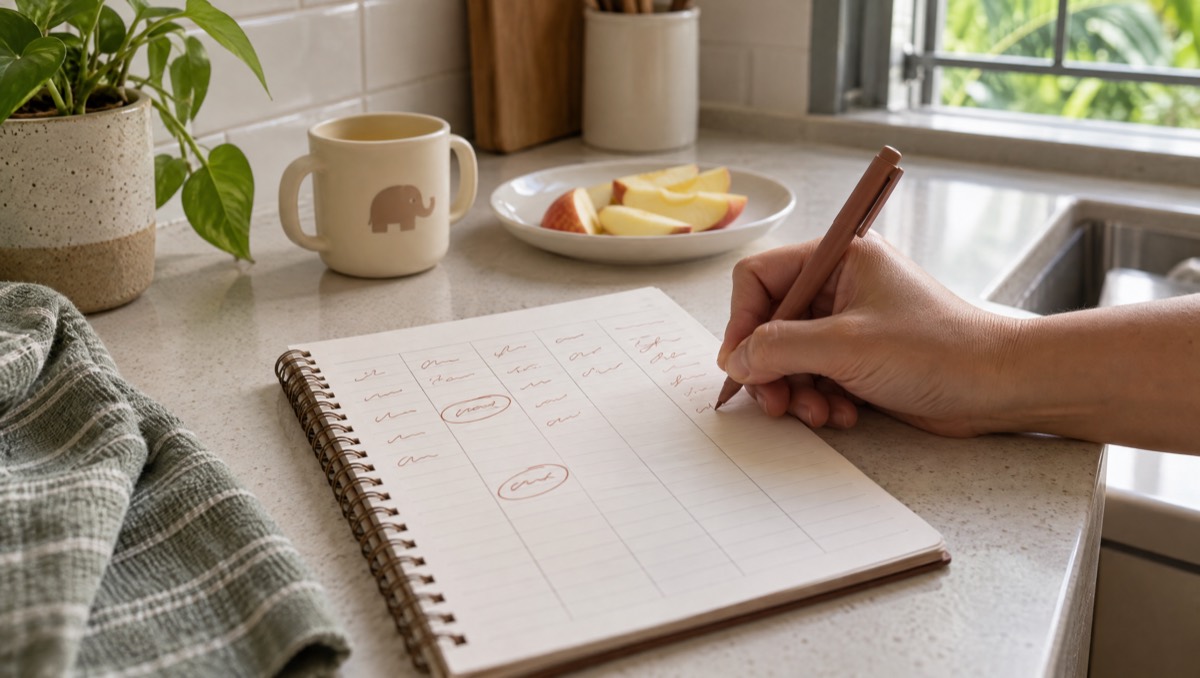
You do not need an app. A notebook on the kitchen counter, or a note on your phone, is enough. One line each time:
| What to write | Why it matters | Example |
|---|---|---|
| Day and time | Shows the hard times of day | Tuesday, 6.10pm |
| What came just before | Points to the trigger | TV turned off for dinner |
| What your child did | Shows how often, and how hard | Hit me twice on the arm |
| What happened right after | Shows what the hitting may be getting your child | TV went back on for five minutes |
| Who was there, and how your child seemed | Shows if one person, or tired or hungry, is part of it | Me and the baby; no nap today |
The “right after” column is easy to skip, and it can matter most. In the example, the TV came back on. Without anyone meaning it, the hitting got the TV back.
That is the kind of pattern a behaviour assessment looks for. A behaviour assessment is a close look by a trained professional at what sets the aggression off and what keeps it going. The next section says how to ask for one.
After two weeks, read it through once. Circle the times of day, the “just before” moments and the people that keep coming up.
Where to ask for help in Singapore
Start with the doctor who already follows your child’s development. That may be a developmental paediatrician, a children’s doctor who specialises in how children develop, at KKH or NUH.
- KKH’s Department of Child Development provides “specialist diagnostic and intervention services for children with developmental, learning and behavioural difficulties”. In plain words, it finds out what a child needs and then helps, and it names emotional and behavioural difficulties among the issues it sees. Our dictionary has what KKH’s Department of Child Development does.
- NUH’s Child Development Unit is part of NUH’s Division of Developmental and Behavioural Paediatrics, the hospital’s team for children with “developmental, learning and behavioural challenges”. The unit, at Jurong Medical Centre and Keat Hong Community Club, mainly sees children from birth until the end of kindergarten, before the age of seven, and its team includes psychologists and social workers as well as doctors. Our dictionary has what NUH’s Child Development Unit does.
If your child sees a private paediatrician, start there. If your child has no developmental doctor yet, our guide to getting an autism diagnosis in Singapore explains the first step and the referral.
What to say. Bring the log. Say plainly that your child is hitting you, or a sibling, how often, and that you want help to find the pattern.
You do not need to soften it. The doctor can only help with what they know.
What to ask for: a behaviour assessment. Ask whether a psychologist or behaviour specialist could look at the hitting. In the UK, NICE’s guideline for autistic children calls this a functional assessment of behaviour. NICE says it should find:
- what seems to set the aggression off
- the patterns in it
- the need your child is trying to meet by doing it
- what happens as a result, which may be keeping it going
That is your log, done by a professional. NICE recommends support built on this assessment as a first step, once other causes, such as pain, an illness or something in the surroundings, have been looked at.
Help for you as the parent. KKH’s Department of Child Development is listed on the Enabling Guide, an online directory of disability services in Singapore, for caregiver training, counselling and a support group, on 6225 5554 (as of October 2026). The Autism Resource Centre (ARC), a Singapore autism charity, runs training for caregivers through its Autism Intervention, Training and Consultancy division.
A break for you: Take-A-Break respite
Being hit at home, day after day, wears a parent down. Respite care means someone else looks after your child for a few hours so you can rest.
You may think it is not for a family like yours. It can be, with one condition worth knowing up front.
Take-A-Break (TAB) is a respite programme for caregivers of people with disabilities. It is run by SPD, and our dictionary explains who SPD are.
Its 2026 leaflet says it gives caregivers “temporary and periodic subsidised respite care”. Subsidised means you pay only part of the cost.
The carer can help your child with daily tasks, take them to and from activities, or do activities with them. As of October 2026:
- Who can apply: caregivers of persons with autism, among other disability types, where the caregiver or the person cared for is a Singapore Citizen or Permanent Resident.
- How much: up to 200 hours of subsidised respite between 1 April 2026 and 31 March 2027.
- Cost: you pay a share of the fee, set by a means test, a check of your household income.
- How to apply: through a social worker, who sends in the forms.
If you do not have a social worker, email SPD at tab@spd.org.sg or call 6579 0796 (Monday to Friday, 9am to 5pm) and ask how to start. For the longer view on looking after yourself, see our guide to autism parent burnout.
What to do next
One step: start the log today and keep it for two weeks. Then book your child’s doctor, at KKH, at NUH or your child’s paediatrician, take the log with you, and ask for help to find the pattern.
Read the slides as words
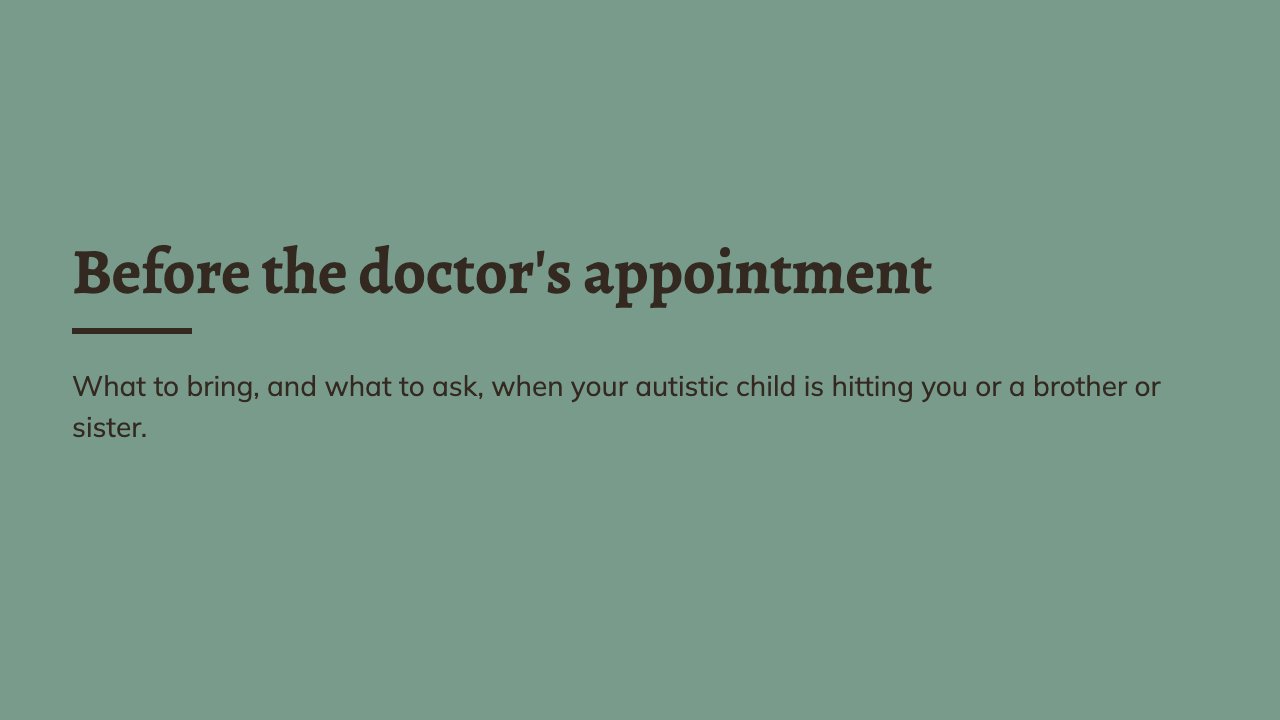
- Before the doctor's appointment: What to bring, and what to ask, when your autistic child is hitting you or a brother or sister.
- Keep the log for two weeks: One line each time:; Day and time; What came just before; What your child did; What happened right after; Who was there, and how your child seemed
- Read it through once: Circle the times of day that keep coming up; Circle the moments just before; Circle the people who are there, or who are hit
- Say it plainly: My child is hitting me, or a sibling; This is how often, from the log; I want help to find the pattern
- Ask the doctor: Could pain or an illness be part of this?; Could a psychologist or behaviour specialist look at the hitting?; Would a functional assessment of behaviour help?
- Ask about support for you: Is there caregiver training or a support group I can join?; Can a social worker help me apply for Take-A-Break respite?
- Until the appointment: Keep the younger children out of reach at the hard times; Answer the hitting the same calm, short way each time; If anyone is badly hurt, call 995
For the moment of overwhelm itself, our guide to managing autism meltdowns sits beside this one. More ideas for daily life are in our everyday autism parenting strategies.
If you would like these guides as we write them, the newsletter form is at the foot of this page.
Common questions
Is hitting the same as a meltdown?
Sometimes. The NHS describes a meltdown as a child losing control of their behaviour when they feel very overwhelmed or upset, and some hitting happens then.
Hitting can also come at calmer times, after the same kind of moment each time. Two weeks of the log will show you which one you are seeing, and the doctor can help you read it.
Why does my child hit me more than anyone else?
When one family member is the target, the National Autistic Society suggests looking for what about that person might set it off. A perfume can be too strong. A person can be linked in the child’s mind with something they find hard.
Or the child may be upset when that person spends time with other people, such as a new baby.
For the last one, the charity suggests set times for just the two of you, shown on a visual timetable, with a sand timer so your child can see when the time ends. A visual timetable shows the day as a row of pictures. Our guide on how to make a visual schedule shows you one step at a time.
Should I punish my child for hitting?
The National Autistic Society’s advice puts the weight on the behaviour you want instead. Reward it straight after it happens, and say what you are rewarding. A reward can be praise, a favourite activity, a toy, or a little of a favourite food.
That fits the no-blame view of this guide: your child is not being bad on purpose, and the aggression is doing a job for them. The aim is to give them a better way to get that job done.