When puberty starts, and what changes
HealthHub describes puberty as the stage when a child matures sexually. It lists the usual ages as around 11 to 12 for girls and 11 to 14 for boys, and says it unfolds over several years, not overnight with a first period.
Autistic girls may start earlier. One US study of 239 children aged 10 to 13 found that the autistic girls in it started puberty earlier, on average, than the non-autistic girls. It found no such difference for the autistic boys. It is one study, so treat it as a reason to start talking early, not as a date for your own child.
| Change | Boys | Girls |
|---|---|---|
| Shape and size | Taller and heavier; muscles grow; shoulders broaden | Taller and heavier; hips broaden; bottom and thighs fill out |
| Hair | Around the penis, under the arms, on the face and chest | Around the vulva (the outer genitals) and under the arms |
| Skin and sweat | Oilier skin, possible acne (pimples); more sweat, which can cause body odour | Oilier skin, possible acne (pimples); more sweat, which can cause body odour |
| Changes of their own | Penis and testicles grow; erections and ejaculations (semen coming out of the penis) happen more often; the voice deepens | Breasts develop; periods begin |
Two early signs are worth knowing. For a boy, HealthHub says the first change you may notice is that the testicles grow and pubic hair, the hair around the genitals, starts.
For a girl, a sticky, pale yellowish discharge in her underwear usually comes before her first period. HealthHub calls this normal and a sign that puberty is on course.
If the changes seem very early or very late. Talk to your child’s doctor. KK Women’s and Children’s Hospital (KKH) runs a Paediatric Endocrinology Service, a team for children’s hormone conditions, and it lists both early puberty (called precocious puberty) and delayed puberty among the conditions it sees.
Explaining the changes in plain words and pictures
The National Autistic Society, a UK autism charity, notes that autistic children often need longer to adjust to any change in their lives. That is the reason to begin before puberty does, and to say each thing many times, not once.
Say exactly what you mean. Your child may take words literally. The charity gives the example of a voice that is “breaking”, which can sound frightening. Say instead that the voice is changing and will probably get deeper, and point to the deeper voices of a father, an uncle or an older brother.
Use the correct names for body parts. You can also explain that other children may use different words in the playground, and that your child does not have to join in those conversations.
Answer honestly, and say so when you are unsure. A clear answer, or a plain “I don’t know, let me find out”, builds trust. A vague answer can confuse. If questions come at awkward moments, the charity suggests one ready-made reply the whole family uses, such as “That’s a good question. Let’s talk about it once we get home.” Then keep the promise when you get home.
Show it, do not just say it. Visual supports are things your child can look at instead of only hear. The National Autistic Society suggests two simple ones:
- photos of your child as a baby and a toddler, and of family members at different ages, to show where puberty sits in a person’s life
- an outline of a body with every part labelled, showing how each part will change and what comes from it, such as sweat, urine, semen, period blood and discharge
A social story, a short story told from your child’s point of view, can walk through one change at a time. Our guide on how to write a social story shows the method step by step.
Keep the tone positive. The charity suggests naming what your child can look forward to as they grow up, such as choosing their own haircut.
If your child speaks little or not at all, the pictures carry even more of the load. Use the same photos and the same body outline every time, so each picture means one thing. Our guide to helping a non-speaking autistic child communicate covers ways to give your child words for what they feel.
Choosing a book or a body diagram. A book can help too. HealthHub suggests an illustrated book to help explain periods. Here is what we would look for before buying one:
- the correct names for body parts, the same ones you use at home
- clear, simple pictures, one change to a page
- plain sentences with no jokes or sayings your child might take literally
- different kinds of bodies, not one ideal shape
That last point matters. The National Autistic Society warns that a child may expect their body to look exactly like the bodies in the pictures you used. Tell your child that every body is a bit different, and that this is fine. Read any book yourself first, and keep the parts that fit your child.
Public and private: one clear rule
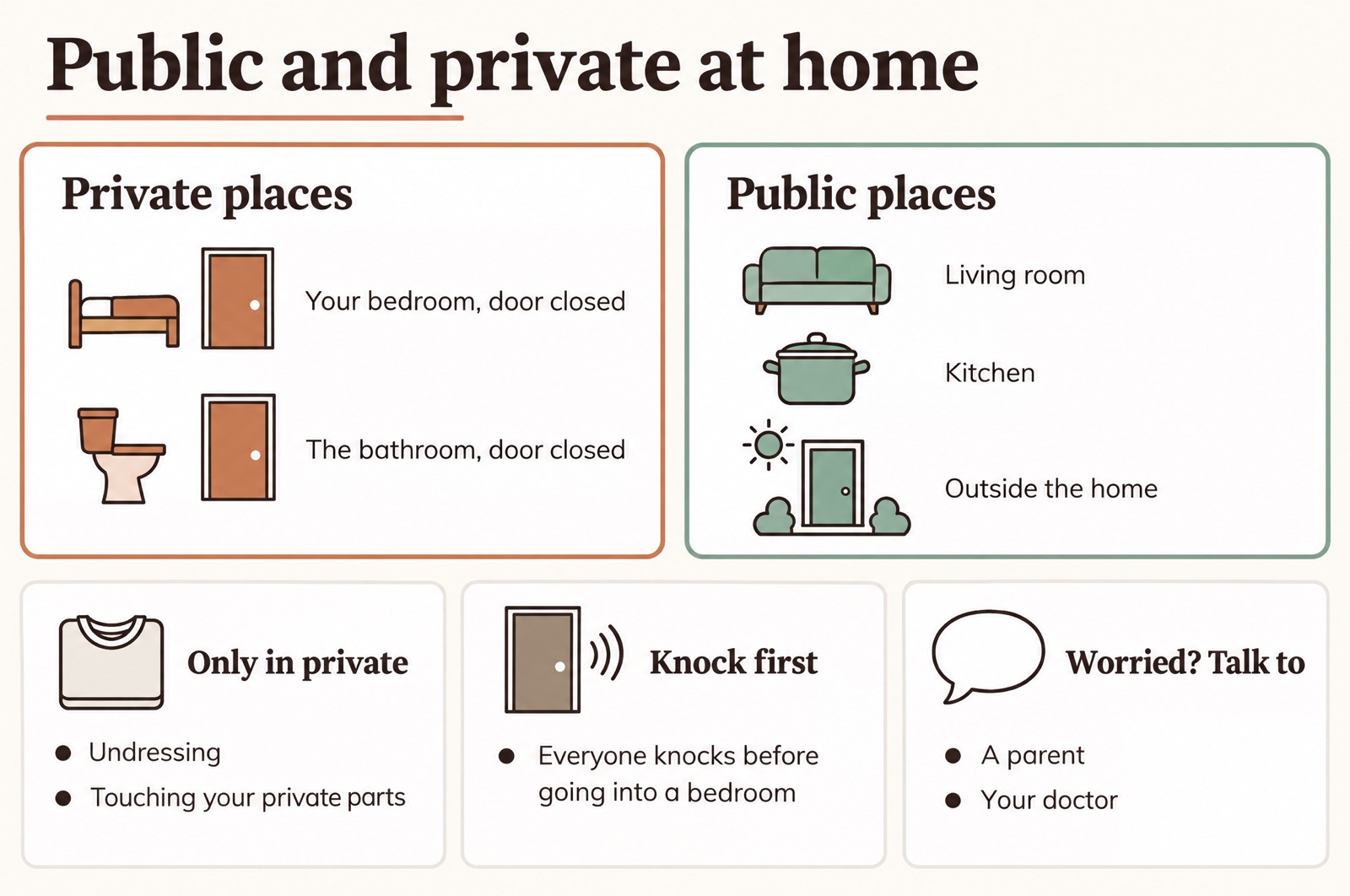
Make public and private one concrete rule your child can see. The National Autistic Society suggests setting out:
- which rooms in your home are private and which are public
- that undressing, and touching their own private parts, happen only in a private room, such as their bedroom
- that everyone knocks before going into a bedroom, and that visitors are told this rule too
- who your child can talk to about worries, such as you and their doctor
Read the rule as words
Public and private at home.
Private places: your bedroom, door closed; the bathroom, door closed.
Public places: living room; kitchen; outside the home.
Only in private: undressing; touching your private parts.
Knock first: everyone knocks before going into a bedroom.
Worried? Talk to: a parent; your doctor.
Start before puberty if you can. The charity notes that some things a young child does, such as taking clothes off at an unexpected moment, will be seen as inappropriate in a teenager, and are easier to change early.
Touching themselves is normal. The National Autistic Society suggests preparing to talk about masturbation so your child does not worry about it: say it is normal, and that it happens in private. Show your child how to clean up afterwards, with tissues or wipes kept in their room.
Erections and wet dreams are normal too. HealthHub says erections can be unpredictable in puberty, and a wet dream, when semen comes out during sleep, can happen for no reason at all. Tell your son these are normal. HealthHub suggests letting him change and wash his own bedsheets if that feels better for him. If saying it aloud is hard, the charity suggests a symbol or a hand signal your child can use to tell you the sheets need changing, or one fixed day a week for washing them.
When a behaviour looks inappropriate, look for the reason before you react. The National Autistic Society notes that what others call inappropriate often has a specific meaning for the autistic person. It may be a routine, a sensory feeling they want again, or curiosity. A behaviour diary, which notes what happened before, during and after each time, can show you the purpose. Keep your reaction calm and your voice level.
Hygiene your child can follow: picture steps
Puberty brings more sweat, and HealthHub notes that sweat can cause body odour, while skin turns oilier. The National Autistic Society suggests preparing your child, as puberty nears, for washing more often, using deodorant and, later, shaving. Explain how to do each one, and also why people do it. A social story can carry the why.
If your child already follows a routine or a tick list for the morning, the charity suggests adding to it rather than starting again: deodorant, a shower every day, shaving every other day, and so on. A visual schedule, a row of pictures that shows what comes next, is the simplest way to do that. Our guide on how to make a visual schedule explains the three kinds.
Here is how we would add one new step:
- Pick one new step. Deodorant after the shower is a good first one. Add the next step only when this one is easy.
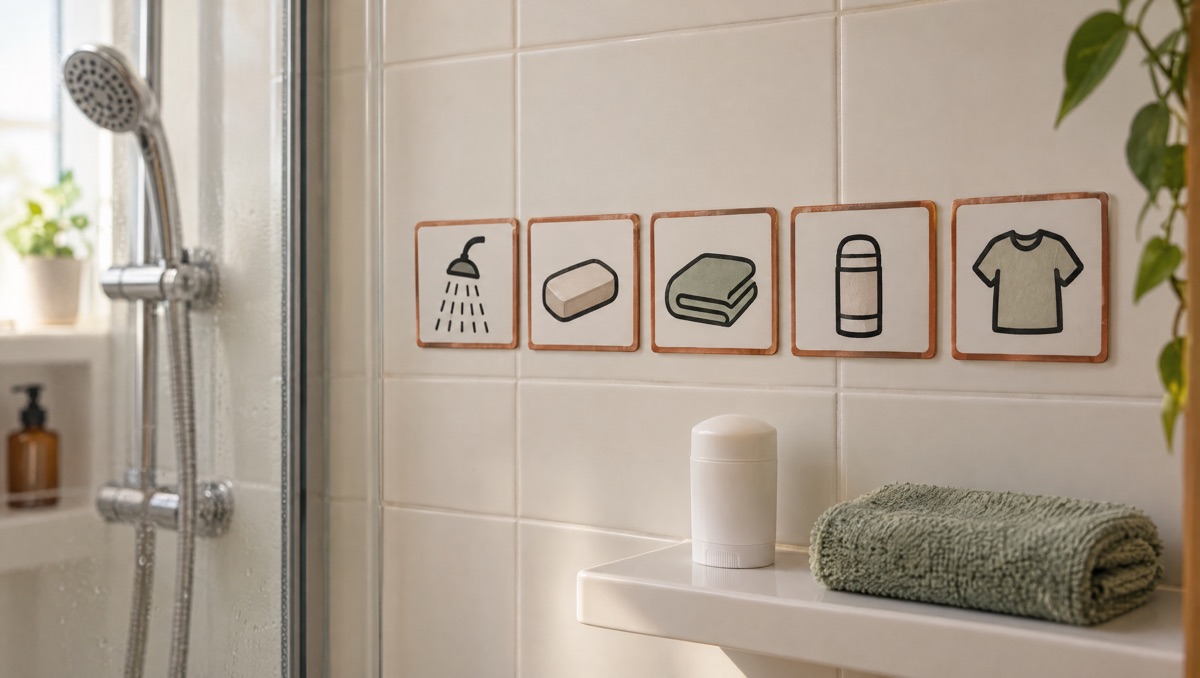
- Take a photo of the real thing. Your child’s own deodorant, their own towel, their own clean clothes. A photo of the actual object is clearer than a drawing of a general one.
- Put the photo into the routine, in the place it happens. Our free visual schedule builder makes a printable strip.
- Show it, then do it together. Do the step side by side for a while, then hand over a little at a time.
- Keep the strip where the step happens, such as on the bathroom wall at your child’s eye level.
New products can feel and smell wrong. A deodorant’s scent, a razor’s buzz or the tug of a new shirt can be hard for a child with sensory differences, who may feel smells, sounds or textures more strongly, or less strongly, than most people. Let your child smell or touch two or three options before you buy, and keep to the one they accept. Our guide to sensory strategies for daily life helps you work out what your child finds easy and what they find hard.
Getting ready for a first period
HealthHub’s advice is to talk to your daughter about periods before her first one comes. Tell her what to expect, and that it is a normal part of growing up. Then show her how to use pads and keep herself clean.
The National Autistic Society adds that an autistic girl may need to hear, plainly, that a period is a normal body process and that she will not bleed to death. Literal thinking makes that worry real, so say it out loud even if it seems obvious.
Practise before it happens. The charity suggests showing your daughter how to use pads, and pointing out the features that will help her remember how. We would practise at home on a calm day: a pad on clean underwear, then off, wrapped and into the bin, then hands washed. Make those steps into a picture strip for the bathroom, the same way as the shower steps above. If one kind of pad feels wrong, try another kind now, not on the first day.
Make it predictable. The National Autistic Society suggests:
- keeping pads in one fixed drawer in her bedroom or the bathroom, so she knows they will always be there
- a calendar, or a period-tracking app on her phone or tablet, so she can see when her period is due, which may ease the worry
- a small notebook she carries, with the steps and a few reassuring words for when you are not there
- telling her who to go to at school if her period starts there
HealthHub notes that before the first period, a girl is likely to see a sticky, pale yellowish discharge in her underwear. Show your daughter what that looks like in a picture, so it reads as a sign to get ready, not as something wrong.
Body safety: who your child can tell
Safety comes before any book. A child who cannot yet name their body parts, or say what happened, needs a way to tell you first.
The rules to teach. The Ministry of Education (MOE), which runs Singapore’s national schools, says children in mainstream primary schools learn about good touch and bad touch from Primary 1, in lessons with their form teacher. They are taught to say “no” to any unwanted contact, and to get help from trusted adults, including parents and school counsellors. HealthHub adds two points for parents: teach your child how to say “no” to an unwanted touch, and know that sexual abuse can happen to anyone, boys and girls.
Use the same words at home, so your child hears one rule from everyone. The National Autistic Society suggests a social story that describes someone acting in a way that is not okay with your child, and names who your child can tell, such as you or a teacher. It also suggests a simple table: people down one side (family, teachers, strangers), actions across the top (holding hands, a kiss on the mouth), and a tick or a cross in each box.
You can add the self-care your child still needs help with, such as washing or dressing, so they know exactly who may help with it. Go over the table often, and update it as your child grows.
Online safety counts too. The charity notes that your child needs to know how to stay safe online, so put the same rules on the screen: who your child may message, and what they never send.
Feelings, and a lot of change at once
HealthHub describes puberty as a time full of worries and doubts for any child, with emotional changes alongside the physical ones. Children become more aware of how they look and where they fit in. Add an autistic child’s need for more time to adjust to change, and some hard weeks are to be expected. They are not a sign that you prepared badly.
What helps is the same calm, predictable approach as everything above. Warn of each change before it comes. Keep the words the same each time. Give your child some control where you can, such as choosing their own deodorant or the day sheets get washed. HealthHub also suggests praising the effort, however small, and letting your child make their own decisions on simple things.
If change shows up as more meltdowns at home, our guide to managing autism meltdowns covers what helps in the moment and how to spot what sets them off.
What Singapore schools teach about puberty
The National Autistic Society’s advice is to find out what your child’s school will teach, and when, so the explanations at home and at school match. It also notes that school lessons may move too fast for your child, or start too late. In Singapore, the answer depends on the type of school.
In a special education (SPED) school. A SPED school is a government-funded school for children who learn best with more support; our dictionary entry on SPED schools says more. MOE told Parliament in February 2021 that sexuality education is an important part of what every SPED school teaches. These are lessons on bodies, growing up and relationships, taught through the Healthy and Safe Relationships (HSR) programme, which began as a trial in six SPED schools in 2013.
HSR covers three broad themes: body awareness, personal safety and relationships. MOE said lessons are adapted to each student’s needs. They use methods such as direct instruction, where the teacher shows and explains each step, and role-play, where students act out a situation to practise it.
MOE launched a guide to teaching HSR in 2016. It was made with SPED teachers and the Health Promotion Board, which writes health advice for HealthHub, with input from parents and caregivers.
SPED schools also bring in social workers and psychologists to help families support their children through these changes, MOE said, and run workshops for parents and caregivers on sexuality education. Our guide to the SPED years from 7 to 18 shows where these lessons fit in your child’s school life.
In a mainstream school. MOE’s personal safety lessons start in Primary 1, as above. MOE Sexuality Education itself starts in Primary 5. As of January 2026, MOE says Primary 5 students get 3 hours of it a year and Primary 6 students 2 hours.
The first of its five themes is human development: the start of puberty and how it affects feelings. MOE says only specially selected and trained teachers teach it, and that parents play the main role in teaching their children about sexuality. Our guide to autism support in mainstream schools covers the other help a mainstream school can give your child.
| SPED school | Mainstream school | |
|---|---|---|
| What the lessons are called | Healthy and Safe Relationships (HSR) | Personal safety lessons; MOE Sexuality Education |
| When they start | MOE’s reply gives no starting age; ask the school | Personal safety from Primary 1; Sexuality Education from Primary 5 |
| What they cover | Body awareness, personal safety, relationships | Good touch and bad touch; then five themes, starting with puberty |
| How they are taught | Adapted to each student; direct instruction and role-play | By specially selected and trained teachers |
| Help for parents | Parent workshops; social workers and psychologists | Parents are named as the main teachers of values at home |
Your next step: ask the school what it teaches, and when
Ask your child’s school what its puberty and safety lessons cover, and when they happen. In a SPED school, ask your child’s form teacher; the school’s social worker can help too.
In a mainstream school, ask the form teacher and the SEN Officer. SEN stands for special educational needs, and the SEN Officer is the staff member MOE places in mainstream schools to give learning and behaviour support to these students.
These are the questions we would bring:
- Which term are the lessons in, and what does each one cover?
- What words and pictures do you use for body parts and changes, so we can use the same ones at home?
- Can my child have the topic early, or more than once, if they need longer to take it in?
- In a SPED school: is there a parent workshop on this, and who in the team can we talk to?
- If my daughter’s period starts at school, who does she go to, and where are the pads kept?
Write down what the school tells you, and build your home pictures from it. Then your child hears one story about growing up, at home and at school.
Read the slides as words
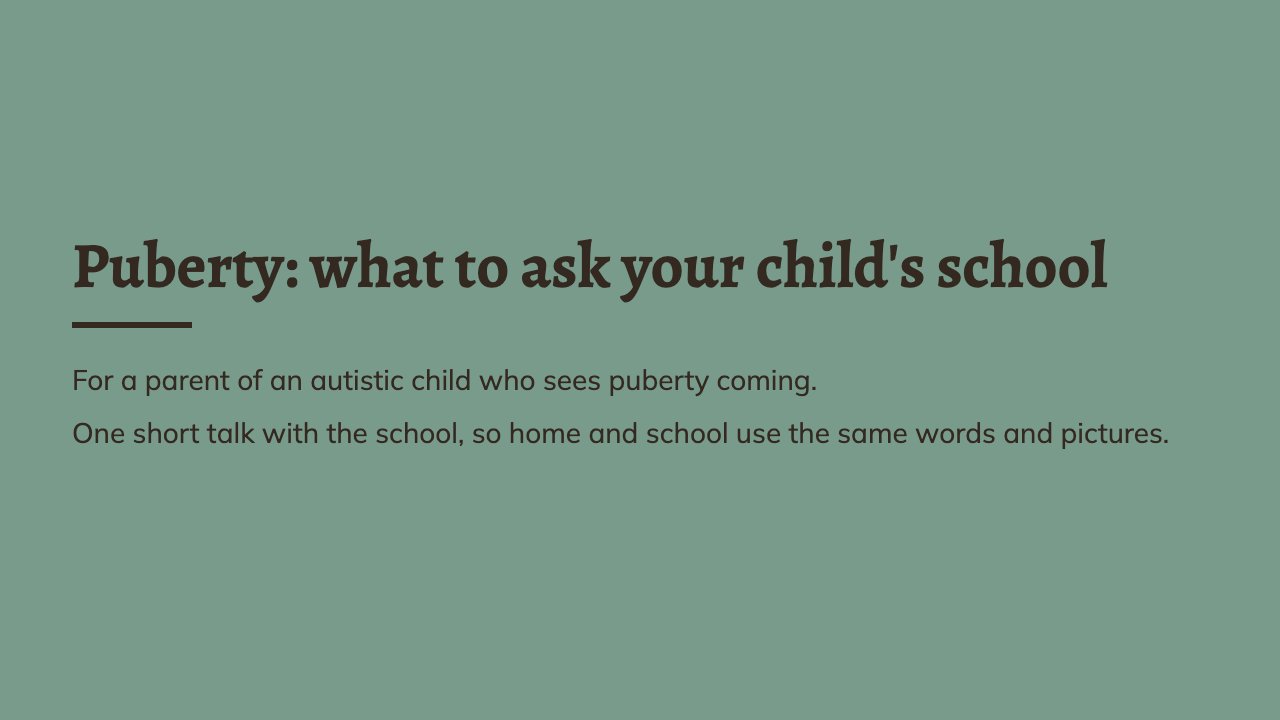
- Puberty: what to ask your child's school: For a parent of an autistic child who sees puberty coming.; One short talk with the school, so home and school use the same words and pictures.
- Who to ask: SPED school: your child's form teacher; The school's social worker can help too; Mainstream school: the form teacher and the SEN Officer
- What a SPED school teaches: The Healthy and Safe Relationships (HSR) programme; Body awareness, personal safety and relationships; Lessons fitted to each student; Workshops for parents and caregivers
- What a mainstream school teaches: Personal safety lessons from Primary 1, with the form teacher; Good touch and bad touch, saying no, telling a trusted adult; MOE Sexuality Education from Primary 5, starting with puberty
- Questions to ask: the lessons: Which term are the lessons in?; What does each lesson cover?; What words and pictures do you use for body parts and changes?
- Questions to ask: your child: Can my child have the topic early, or more than once?; SPED school: is there a parent workshop, and who in the team can we talk to?; If my daughter's period starts at school, who does she go to, and where are the pads kept?
- After the talk: Write down what the school told you; Build your home pictures from the same words; Go over them often, calmly, before each change comes
Questions parents ask
Can puberty come early in autistic children?
It can for girls. One US study of children aged 10 to 13 found autistic girls started puberty earlier on average than other girls, and found no difference for autistic boys. HealthHub gives the usual ages as around 11 to 12 for girls and 11 to 14 for boys. If the changes seem very early or very late, ask your child’s doctor.
How do I explain puberty to a child who speaks little or not at all?
Lean on pictures. Use photos of your child and your family at different ages, and one body outline with every part labelled. Use the same pictures and the same words every time, and add a symbol or hand signal your child can use to tell you something, such as that the sheets need washing.
When should I talk to my autistic daughter about periods?
Before her first one. HealthHub advises talking about periods before they start. Practise with pads at home, keep them in one fixed place, and tell her who to go to at school. A pale yellowish discharge in her underwear is a sign the first period is getting closer.
Do SPED schools in Singapore teach sexuality education?
Yes. MOE told Parliament in February 2021 that every SPED school teaches it through the Healthy and Safe Relationships (HSR) programme, covering body awareness, personal safety and relationships. Ask your child’s school when the lessons happen and which words and pictures they use.