Dictionary: EIPIC · DS-Plus · SG Enable · KKH DCD · Visual schedule
Why toilet training can take longer for an autistic child
Using the toilet starts with a feeling: the body saying “I need to go”. SPD, a Singapore disability charity, describes toilet training as teaching a child to recognise their body’s signals for wee and poo, and then to use the toilet at the right times.
That signal comes from inside the body. The sense that picks it up is called interoception, and the occupational therapists at KK Women’s and Children’s Hospital (KKH) list it among the senses a child’s brain has to take in and make sense of.
If a child does not notice the signal, or does not know what it means, the message “toilet, now” never arrives in time. SPD’s occupational therapist names “decreased or lack awareness of the need to go to the toilet” as one of the common barriers.
Other hurdles can sit on top of that one. SPD’s list also has fear of the flush or of the toilet seat, finding it hard to ask for the toilet, difficulty with changes in routine, and sensory dislikes such as the feel of being wiped or the smell of poo. Constipation is on the list too.
So it often takes a while. In a 1992 US study, 100 parents of autistic children and adults looked back on toilet training.
On average it had taken 1.6 years for wee and 2.1 years for poo. Constipation was among the most common problems they reported, and almost half had taught their child using a schedule.
Signs your child may be ready
Look for the signs any child shows, whatever your child’s age. Singapore’s Families for Life parenting site and SPD both list them, and Families for Life says not every sign needs to be there. You are looking for a general trend.
- Your child stays dry for up to two hours in the day, or through a nap.
- Your child notices a wet or dirty nappy: fidgets, pulls at it, or tells you with a word or a gesture.
- Your child can sit still for a short while.
- Your child can follow a simple instruction and find the way to the toilet.
- Your child can pull pants down and up, or help with it.
- Poos are regular, soft and formed.
If your child speaks little or not at all, a gesture counts as telling you. Our guide on helping a non-speaking child communicate has more ways in.
Some children do not notice a wet nappy yet. SPD lists this lack of awareness as a common barrier.
For these children, the National Autistic Society describes habit training: taking your child to the toilet at set times every day, so the body learns to go at those times. It suits children who may not notice or understand the body’s signals, and children who have tried toilet training before without success.
If poo is held in, see a doctor first
Constipation can make toilet training harder, Families for Life says, so it is worth sorting out before you start. HealthHub, the Ministry of Health’s site, lists signs such as:
- two or fewer poos a week
- small, hard poos, or poos that are hard to pass
- tummy aches or bloating
- poo soiling your child’s underwear between poos
HealthHub also explains why a child holds poo in. They may not want to stop playing, may not like doing a poo away from home, or may be scared after a poo that hurt. Holding back often can make poos harder.
If poo is the hard part, tell the doctor you are about to start toilet training. Then the two plans can fit together.
Build the routine in pictures
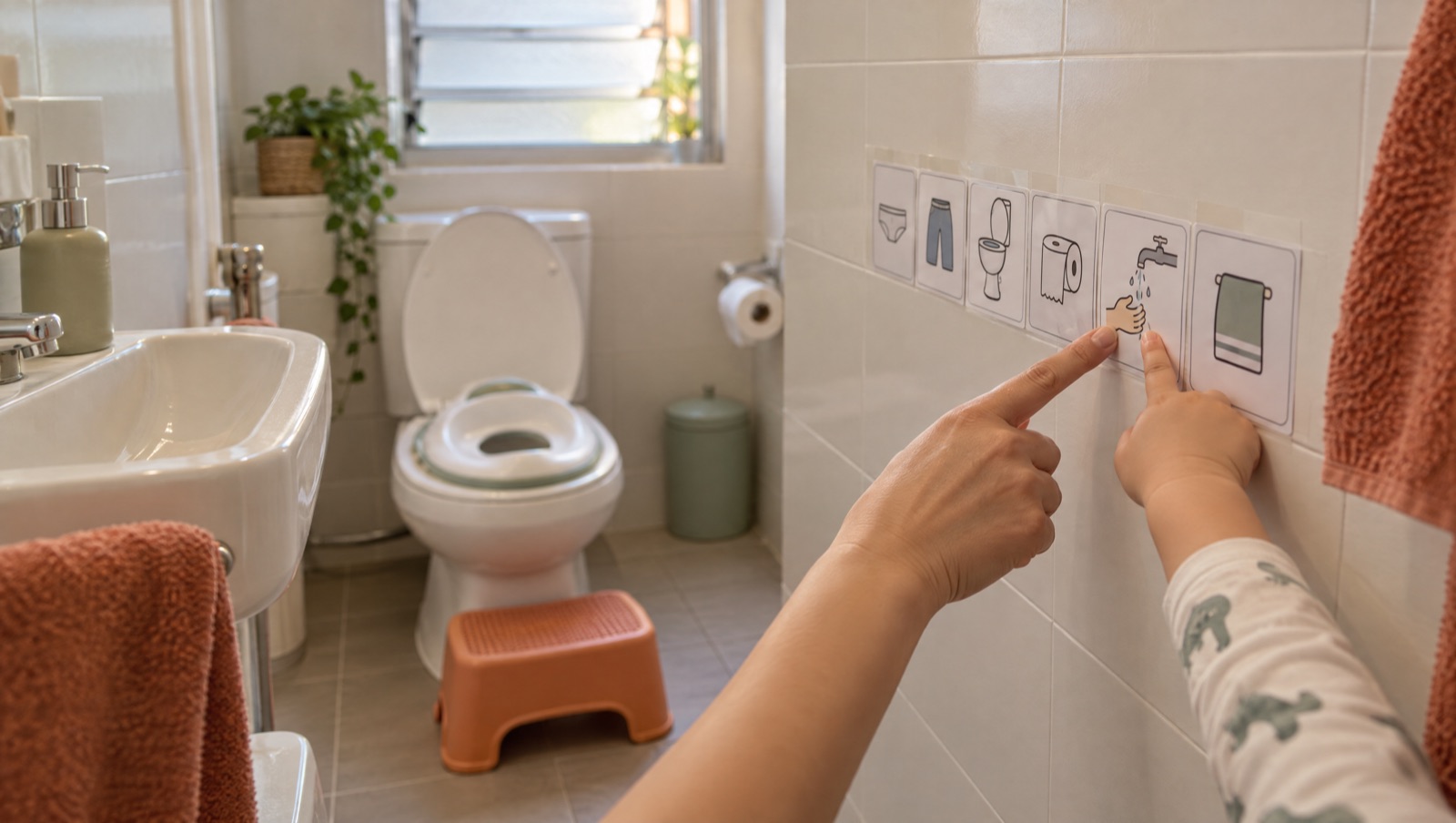
Autistic children often like routine, and the National Autistic Society suggests building toilet training on that liking. The routine becomes a row of pictures beside the toilet, in the order your child does it.
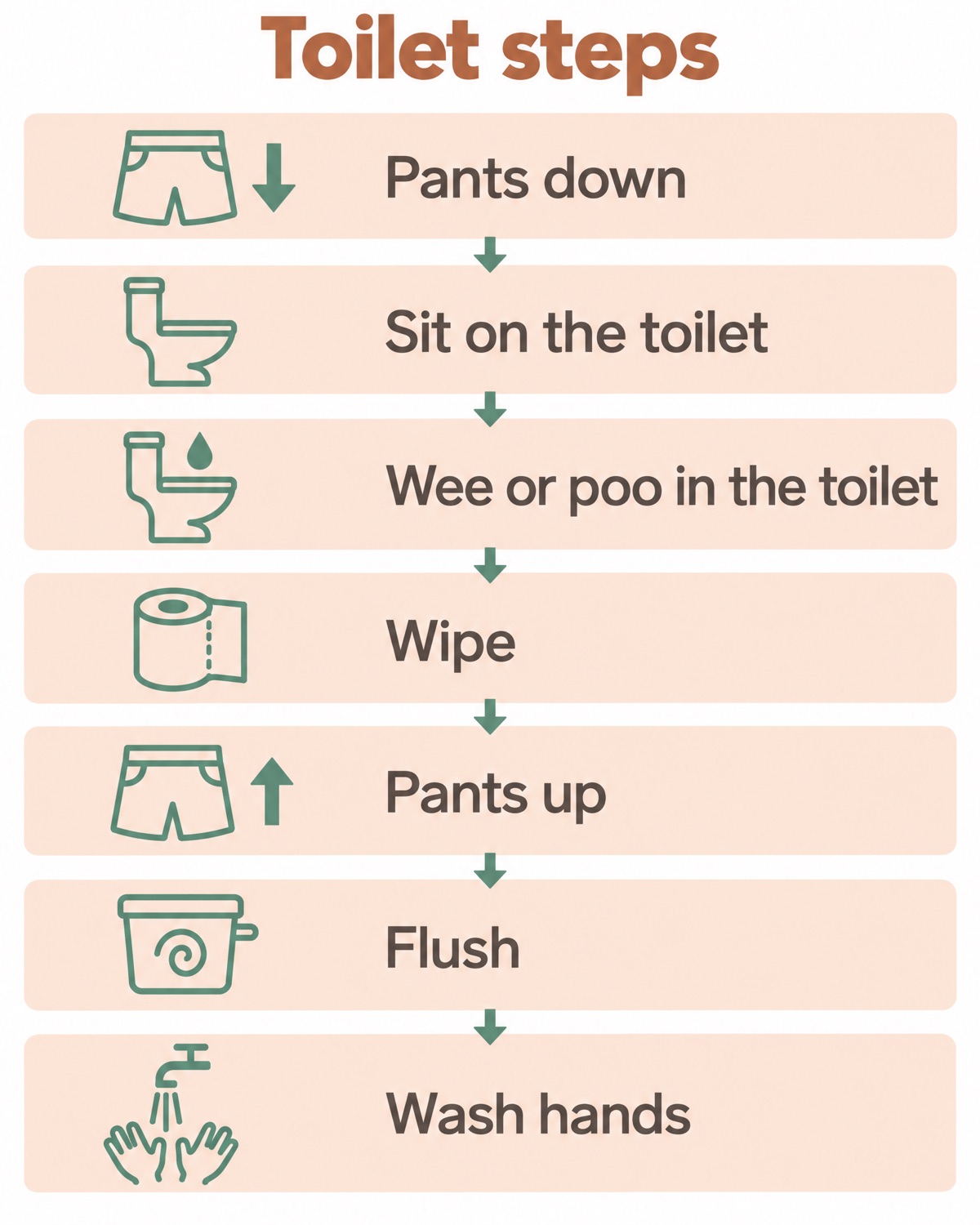
- Pants down.
- Sit on the toilet.
- Wee or poo in the toilet.
- Wipe.
- Pants up.
- Flush.
- Wash hands.
Photos, drawings or written words all work, so use whatever your child follows best. Some children do better when they can cover or take away each picture as they finish that step. A second strip above the sink, at your child’s eye level, can show the hand washing.
Read this as words instead
Toilet steps
- Pants down
- Sit on the toilet
- Wee or poo in the toilet
- Wipe
- Pants up
- Flush
- Wash hands
Keep it the same every time. The NAS guide says to follow the whole sequence even when nothing comes out, as if it had. It also suggests changing nappies in the bathroom, so the room and the job start to belong together, and working on one new behaviour at a time, because changing two at once is very hard.
Where the toilet fits in the day
The pictures in the bathroom show how. A day schedule shows when.
Our free Visual Schedule Builder has a Toilet picture you can place in your child’s morning, afternoon and evening, and a First, then board: first toilet, then something your child enjoys. You can print either one.
Our guide to visual schedules explains how to introduce a schedule so your child uses it.
To choose the times, watch your child for a few days and note when wees and poos come. The NAS suggests taking your child at set times based on what you see.
Families for Life gives the example of about 30 minutes after eating or after a bath, if that is when your child tends to poo. If nothing comes after three to five minutes, it suggests taking your child off; a long sit starts to feel like a punishment.
Praise does not suit every child. The NAS notes that some children enjoy a “well done”, some prefer an object, and some find praise hard.
For them, a calm routine with a favourite activity straight after the toilet may work better. That is the job of the First, then board.
Give the feeling a name
Parents name “hungry” for a child many times a day, often without thinking. The feeling of needing the toilet is easy to leave without a name.
One idea worth trying: choose one word for it, or one picture card, and use it every time. Say it when you see the signs, on the walk to the toilet, and as your child sits.
Pick a word your child can keep as they grow. The NAS advises against babyish toilet words, because they can be hard to change later.
“Toilet” works. So does “I need to go”, one of the phrases Families for Life suggests teaching. For a child who does not speak, the picture card does the talking, and in time handing it to you can become the way your child asks.
Make the bathroom easier on the senses
A bathroom can be loud, bright and strong-smelling. For a child who feels those things sharply, the room itself can be the problem. The National Autistic Society suggests a few questions to ask:
- Is the soap smell too strong?
- Does the noise of the exhaust fan bother your child?
- Does the water temperature need changing?
- Is the light too bright?
Then make the seat feel safe. A smaller seat that fits inside the toilet helps a child who is uneasy about falling in, Families for Life notes. The NAS adds something solid under the feet, so your child sits with feet flat and hips and knees bent at about a right angle.
If the flush is the fear, the NAS suggests taking it out of the picture strip for now. Your child dries their hands first, then stands at the door while you flush, a little closer each time, until they can flush by themselves. Calm music over the sound, or pictures that show what makes the noise, may also help.
Our guide to sensory strategies shows how to read what overwhelms your child and what calms them, and how to make the home calmer.
Setbacks are part of it
There will be accidents. Families for Life says to expect accidents and setbacks, because they are part of the process.
Children do not usually have accidents on purpose, so clean up without comment or fuss. HealthHub is just as plain: do not punish a child who has soiled their underwear.
Pressure tends to backfire. Too much tension or stress, Families for Life warns, can lead a child to avoid the toilet.
Poo often comes later than wee. The NAS notes that bowel control is usually learnt after bladder control, so a child who is dry but still poos in a nappy is at a common stage.
Some setbacks you can see coming. Families for Life suggests planning toilet training well before or after a big change, such as starting childcare, a new baby or a move.
HealthHub notes that starting at a new school can unsettle a child’s routine and their bowels, and SPD lists loose stools and poor sleep among the things that get in the way. When a change is coming, tell everyone who cares for your child; the NAS points out that a child may behave differently when the routine changes.
Through all of it, keep the same pictures, the same word and the same times. The routine is what your child comes back to.
Who can help in Singapore
One professional to ask is an occupational therapist (OT), who helps children with the everyday tasks of daily life. KKH’s occupational therapists list toileting among the self-care skills they work on, beside dressing, feeding and brushing teeth, and they coach parents to carry the work into the child’s daily routines.
Who to ask depends on where your child is now.
Your child is in EIPIC
EIPIC, the Early Intervention Programme for Infants and Children, is a government-funded programme for young children who need medium to high levels of early intervention support. Its early intervention staff and therapists set your child’s goals together in an Individualised Educational Plan (IEP), and SG Enable, Singapore’s first-stop agency for disability, says the sessions may include occupational therapy.
Ask the team whether toileting can be one of those goals.
Your child gets DS-Plus at preschool, or sees a private therapist
DS-Plus (Development Support-Plus) brings early intervention to your child inside the preschool, for children who need a low level of support. Ask the early intervention professional or therapist who already works with your child.
Toileting is a self-care skill, and SG Enable describes self-care as part of what occupational therapy works on. Our DS-Plus guide explains how that support works inside a preschool.
Your child is not in a programme yet
Start with your family doctor. KKH asks parents with concerns about daily living skills to speak to their family doctor for a referral to KKH’s Department of Child Development, which has its own occupational therapists. SG Enable also notes that a child outside a programme can still get therapy from social service agencies (the charities that run disability services) or private centres, and its Enabling Guide lists them.
Bringing the preschool or school in
A routine works best when it is the same routine everywhere. The National Autistic Society says everyone working with your child should start toilet training at the same time and follow the approach you have agreed.
So give the preschool, EIPIC centre or school what you use at home:
- a copy of the picture strip, the same pictures in the same order
- the word or card you use for “I need to go”
- the times you take your child, and what comes after the toilet
- any toilet seat insert your child uses
- spare clothes, plastic bags for wet clothes, and wet wipes
Then agree how you will pass news both ways. The NAS suggests a home and school book for worries and successes. A notebook in the bag or short messages with the teacher both do the job.
Here is one way to open the conversation. Change the details to fit your child.
“We are starting toilet training at home. [Name] uses these pictures, in this order, and the word ‘toilet’. We take [Name] about 30 minutes after meals, for a few minutes at most. After the toilet comes [favourite thing]. Could you use the same pictures and the same word here? And can we tell each other how it went each day?”
If your child is still starting preschool, our guide to childcare for an autistic child in Singapore covers what support comes into the classroom and what to ask on the visit.
Common questions
My child will only poo in a nappy. What can we try?
Rule out constipation first, with the checks above. After that, the NAS notes that some children find the feel of a full nappy comforting, and some hold on until a nappy goes back on.
One step it suggests: your child sits on the toilet with the nappy still on, then with a hole cut in the bottom, and a little more is cut away each time until the nappy is not needed. It also suggests giving the comfort another way, such as being wrapped in a warm, heavy blanket, as part of the routine.
Should we use a potty or go straight to the toilet?
Either can work. The NAS says skipping the potty is often easier, because it avoids a second change later, from potty to toilet.
Families for Life points out that a potty is familiar and can feel less scary than a toilet, and suggests going with your child’s preference. Whichever you choose, put it in the picture strip and keep it.
When can we stop nappies at night?
The NAS suggests starting night-time training once your child is mostly dry during the day. Its tips: a bedtime routine that stays the same on weekends and holidays, a trip to the toilet before bed, and no drinks in the hour before bed while making sure your child drinks enough through the day.
What to do next
This week, keep a simple three-day log. Write down when your child is wet, when they are dry, and each time they sit on the toilet and what happens. It is the watching the NAS recommends before you set the times, and it gives your child’s team something real to plan from.
Then take the log to your child’s EIPIC, DS-Plus or therapy team, such as their occupational therapist, and ask for toileting to become one of your child’s goals. If your child has no team yet, take it to your family doctor.
Our newsletter is the easiest way to hear when the next guide for Singapore families is out.
Sources
- National Autistic Society, Toileting: a guide for parents and carers, last reviewed 14 August 2020. The picture sequence, habit training, the bathroom, the flush, nappies and night-time.
- SPD, Is My Child Ready for Toilet Training? (Part 1), 7 June 2021. What toilet training is, the signs of readiness and the common barriers, by an SPD occupational therapist.
- Families for Life, Toilet Training. The signs of readiness, timing the sits, setbacks and constipation.
- HealthHub, Constipation in Children, last reviewed 17 June 2026. The signs, why children hold in poo, and when to see a doctor.
- KK Women’s and Children’s Hospital, Occupational Therapy. Toileting as a self-care skill, interoception, and how to be referred.
- SG Enable, Enabling Guide: Therapy and Intervention. What occupational therapy covers, therapy inside EIPIC, and therapy outside a programme.
- ECDA, Early Intervention Programme for Infants and Children (EIPIC), last updated 21 April 2026. How EIPIC’s professionals set IEP goals.
- Dalrymple and Ruble, Toilet training and behaviors of people with autism: parent views, Journal of Autism and Developmental Disorders, 1992. How long training took, from 100 parents.