Dictionary: CHAS · Social Stories · KKH DCD
Get your child ready before the visit
Tell the story first
A social story is a short, true story that walks your child through a new situation from their own point of view. A first dentist visit is exactly the kind of first time it is for.
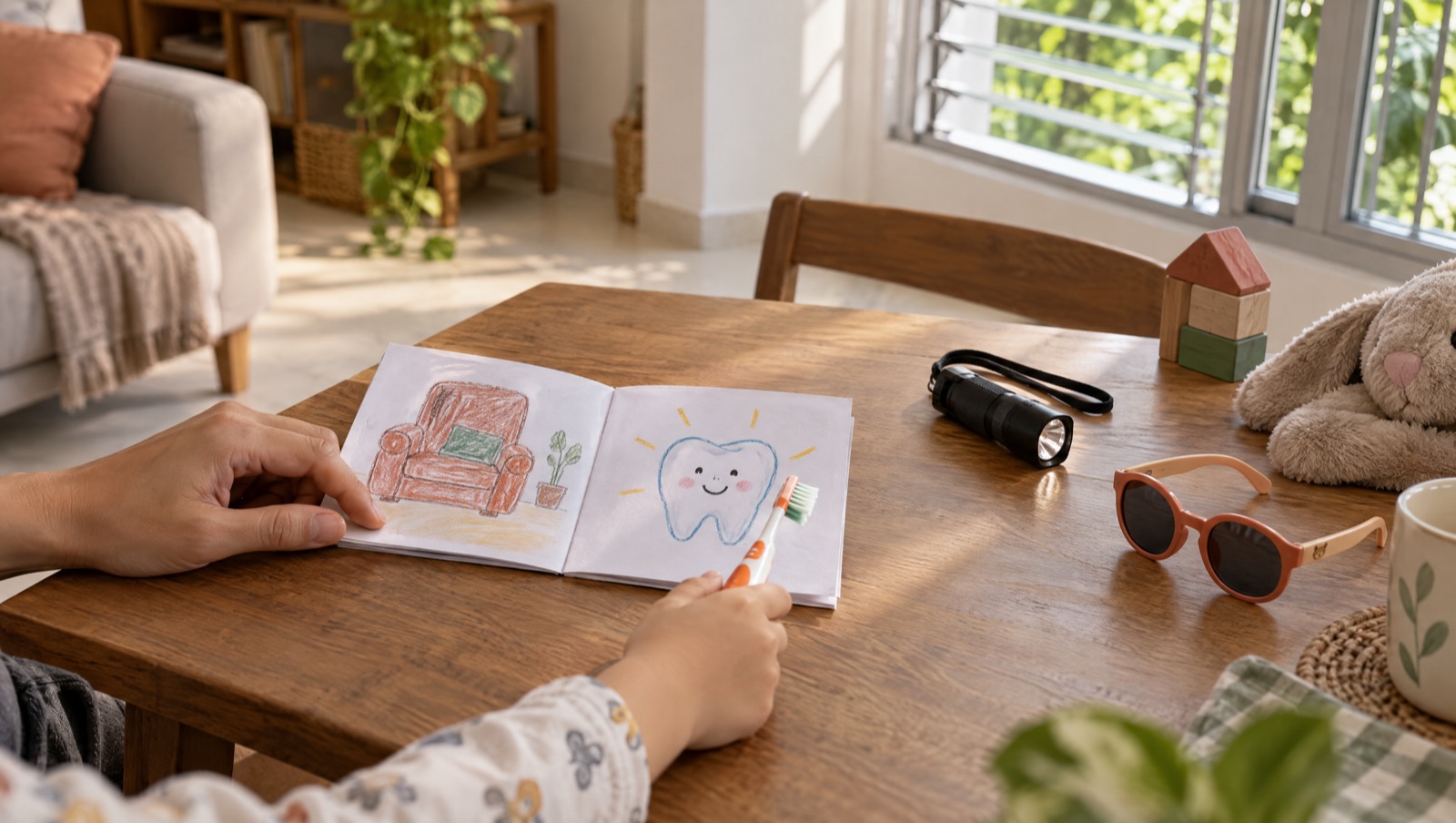
KKH has already made something close to one. Its picture story, “My Visit to the Dentist at KKH”, walks through the day in the child’s own words: the queue number, the toys in the waiting room, the dentist in a mask, gown, cap and gloves. The big chair moves back, the child puts on “cool sunglasses”, and the dentist counts teeth with a small mirror.
If your child is going somewhere else, use it as a model and write your own with that clinic’s details. Keep it literally true. KKH’s leaflet for parents says X-rays may be needed if a child has deep cavities, so a story that promises “the dentist just counts my teeth” can break a promise on the day.
Our guide to writing a social story takes you through it step by step.
Play dentist at home
KKH suggests you “rehearse and play dentist” with a torch and play at counting teeth. Before our daughter’s first dentist visit, the two of us role-played the whole thing at home, the same way we did for her first haircut.
Take turns. Let your child be the dentist and count your teeth, then swap. Practise lying back on the sofa with a wide-open mouth.
In KKH’s story the big chair tips back, and the child helps by opening wide so the dentist can count.
Make a practice visit
KKH’s leaflet suggests bringing your child along when a family member has a check-up, so the clinic is familiar before it is their turn. You can also ask the clinic whether your child may come in just to look at the waiting room and sit in the chair.
The same leaflet says it may take more than one visit before your child lets the dentist look at their teeth. A first visit that ends at “hello” is not a failed visit.
Pick the time, and pack a bag
KKH’s tips for children with special needs say to ask for a visit at the start of the day or early on. Choose a time your child is unlikely to be tired, and leave plenty of time so nobody is rushed.
Pack what normally helps your child cope with noise, light and waiting. Our sensory strategies guide explains how to read what your child needs. For the dentist, KKH names a few things:
- your child’s own toothbrush, for the first visit
- something that comforts them, such as a toy, a blanket or music
- another relative or a sibling who helps your child feel at ease, if your child is very anxious
Add anything else that works at home, such as headphones for the noise. The leaflet also asks parents not to give food or flavoured drinks while your child waits to be seen.
Choose your words
KKH asks parents to avoid words like pain, injection, pulling teeth and drilling, and to keep explanations simple rather than detailed. Keep your own worries out of it too. Plan something your child enjoys for afterwards, but KKH advises against bribes or threats to get them to cooperate.
What to ask the clinic before you book
When a clinic calls itself autism friendly, these questions show you what that means in practice. Ask them on the phone, before you book, and listen for plain, specific answers.
Start by telling them. KKH asks parents to let the dental team know in advance that a child has special needs, and to share past experiences with the staff. What your child finds hard, what calms them and how they tell you they have had enough are all worth saying.
About the first visit
- Can the first visit be short, only to meet the dentist and see the room?
- Can we have the first slot of the day, or a time when the waiting room is quiet?
- Can we wait outside or somewhere quieter, and be called when you are ready?
- Can I stay with my child the whole time?
About the room
- Can my child wear headphones or sunglasses, and bring a comfort item into the chair?
- Will the dentist show and tell before each step, and stop when my child signals?
- Has the dentist seen autistic children before?
If treatment is needed
- If my child cannot sit still for treatment, what are the options here, and where would you refer us?
- Will you tell me the cost before you start?
- Do you take CHAS?
Read this as words instead
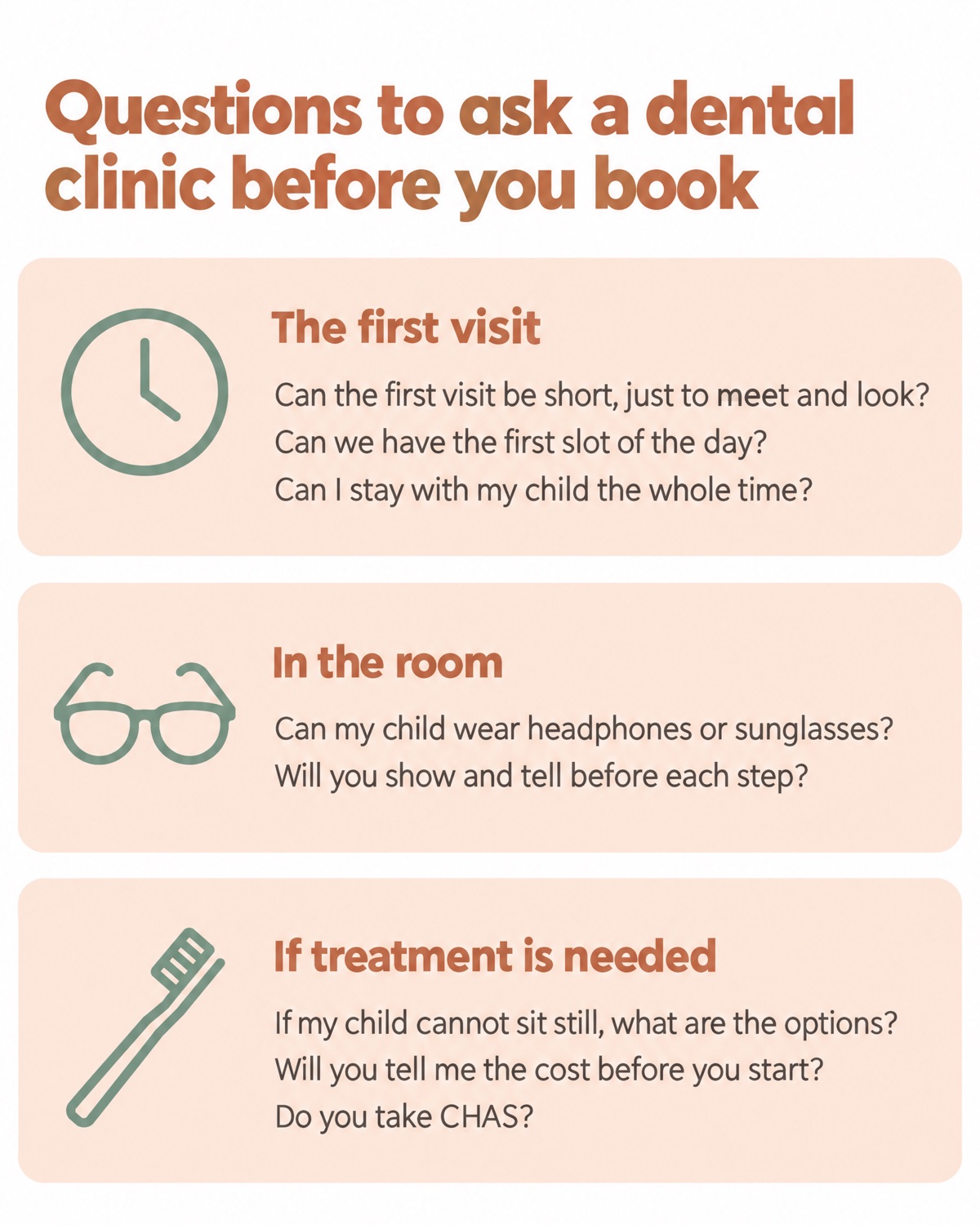
Questions to ask a dental clinic before you book
The first visit
- Can the first visit be short, just to meet and look?
- Can we have the first slot of the day?
- Can I stay with my child the whole time?
In the room
- Can my child wear headphones or sunglasses?
- Will you show and tell before each step?
If treatment is needed
- If my child cannot sit still, what are the options?
- Will you tell me the cost before you start?
- Do you take CHAS?
If the answers are vague, or the clinic sounds uneasy on the phone, that is useful to know before the day, not on it. Try the next clinic, or go the public route below.
Public dental care for an autistic child: KKH, NDCS and NUCOHS
Singapore’s public dental care has two layers. Basic care, such as scaling, polishing and fillings, is subsidised at polyclinics and at CHAS dental clinics. More complex care happens at the two National Specialty Dental Centres, NDCS and NUCOHS, where MOH says patients “may be referred from the polyclinics and CHAS clinics to receive subsidised treatment”.
KKH, the women’s and children’s hospital, runs a Dental Service of its own. Its Department of Child Development is also one of the public routes to an autism assessment, so you may know the hospital already.
Ask for paediatric dentistry, not special care dentistry
The names can mislead. Special care dentistry sounds like the right door for an autistic child, and since July 2025 it has been a recognised dental specialty in Singapore. But when it was recognised, The Straits Times reported that its specialists look after adults with complex needs.
The two public special care clinics say the same. NDCS’s Special Care Dentistry Clinic is set up for “the elderly and special needs patients”, and NUCOHS’s Special Care Dentistry names its patients as “young adults with disabilities or behavioural challenges to older adults with complex medical issues”. Neither page mentions children.
For a child, the door is paediatric dentistry, the dental specialty for children from birth to the teenage years. All three public centres list children with special needs under it.
| Centre | Who the children’s service sees | What it lists for special needs | If a child cannot sit through treatment |
|---|---|---|---|
| KKH Dental Service | Infants, children and adolescents | “Dental services for sick and special children and adolescents”; “Management of children with special medical, developmental needs” | “Treatment under general anaesthesia” |
| NDCS Paediatric Dentistry | Children from birth to adolescence | “Dental treatment for children with special healthcare needs” | Behaviour management without medicine; nitrous oxide sedation; treatment under general anaesthesia |
| NUCOHS Paediatric Dentistry | Children who are healthy and those with special needs | “Management of children with behavioural problems, including children with autism” | “Behaviour modification techniques, sedation and general anaesthesia” |
A listed service is not a promise for your child. The dentist decides after seeing them. What the table does tell you is that each centre plans for children who need more than a routine visit.
How to get there
- Book a dental check at a polyclinic, through HealthHub, or at a CHAS dental clinic. MOH says polyclinic dental services are strictly by appointment.
- When you book, ask whether they can see a young autistic child, and tell them what your child finds hard.
- If your child needs more than the clinic can give, ask for a referral to Paediatric Dentistry at NDCS or NUCOHS. Name the department, so the referral does not go to special care dentistry.
- If you would rather go to KKH, ask your polyclinic dentist, or call KKH, whether a referral is needed. KKH’s Dental Service page does not say.
When your child is older, the picture changes. NUCOHS’s Special Care Dentistry takes young adults with disabilities or behavioural challenges, so it can be the next door after paediatric dentistry.
If your child cannot sit through treatment
Sometimes a check-up is fine and treatment is not. KKH tells parents plainly what can happen in the chair: a child may feel unusual sensations or tastes, and may respond with anxious noises or actions. Its dentists and nurses, it says, are trained in caring for children with special needs.
If it is not possible to examine or treat your child in the chair, KKH says it may reschedule your child for treatment under general anaesthesia, where your child is asleep for the whole treatment, on a later date. The table above shows the other public centres list the same option. NDCS and NUCOHS list sedation too, and NDCS lists behaviour management without medicine.
The sedation NDCS offers children is nitrous oxide, known as laughing gas. It is mixed with oxygen and breathed in through a rubber mask over the nose, and it helps a patient relax. NDCS’s paediatric dentist has said a child “has to be relatively cooperative” for it and must be able to tolerate the nose mask.
If your child cannot bear things on their face, say so early.
Which of these fits your child is the dentist’s call, made with you. Questions worth asking at that point:
- Why do you recommend this for my child, and what else could we try first?
- Can the treatment be split over several shorter visits?
- If it needs general anaesthesia, where is it done, how long is the wait, and what will it cost?
- How do I prepare my child for the day?
What it costs, and how CHAS helps
CHAS is the government scheme that pays part of the bill at private clinics that take part in it. For dental care, CHAS says holders of a CHAS Blue, CHAS Orange, Pioneer Generation or Merdeka Generation card can get subsidies for selected dental services at participating dental clinics.
Two things to know before you go. The dentist has to assess whether each procedure meets CHAS’s claim rules, so ask before the treatment, not after. And you still pay a share: CHAS asks patients to check the likely fees with the dentist before treatment.
Since 1 October 2025, MOH has published fee benchmarks for common dental procedures at CHAS dental clinics. They are a reference range for reasonable charges, not a fixed price, and CHAS says the actual charge can vary with your child’s needs.
At the public centres, MOH describes the referred care as subsidised. When you get the appointment, ask the centre what your child’s share will be.
Common questions
When should an autistic child first see a dentist?
Early. KKH’s leaflet recommends a first visit when the first front tooth comes through, or before the first birthday, and says early visits are important for children with behavioural conditions, naming autism. Going only when there is a problem, it adds, may cause unnecessary anxiety.
If your child is older and has never been, you are not late in any way that matters. Start now, with a short first visit that asks very little.
Can I stay with my child during the visit?
KKH says a child is best accompanied by a parent or guardian, and that a parent’s help may be needed if the child finds the examination hard. At any other clinic, ask when you book.
What if the first visit goes badly?
It happens, and it is not the end of the road. KKH says it may take more than one visit before a child lets the dentist look. Keep the next visit shorter, change one thing (the time, the words, the thing in their hand), and tell the dentist what went wrong last time.
If it ended in a meltdown, our guide to meltdowns covers what to do in the moment.
What to do next
Before you book, call the clinic with the questions above, and ask for a short first visit at a quiet time. For the public route, ask your polyclinic or CHAS dentist about a referral to Paediatric Dentistry at KKH, NDCS or NUCOHS.
Then write the dentist story, with that clinic’s details, using our social stories guide.
Sources
- MOH, Dental services, last updated 18 February 2025. Where to get subsidised basic and specialist dental care, and the referral route.
- KKH, Dental Service. Paediatric dentistry at KKH, care for special children, treatment under general anaesthesia.
- KKH, Preparing Your Child for the First Dental Visit (PDF). The tips for children with special needs.
- KKH, My Visit to the Dentist at KKH (PDF). A picture story for children.
- NDCS, Paediatric Dentistry. Services for children with special healthcare needs.
- NDCS, Keeping young patients calm during dental visits, 12 January 2024. How nitrous oxide sedation works for children.
- NDCS, Special Care Dentistry Clinic. Who the clinic is for.
- NUCOHS, Paediatric Dentistry, dated 7 July 2026. Care for children with autism.
- NUCOHS, Special Care Dentistry, dated 20 August 2025. Who the service is for.
- The Straits Times, republished by NDCS, More support for special needs patients as Singapore recognises special care dentistry, 16 August 2025.
- CHAS, Dental Services, checked September 2026. Who gets dental subsidies, the claim rules, the fee benchmarks.
- MOH, Improving healthcare accessibility for persons with disabilities, 9 September 2026. The Taskforce and the review of primary care.