
Dictionary: Social Stories · Visual schedule · SG Enable
Before the doctor’s visit
Tell the clinic when you book
The clinic can only plan for what it knows. So say it at the booking, not at the counter with your child beside you.
At a polyclinic, you can book through the clinic’s online system, the HealthHub phone app or a call centre. For example, SingHealth Polyclinics, the polyclinics of one cluster, takes bookings by phone on 6643 6969. If you book online, phone the clinic as well, so a person hears what your child needs. Keep it to two or three lines:
- My child is autistic, and is [age].
- What upsets them: for example, waiting in a crowd, loud noise, being touched without warning.
- What helps: for example, headphones, a few minutes outside, being told each step first.
Then ask for the time of day that suits your child. That might be the first slot, before the waiting room fills, or the last one, when it has emptied out. Ask whether you can wait outside and be called or messaged when it is your turn.
Read this as words instead
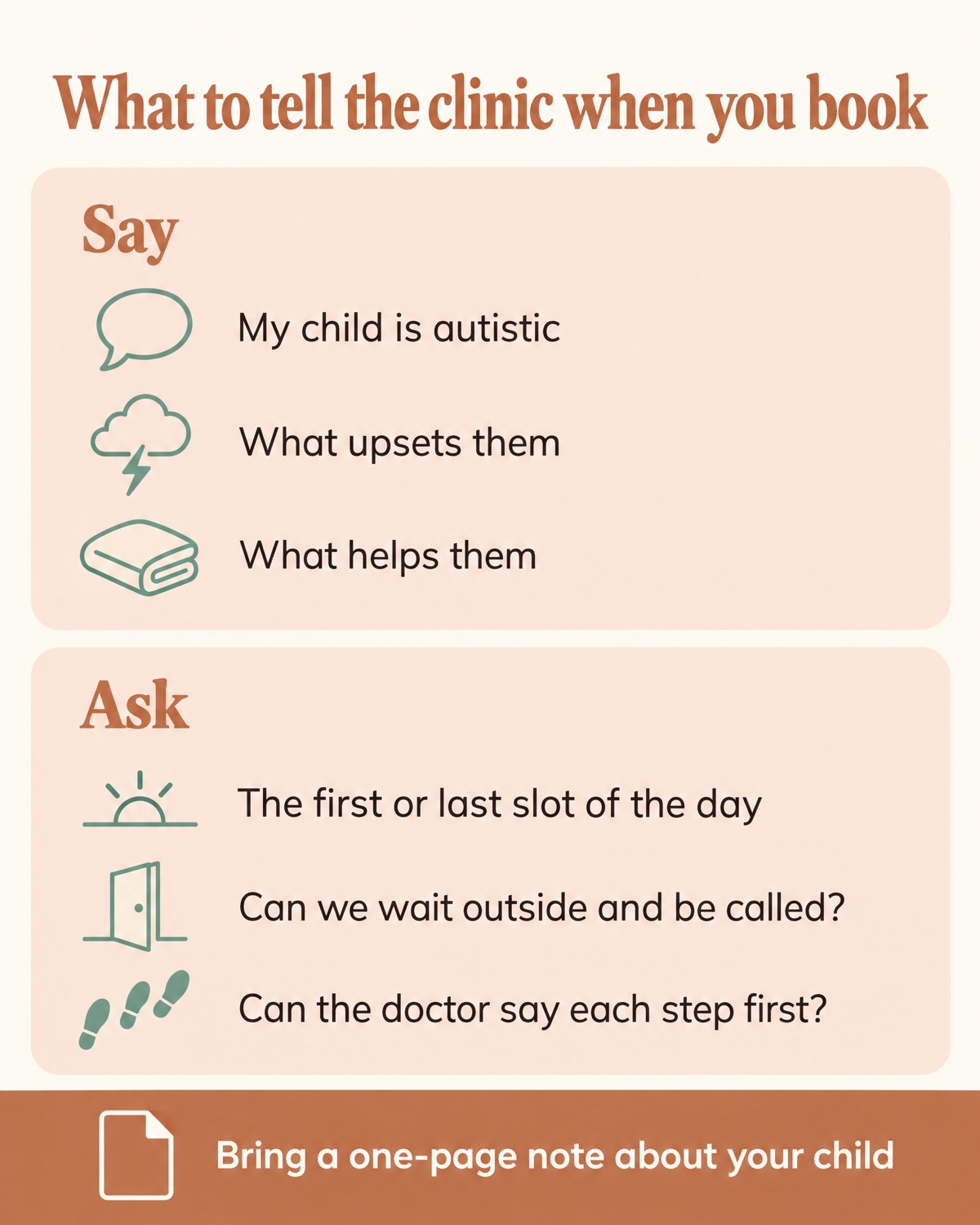
What to tell the clinic when you book
Say
- My child is autistic
- What upsets them
- What helps them
Ask
- The first or last slot of the day
- Can we wait outside and be called?
- Can the doctor say each step first?
Bring a one-page note about your child
Show your child what will happen
A social story is a short, personal, literally accurate story that explains a situation from your child’s point of view. For a doctor’s visit, write it with your actual clinic and the real order of the day: the queue number, the waiting room, the doctor calling your child’s name, the doctor looking in their ears.
Keep every line true. If the doctor might press on your child’s tummy or look in their throat, put that in the story, so nothing on the day breaks a promise. Our guide to writing a social story walks you through it.
A visual schedule does a different job. It is a row of pictures showing what happens next, in order. For a doctor’s visit it might be: car, register, wait, doctor, pay, home. Real photos of your own clinic usually beat clip art for young children. The simplest version is a first/then board with just two pictures: first doctor, then playground.
Not every child needs a schedule. Ours does not. Before our daughter’s first doctor’s visit, the two of us role-played the whole thing at home instead. Try it with a toy doctor’s kit: take turns being the doctor, listen to each other’s chest, look in each other’s ears.
Pack the bag
Bring whatever normally calms your child: headphones for noise, a comfort object, a familiar song on your phone. Our daughter loves certain soft cloths, the small handkerchiefs Asian families keep for babies; that is the kind of thing to pack. Our sensory strategies guide explains how to read what your child needs.
Add a snack and a drink for after, unless the doctor has said not to eat before a test. If a jab or a blood test is likely, dress your child in a short-sleeved top, so there is no sleeve to wrestle with.
At the clinic
The wait
The wait can be harder than the doctor: a crowded room, a loud number board, nothing to do and no idea how long. At a press conference on 2 October 2026, Rahayu Mahzam, a Minister of State (a junior minister) at MOH, described how hard it can be to bring a family member to a crowded polyclinic, with some patients so affected by noise or long queues that they skip the doctor’s visit altogether, Mothership reported.
You do not have to spend it inside. SingHealth Polyclinics, for one, says that a patient who comes without an appointment gets an estimated time slot at registration, and can either wait in the clinic or come back before that time. So register, check the time you are given, and spend it somewhere calmer: a walk, the car, a quiet corridor. At a GP, ask the counter roughly how long it will be and whether they can call you.
If you do wait inside, choose the edge of the room over the middle, put the headphones on early, and bring the one thing that holds your child’s attention longest. Show your child the picture schedule again, with “wait” as the step you are on.
Being examined
A doctor’s exam piles up what our sensory guide calls the hard part of haircuts and dentists: an unfamiliar person very close, and being asked to stay still. Add touch, a cold stethoscope, a light in the ear, a hand on the tummy. What helps is warning, choice and pace.
- Ask the doctor to say each step before it happens, in a few words: “Now I listen to your chest.”
- Ask them to show it first, on you or on a toy, then on your child.
- Offer small choices: which ear first, sitting on the bed or on your lap.
- Let your child hold something in each hand, or squeeze yours.
- Tell the doctor how your child shows they have had enough, and agree a short break when that happens.
“You know your child best,” as a child development specialist at KK Women’s and Children’s Hospital (KKH) puts it to parents, so say what works at home. A doctor who hears “my child copes if you count to three first” can use it.
Jabs and blood tests
Needles need their own plan. KKH’s advice to parents of young children getting a vaccination, from a child development specialist, fits an autistic child well:
- Be honest. Say there may be pain, and that it goes away quickly.
- If your child is very anxious about needles, do not over-talk it, and do not bring it up too often before the day.
- Use a word other than “injection”.
- For younger children, use large pictures to show what will happen, and a first/then: first the jab, then something they love.
- Bring a small reward for straight after, such as a plaster with their favourite cartoon character.
The same moves work for a blood test. Put the jab or the blood test in the social story, at the point it really comes in the doctor’s visit, so it is not a surprise. On the day, the short-sleeved top saves a struggle, and the thing your child holds or watches matters most in the few seconds the needle is in.
Check where the blood will be taken before you go. SingHealth Polyclinics says its laboratory service is by appointment only, and that it does not draw blood from children under 7 years old. If the doctor orders a blood test for a young child, ask where it will be done, and ask for a time slot rather than a walk-in queue.
If you are worried about the pain itself, ask the doctor or nurse what they can do to make it easier for your child. That is their call to make with you.
If your child melts down at the clinic
A meltdown is not bad behaviour. It is your child being completely overwhelmed, and nobody can reason a child out of one. What helps is staying calm, lowering the noise and light around them, and giving them time and space.
At a clinic, that means stopping whatever is happening and asking for a few minutes. Move to a quieter spot if you can: a corridor, outside, the car. Focus on your child, not the room. You do not owe the other patients an explanation.
When your child has come back down, decide with the doctor what happens next. You might finish later that day, do only the part that cannot wait, or rebook. A doctor’s visit that stops halfway has not failed. It shows you what to change next time, and that goes into the next booking call. Our guide to meltdowns covers the moment itself in more depth.
What polyclinics are adding, and when
The changes come from the Taskforce on Assurance for Families with Persons with Disabilities, a five-member group drawn from several ministries and chaired by Mr Goh Pei Ming, Minister of State for Social and Family Development. On healthcare, MOH says it is focusing on people with intellectual disability and on autistic people, because these are less visible disabilities.
- The Taskforce is set up.
- MOH tells Parliament it is reviewing how to make healthcare more accessible for persons with disabilities, starting with primary care (everyday care at GPs and polyclinics), with details due through the Taskforce by the end of 2026.
- At the Taskforce press conference, MOH sets out three layers of help at polyclinics.
- All polyclinics: front-line staff trained in communication and in handling distress.
- At least one polyclinic in each of the three clusters: preparation before the doctor’s visit, more time with the doctor where needed, closer work with caregivers, and links to disability services.
Every polyclinic: staff who give more time
This is the layer most families will meet, at the registration counter and in the consult room. The minister described it as “perhaps giving them more time, listening to them a bit more”. Mothership reported that the training will also cover practical help such as priority queuing (being called sooner), to cut the wait for patients with behavioural or anxiety needs. Ask your polyclinic whether it offers this yet, rather than expect it.
Selected polyclinics: a Health Communication Passport
The second layer is a Health Communication Passport, which MOH is building with SG Enable, Singapore’s main agency for disability and the first stop for persons with disabilities and their caregivers. MOH says it is a place for a person to set out their healthcare needs and the support they need, and that it will start in selected polyclinics. Mothership reported that it would roll out from 2027, and that social service agencies taking part, the charities and community groups that run support services, would help people fill it in and send it to the polyclinic before the doctor’s visit.
One polyclinic per cluster: fuller help
The third layer is for patients with intellectual disability or autism who have more complex needs. The three clusters’ polyclinics are SingHealth Polyclinics, NHG Polyclinics and National University Polyclinics. Which of them will offer this is still to be picked: Mothership reported that the choice would weigh accessibility, readiness and expected demand.
You may also read about the SPARk Clinic at Ang Mo Kio. Mothership reported that MOH is studying it as a possible model, and described SPARk clinics as ongoing care for long-term health conditions, for adults with disabilities who have higher support needs. It is not a clinic to ask for with a young child.
What you can ask for today
None of this needs to wait for 2027. You can make your own version of the passport now: one page, handed over at registration and again to the doctor. Put on it:
- how your child communicates: words, pictures, a device, or mostly by showing you
- what overwhelms them, and the signs that they are close to their limit
- what calms them, and what to avoid saying or doing
- how they show pain, if it is not the usual way
Then ask for what would help on the day. More time with the doctor, if your child needs time to settle. The same doctor next time, if the last one went well. A quieter corner to wait in. A clinic may not manage every request, but it cannot plan for any request it never hears.
For the dentist, the questions are a little different. Our guide to an autism-friendly dentist in Singapore covers them.
Common questions
Will my child get their school jabs at a clinic or at school?
Often at school. In a 2017 reply to Parliament, MOH said the Health Promotion Board’s school health and dental teams give health and dental checks and jabs (screening and immunisation) to students in Special Education (SPED) schools, as well as in mainstream schools. It added that the Board works with each special school’s doctors, dentists, parents and staff to deliver them in a way that suits the students.
Ask your child’s school when the jab is due, and send it the same two or three lines you would give a clinic.
Should I tell the doctor my child is autistic if the doctor’s visit is about something else?
Yes. A cough or an ear infection is the reason for the doctor’s visit; how your child copes with it is what the doctor needs to plan around. One sentence at the start is enough: “My child is autistic. They do better if you tell them each step first.”
Can we go to the clinic once just to look?
Ask. A short trip to see the entrance, the waiting room and the counter, with nothing else happening, gives you real photos for the story and the schedule. If the clinic would rather you did not, photos from outside and the clinic’s own website will do.
What to do next
Before the next doctor’s visit, call the clinic. Tell them your child is autistic, say in two or three lines what upsets them and what helps, and ask for the first or last slot of the day.
Then make its picture schedule with our visual schedule builder, and write its story with our social stories guide.
Sources
- MOH, Remarks by Mdm Rahayu Mahzam at the Taskforce on Assurance for Families with Persons with Disabilities press conference, 2 October 2026. The three layers of polyclinic help.
- MOH, Improving healthcare accessibility for persons with disabilities, 9 September 2026. The Taskforce and the review of primary care.
- MSF, Launch of New Taskforce: Assurance for Families with Persons with Disabilities. Who sits on the Taskforce.
- Mothership, Pre-visit prep and longer consults: 3 S’pore polyclinics to provide tailored services for persons with disabilities, autism by 2028, 4 October 2026. Reporting on the press conference.
- SingHealth Polyclinics, Plan Your Visit, Make An Appointment, accessed October 2026. Booking, the estimated time slot, emergencies.
- SingHealth Polyclinics, Clinical Laboratory, accessed October 2026. Blood tests by appointment, and the age limit.
- KKH, COVID-19 vaccination for young children (five to 11 years), 10 February 2022. The coping tips for anxious children, from a child development specialist.
- MOH, Health screening for persons with disabilities and special needs, 21 February 2017. School health services in SPED schools.
- SingHealth Polyclinics, Who We Are; NHG Polyclinics, Ang Mo Kio; National University Polyclinics, About NUP. The three clusters’ polyclinics.