Dictionary: SEN Officer · MOE
Why are loud places so hard for some autistic children?
Many autistic children hear everyday sounds as louder, or more painful, than other people do. Occupational therapists call this decreased sound tolerance. It is also called hyperacusis.
An occupational therapist (OT) helps a child with the skills of daily life, and sound is often part of that work.
It is common. Up to 60% of autistic people have it at some point in their lives, against 17.1% of people who are not autistic, according to a 2024 paper in Frontiers in Psychiatry, a medical journal.
The National Autistic Society, a UK autism charity, describes what it looks like. Sounds may seem much louder, and sudden noises more upsetting.
A child may avoid loud places, or cover their ears. The society calls this sensory-avoiding behaviour: a way of getting away from a sound that is too much.
Cutting the noise can help with the stress, not only the sound. In a small 2019 study of six autistic children aged 8 to 16 with hyperacusis, wearing noise-cancelling headphones during everyday activities lowered their body’s stress signals. These signals were tiny changes in sweat on the skin.
Six children is a very small group, so read it as a promising sign, not proof.
Every child’s senses are different. Our guide to sensory strategies for daily life helps you work out what overwhelms your child and what soothes them. Ear defenders are one tool on that list, and our autism parenting guides for Singapore cover diagnosis, school and more everyday tools.
Ear defenders or noise-cancelling headphones: which suits your child?
Parents and shops use the two names loosely, so here is the difference.
Ear defenders (also sold as earmuffs) are passive. Thick foam cups seal around the ear and block sound on the way in. There is no battery and no music.
The box gives a rating in decibels (dB), the unit for loudness, that says how much they cut.
Noise-cancelling headphones are active. Microphones on the cups pick up the sound around your child, and the pair plays an opposite sound wave that cancels it out.
LG, a headphone maker, says noise cancelling works best on steady, low sounds such as engine hum, aircon and train noise. Sudden or high-pitched sounds reach the ear before the system can block them. The cups still block some sound on their own, the way ear defenders do.
So the type to pick depends on the sound that bothers your child.
| Ear defenders (passive) | Noise-cancelling headphones (active) | |
|---|---|---|
| How they cut sound | Foam cups seal around the ear | Microphones and an opposite sound wave, plus the cups |
| Best for | Noisy places of many kinds: a noisy classroom, a party, fireworks | Steady hum: a bus, a plane, an aircon unit |
| Weaker on | Very low, bass-heavy rumble | Sudden or high-pitched sounds |
| Battery | None | Needs charging (the JBL Junior 470NC: up to 28 hours with noise cancelling on) |
| Plays music or shows | No | Yes, so check the volume cap |
| Example and price | Alpine Muffy Kids, S$56.54 on Amazon SG | JBL Junior 470NC, S$89.90 at Challenger |
For a first pair, most families can start with ear defenders. A 2023 research update from the American Occupational Therapy Association, the US professional body for occupational therapists, says therapists working with autistic children can consider passive devices to give quick relief from distressing noise, and to help a child take part in daily life. The example pair here also costs less, and there is nothing to charge.
Noise-cancelling headphones make sense when the hard sound is a steady one, like a long bus ride or a flight, or when your child likes to listen to calm music or a show to settle.
If they play sound, check the volume cap. The JBL Junior 470NC never goes above 85 dB, and the JBL Headphones app lets you set a lower cap and a daily time limit. The World Health Organization (WHO) sets a safe-listening standard for children as a weekly allowance instead: 40 hours of sound at 75 dB a week.
Louder sound uses up that allowance faster. So 85 dB is a ceiling, not a target. Keep the volume low and the listening time short.
What should you check before you buy?
A pair your child will not keep on is no help, however good its rating. Check these, in roughly this order.
- The size for your child’s age. Kids’ ear defenders come in age ranges. Alpine, for example, sizes Muffy Kids for ages 5 to 16, and makes a smaller Muffy Baby for younger children. The headband should adjust, and the cups should cover the whole ear with no gap.
- The weight. Lighter is easier to wear for longer. Muffy Kids weighs 174 g. Check the weight on any pair you compare.
- How hard the cups press. The cups need to press enough to seal, but not so hard that they hurt. After 10 minutes of wear, look for red marks around the ears, and watch whether your child keeps pulling them off.
- The rating on the box. This is the number of decibels the pair cuts. American labels call it the Noise Reduction Rating (NRR), and some makers, such as Alpine, give a Single Number Rating (SNR) instead. Under a US federal rule, ratings for hearing protectors run from about 0 to 30, and a higher number means a pair cuts more. Muffy Kids is rated SNR 25 dB.
- Glasses. The arms of a pair of glasses leave a small gap under the cups. Alpine says this stops its Muffy Kids from protecting as well as it should.
- Heat and sweat. Singapore is hot and humid all year round, and foam cups get warm. Pads with a wipe-clean surface help: Alpine says Muffy Kids has a plastic outer layer that is easy to clean. Wipe the pads after use, let them air, and take the pair off for a break once you are somewhere quieter.
- The battery, for noise-cancelling headphones. A flat battery means no cancelling. The JBL Junior 470NC lasts up to 28 hours with noise cancelling on and charges in about 2 hours, so charge it the night before an outing.
- Whether it folds. A pair that folds fits in a school bag. Both example pairs fold, and Muffy Kids comes with a soft pouch.
Two pairs to start with
We picked one pair of each type. Neither is the only good choice: use the checklist above on anything else you see.
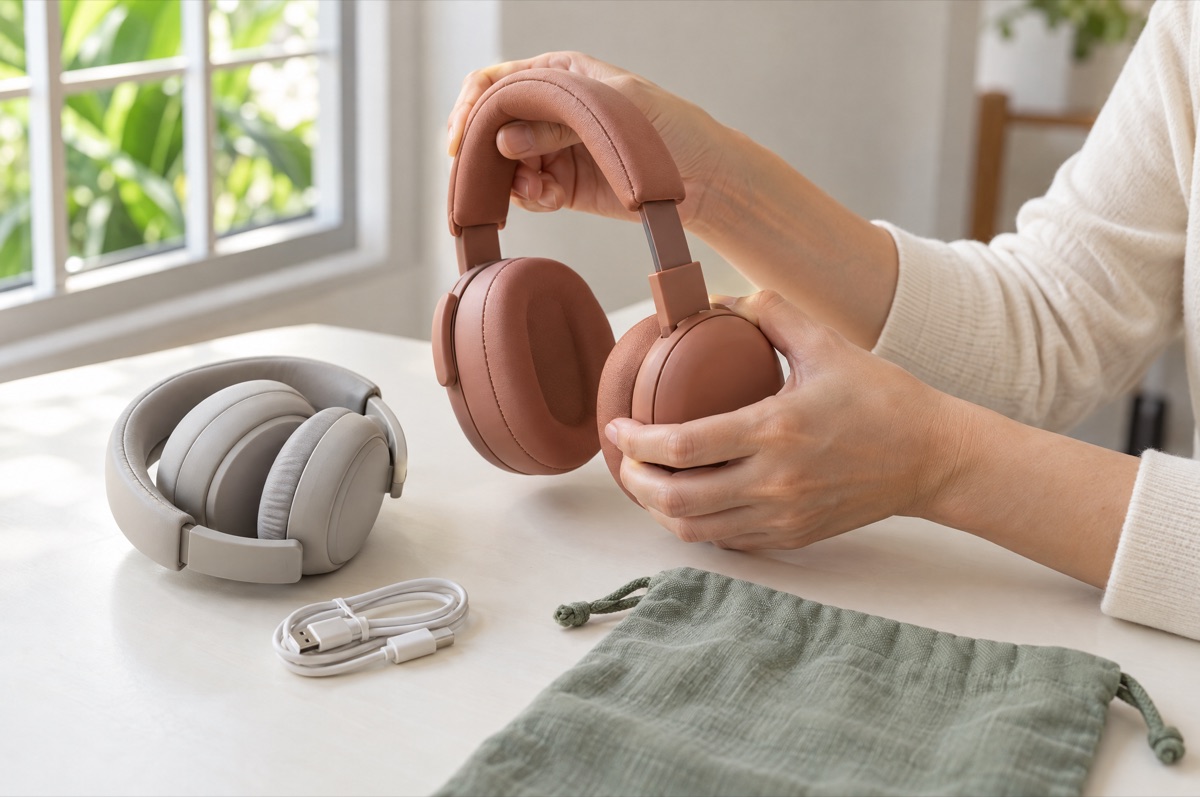
For most children: Alpine Muffy Kids (ear defenders)
A passive pair from Alpine, a maker of hearing protection. Alpine says the cups use several layers of foam to seal around the ear, the headband adjusts and has a soft lining, and the pair is CE certified and ANSI tested, against European and American safety standards.
It suits a child of 5 or older whose hard places are mixed and loud: the school hall, a party, the hawker centre at peak hour. Alpine also says it can help with concentration in a noisy classroom. For a child under 5, look at the same maker’s Muffy Baby instead, and check its age range on the listing.
As of 24 October 2026, Amazon SG lists Muffy Kids at S$56.54. It ships from Amazon Japan as an import, so check the delivery date to your address on the page.
For steady hum and travel: JBL Junior 470NC (noise-cancelling headphones)
A wireless pair made for children, with two microphones to pick up the sound it cancels. JBL says the volume never goes above 85 dB. In the JBL Headphones app, a parent can set a lower cap and a daily time limit, see daily and weekly reports, and lock the settings with a PIN.
It suits a child who finds a steady sound hard, such as a long bus ride or a flight, or who settles better with quiet music. With noise cancelling off, the battery lasts up to 50 hours. A built-in microphone lets your child talk to family on a call.
As of 24 October 2026, Challenger lists it at S$89.90, down from S$119.00. Its page has an in-store availability check, so use it before you travel to a store.
Where can you buy, or try, a pair in Singapore?
To buy. The two pairs above are on Challenger’s page for the JBL Junior 470NC and Amazon SG’s page for Alpine Muffy Kids. For any other pair, the checklist above works the same way. Look for the age range, the weight and the rating on the listing before you pay.
To try one first, for free. Some children refuse anything on their head the first time. A free trial in a real loud place tells you more than a shop shelf.
- The National Museum of Singapore lends free Sensory Bags, first come, first served, made for families with autistic children. Each bag holds ear defenders, sensory toys and a visual schedule, a set of pictures that shows a child what comes next. The museum also has a Quiet Room where a child can calm down before going on with the visit.
- Some bus interchanges and MRT stations. In February 2025, the Land Transport Authority (LTA) and the public transport operators announced a trial of a sensory tool kit for passengers with autism. The kit holds earmuffs and other calming items, and a passenger or carer can borrow it at no charge from the staff at the Passenger Service Centre, the staffed counter at the station. It began at seven places, including Bedok and Tampines bus interchanges and Hougang MRT station. Ask the staff at yours whether they have one. Our safety plan for an autistic child who wanders off covers what to tell station staff about your child.
A museum trip or a short bus ride with borrowed ear defenders is a low-cost test. If your child keeps them on and looks calmer, that is a good sign a pair of ear defenders will suit them.
When does a pair get in the way?
The National Autistic Society lists ear defenders and noise-cancelling headphones among the items autistic people find helpful. It adds one caution: using them a lot may increase sensitivity over time.
So we would treat them like an umbrella, not a hat. Keep them for the loud moments you can see coming:
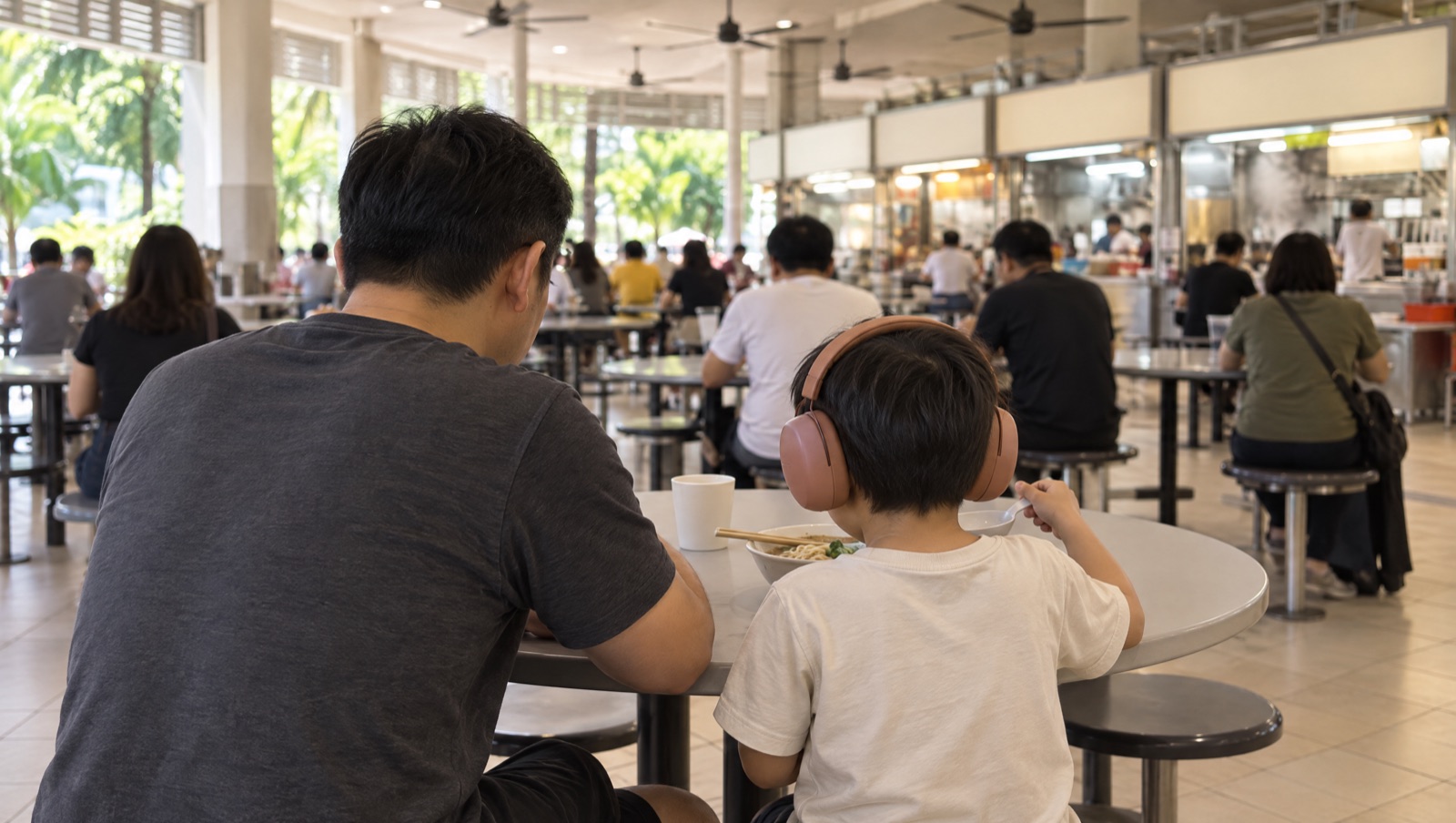
- the hawker centre or food court at peak hour
- school assembly, the canteen, or a hall full of children
- fireworks, a concert or a birthday party
- the hand dryer in a public toilet, or the vacuum cleaner at home
Then take them off once the place is quiet again. Keep the pair where your child can reach it, so they can put it on themselves when a sound starts. A child who can choose when to put them on has some say over the next loud moment.
Near roads, they also block traffic noise. Hold your child’s hand, or keep them close, when you cross.
Ask your child’s occupational therapist if your child wants the pair on all day, gets more upset by sounds than before, or will not wear any pair at all. An OT can look at the sounds that are hard, and plan small steps that help your child cope with them. If a sound already ends in a meltdown, our guide to managing autism meltdowns covers what to do in the moment.
How do you tell the school?
School is where many children need the pair most: the hall at assembly, the canteen at recess. It works better there when the teachers know what it is for.
In a mainstream school, tell the form teacher and the school’s Special Educational Needs Officer (SEN Officer). An SEN Officer is a school staff member who supports students with special educational needs, in class and in small groups.
The Ministry of Education (MOE) says parents can contact the school or the SEN Officer about the support on offer. Our guide to autism support in mainstream schools explains the other help a school can give.
At preschool or a special education (SPED) school, the class teacher is the person to tell.
A short note is enough. Put four things in it:
- What the pair is for. Loud moments, not lessons.
- When your child may wear it. Assembly, recess in the canteen, a hall event.
- That your child can put it on and take it off without asking, and where it lives in the school bag.
- When to tell you. If your child wants it on all the time, or stops using it.
Give the teacher a few days, then ask how it went. What a teacher sees at recess is often new to you.
Common questions
Do noise-cancelling headphones help autistic children?
Many autistic children find them helpful, and they are one of the tools the National Autistic Society lists. In a small 2019 study, wearing them during everyday activities lowered the stress signals of six autistic children.
They do not treat autism or hyperacusis. They make a loud place easier to stay in.
Which pair fits a small child’s head?
Look for a pair sized for your child’s age, with an adjustable band. Alpine sizes Muffy Kids for ages 5 to 16, and makes a smaller Muffy Baby for younger children. Try it on: the cups should cover the whole ear, and leave no red marks after 10 minutes.
Can wearing ear defenders or noise-cancelling headphones all day make sound sensitivity worse?
The National Autistic Society says using them a lot may increase sensitivity over time. Keep them for the loud moments you can plan for, and take them off when the place is quiet again. If your child wants them on all day, talk to their occupational therapist.
Are ear defenders too hot to wear in Singapore?
They get warm, because Singapore is hot and humid all year. Short wear helps most. Choose pads with a wipe-clean surface, wipe them after use, and let your child take the pair off once somewhere quieter.
Does the Assistive Technology Fund pay for ear defenders?
The Assistive Technology Fund helps people with disabilities pay for devices that help them live on their own. Its examples are wheelchairs and hearing aids, not ear defenders or noise-cancelling headphones.
A device also needs an assessment by an assessor, such as a therapist. If your child’s OT thinks a pair is needed for school or therapy, ask them whether it could count.
What to do next
For most children, the first pair is ear defenders. Before the next loud outing you can plan for, open Alpine Muffy Kids on Amazon SG and check the age range, the price and the delivery date to your address. This is not an affiliate link, and no one paid us to name it.
Sources
- Carson and others, Frontiers in Psychiatry, 2024. How common decreased sound tolerance is in autistic people.
- Pfeiffer and others, Frontiers in Integrative Neuroscience, 2019. The study of six children wearing noise-cancelling headphones.
- American Occupational Therapy Association, Research update: noise-canceling headphones for autistic children, April 2023. Passive devices for quick relief.
- National Autistic Society, Sensory differences, checked October 2026. What sound sensitivity looks like, and the caution on heavy use.
- World Health Organization and ITU, Safe listening devices and systems, 2019. The weekly listening allowance for children.
- US Code of Federal Regulations, 40 CFR Part 211 Subpart B, checked October 2026. The Noise Reduction Rating on hearing protectors.
- LG, How does noise cancelling work?, checked October 2026. Which sounds noise cancelling handles best.
- Alpine, Muffy Kids and JBL, Junior 470NC, checked October 2026. Each maker’s specs.
- Challenger, JBL Junior 470NC and Amazon SG, Alpine Muffy Kids, checked 24 October 2026. Prices and stock.
- National Heritage Board, National Museum of Singapore access-friendly amenities, checked October 2026. Sensory Bags and the Quiet Room.
- Mothership, SBS Transit and LTA sensory tool kits, February 2025. The tool kit trial at bus interchanges and MRT stations.
- Meteorological Service Singapore, Climate of Singapore, checked October 2026. Heat and humidity all year.
- MOE, Special educational needs support in primary schools and MOE, Special Educational Needs Officer, checked September and October 2026. The SEN Officer’s role.
- Enabling Guide, Assistive Technology Fund, checked October 2026. What the Fund covers.