
Dictionary: ECDA · DS-LS · DS-Plus · EIPIC · SG Enable · MSF
How early intervention works inside an ordinary preschool
Two programmes bring the help to your child’s own classroom. Both are for children who need what ECDA calls “low levels of Early Intervention (EI) support”, and a child is in one of them at a time, not both.
DS-LS, the Development Support and Learning Support Programme, is for children in K1 and K2, Kindergarten 1 and 2. Preschools that offer it assess your child’s eligibility themselves.
If your child’s preschool does not offer it, ECDA’s page says you may ask the preschool to contact “their respective Therapy Teams”. Ask the preschool who that is.
DS-Plus, Development Support-Plus, starts younger, at two, and runs to six. You do not apply for it: a paediatrician or an early intervention professional refers your child. Then, with your consent, the early intervention operator contacts your child’s preschool principal and asks the preschool to agree to have its professional work inside it.
ECDA’s DS-Plus page does not say how many hours the help takes. SG Enable, the agency that coordinates early intervention referrals, does.
Early intervention professionals from the centre work with your child in the preschool for an average of 2 to 4 hours a week, “co-teaching the child alongside the preschool teacher”. SG Enable’s FAQ adds that your child’s routine will not be affected, because the sessions are built into what the class is already doing.
So the teacher your child already knows stays, and a specialist joins them for part of the week.
What to ask on the preschool visit
Take these to the visit and ask them plainly. Listen for specific answers: a name, a room, a routine. A vague answer tells you something too, and it is better heard before you sign than after.
About the support
- Do you run DS-LS here? If not, who is your Therapy Team, and will you contact them?
- Has an early intervention professional worked in your classrooms before, under DS-Plus? Would you agree to one working here?
- Are you an InSP preschool (the Inclusive Support Programme, explained below), or do you know one near us?
- Who is your Inclusion Coordinator, and can we meet them?
About my child’s day
- Which class would my child join, and how many children and teachers are in it?
- When my child is overwhelmed, what happens? Is there a quieter place, and who decides when to use it?
- How do you handle changes to the routine, like an outing or a new teacher?
About talking to me
- How will you tell me how the day went, and how often?
- If early intervention staff come in, can they, your teacher and I talk together?
- What would make you say you cannot support my child, and what would you need to change that?
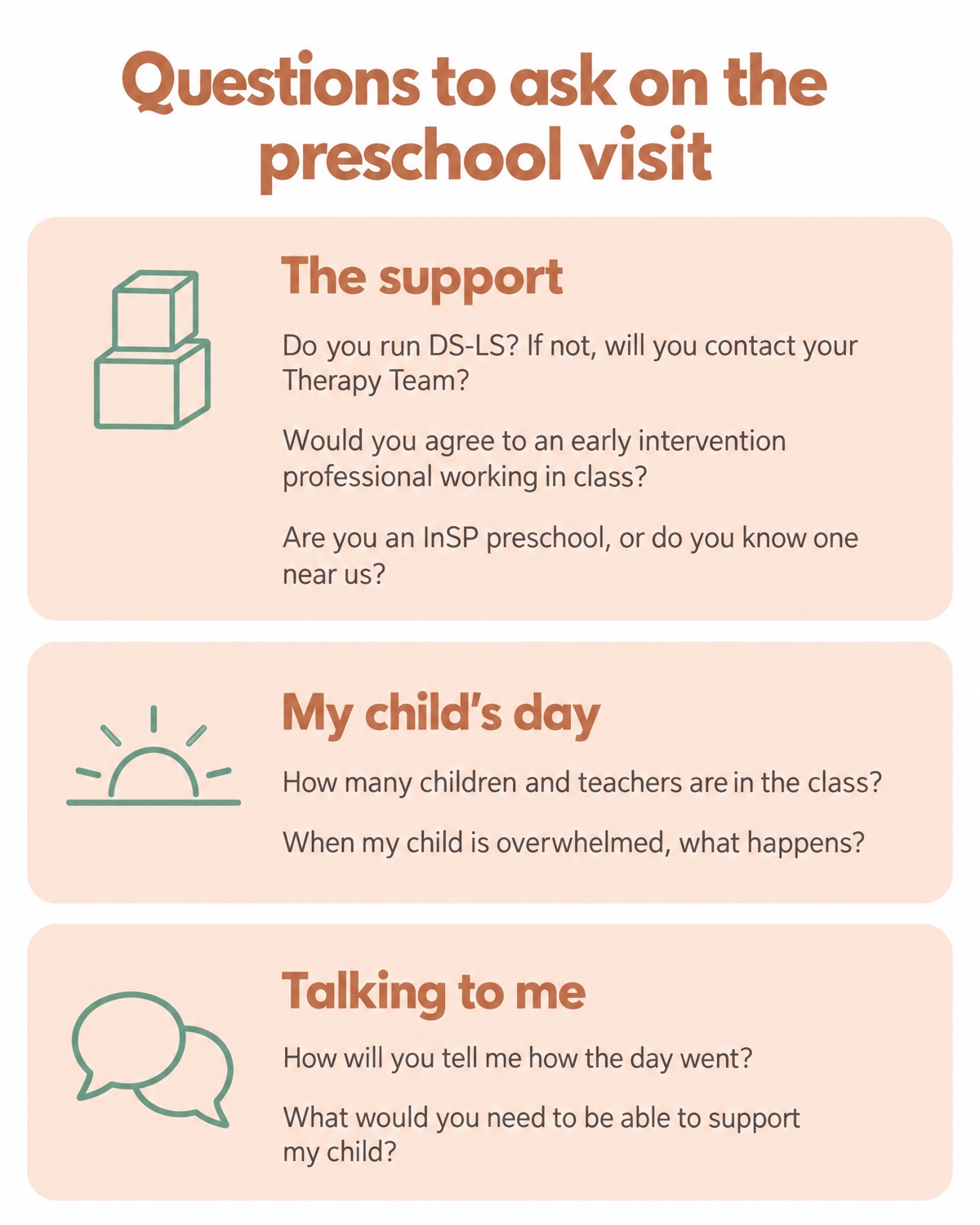
Read this as words instead
Questions to ask on the preschool visit
The support
- Do you run DS-LS? If not, will you contact your Therapy Team?
- Would you agree to an early intervention professional working in class?
- Are you an InSP preschool, or do you know one near us?
My child’s day
- How many children and teachers are in the class?
- When my child is overwhelmed, what happens?
Talking to me
- How will you tell me how the day went?
- What would you need to be able to support my child?
That last question matters most. It turns a possible “no” into a list of things someone could fix, which is where the next section starts.
If the preschool says no
ECDA’s Code of Practice sets the minimum rules for licensed preschools. Two of its rules matter here.
First, a centre may enrol children diagnosed with developmental needs only up to 15% of the places it is licensed for, not counting infant places. The Chief Licensing Officer, the official who approves the Code, can set a different limit. To go past 15%, the centre must ask that officer for approval. The Code says this is so the centre has enough resources to support all its children.
Second, every childcare centre and kindergarten under the Code must have an Inclusion Coordinator. Only centres that run infant care alone are left out. Part of this person’s job is to guide parents to the right early intervention support. Another part is to work with the principal on how the centre supports the enrolment of children with developmental needs.
What the system also shows is that a preschool’s hesitation is expected, and there is a way through it.
DS-Plus is built on the preschool agreeing to let an early intervention professional in, and SG Enable plans for a preschool that needs time. If it “requires more time to make internal adjustments”, SG Enable says your child “will continue to be supported at the EI centre”, the early intervention centre, in the meantime. A slow yes is something the process plans for.
If you hear no, these are the steps, in order.
- Ask to speak to the centre’s Inclusion Coordinator.
- Ask the centre what exactly it is worried about: a time of day, the class size, a behaviour, or not knowing what support exists.
- Ask your child’s paediatrician or early intervention professional which support level fits your child, and whether DS-LS or DS-Plus could come into this preschool.
- Go back to the centre with that answer. If DS-Plus is recommended, the operator contacts the principal, with your consent, to explain the programme and ask for the preschool’s agreement.
- If your child needs more support than a few hours a week, look at the preschools on ECDA’s InSP map, in the next section.
- If the answer is still no, try another centre. One preschool’s no is not the system’s no.
If you want the agency that licenses preschools to know what happened, ECDA’s programme pages carry contact and feedback links at the foot of each page.
Childcare and EIPIC at the same time
EIPIC, the Early Intervention Programme for Infants and Children, is for children who need what ECDA calls “medium to high levels” of support. It happens at an early intervention centre, not in the preschool. SG Enable puts EIPIC@Centre, the version for children aged two to six, at 5 to 12 hours a week.
That leaves room for a preschool, and ECDA has answered the money question directly. Its ask.gov.sg page (as of September 2026) says: “If your child attends both an EI programme and a regular preschool, your child may be eligible for preschool subsidies for the regular preschool component”.
The usual conditions still apply, and ECDA names three: citizenship, household income, and the preschool being licensed by ECDA. The EIPIC sessions are paid for under a separate early intervention subsidy.
What you cannot do is stack funded early intervention programmes. EIPIC’s admission criteria rule out a child already in another early intervention programme funded by the Ministry of Social and Family Development (MSF), and name DS-LS as the example. So a child in EIPIC gets the ordinary preschool on top, not DS-Plus or DS-LS as well.
When InSP or EIPIC fits better
The Inclusive Support Programme (InSP) sits between the in-class programmes and EIPIC. It is for children aged three to six who need “medium levels of early intervention support” and are suited to getting it in a preschool. Early childhood education and early intervention are run together, inside the preschool, so your child learns alongside the other children there.
It began as a pilot in 2021, and it is growing. The Ministry of Social and Family Development announced the numbers on 25 September 2025.
- Preschools in the InSP pilot at launch, 2021 (MSF)
- 6
- InSP places before the expansion (MSF, 2025)
- 150
- InSP places being added, from 2026 (MSF, 2025)
- About 600
- InSP parents who would recommend an inclusive preschool (MSF, 2025)
- More than 95%
That last figure counts every parent at an InSP preschool, whether or not their own child had developmental needs.
The same evaluation found that the children receiving support made progress and began to close the gap with their classmates in areas such as language and daily skills. Their classmates kept pace with or went past the milestones expected for their age.
In the first phase, the new places are at preschools run by Anchor Operators and selected Partner Operators. These are two ECDA schemes that fund preschool operators, in part to keep their fees under a monthly cap. Ask a preschool whether its operator is in either scheme.
Two assessments decide entry. A paediatrician assesses your child as at risk of, or diagnosed with, a developmental disability. Then, after a referral through SG Enable, the InSP preschool itself assesses whether it can support your child’s needs, and a place also depends on a vacancy.
How you start depends on where your child is now.
Your child is already at a preschool that runs InSP, and is in EIPIC or waiting for it
Ask the preschool’s own InSP team about a transfer. ECDA notes that a child already in EIPIC may be moved into InSP if there is a vacancy, after the preschool consults your child’s early intervention centre.
Your child is in EIPIC or waiting for it, but not at an InSP preschool
Go straight to the SG Enable case officer who handled your child’s EIPIC or EIPIC-P referral.
Neither: no InSP preschool and no EIPIC referral yet
Ask a doctor at any polyclinic to refer your child for assessment at KKH’s Department of Child Development or NUH’s Child Development Unit, or see a private paediatrician. If your child is assessed as suitable, the hospital sends the referral to SG Enable. ECDA says SG Enable will contact you within 10 working days of receiving the completed forms.
The InSP fee is paid to the preschool, on top of the preschool’s normal childcare fees. For Singapore Citizen children the maximum is S$10 to S$430 a month, and for Permanent Resident children S$20 to S$1,270, depending on household income per person (as of August 2026). ECDA’s InSP page carries the full income table and a map of the preschools that offer it.
EIPIC fits when your child’s needs are at the “medium to high” level. ECDA says a medical professional has to assess and recommend your child for it, so that call belongs to a professional, not to the preschool.
For the full side-by-side of EIPIC, DS-Plus and DS-LS, with ages, entry and cost, read our comparison of the three.
Common questions
Do I need a private shadow teacher at preschool?
Check first. ECDA’s DS-LS and DS-Plus pages describe early intervention professionals giving in-class support to the child, and neither mentions shadow teachers. So ask your child’s paediatrician or early intervention professional whether one of those programmes fits.
If you still want a private aide, ask the preschool whether it allows one in class. If you hire one, ask the provider for its fee in writing before you agree.
Can my child be in DS-Plus and InSP at the same time?
No. Each programme’s admission criteria rule out a child already enrolled in another funded early intervention programme. A child is in one at a time, and a move between them goes through the professionals, as with a transfer from EIPIC into InSP when a place opens.
How young can my child get support at preschool?
DS-Plus starts at two, and InSP takes children who are three to six in the year they enrol. DS-LS is for K1 and K2 only. EIPIC, at a centre, can start from birth.
Can a Permanent Resident child get this support?
Yes. DS-LS, DS-Plus, InSP and EIPIC are each open to Singapore Citizens and Permanent Residents. The fees differ: for InSP, ECDA publishes a separate, higher maximum for PR children, S$20 to S$1,270 a month (as of August 2026).
What to do next
Ask one question at your child’s next appointment: which support level fits my child, DS-LS, DS-Plus, InSP or EIPIC? Your child’s paediatrician or early intervention professional is the person to ask, because DS-Plus, InSP and EIPIC all start from a professional’s assessment.
Take that answer and the question list above to your preschool visit. It changes the conversation from “will you take my child” to “here is the support that comes with my child”. For the detail on each scheme, read EIPIC vs DS-Plus vs DS-LS, side by side.
Sources
- ECDA, Inclusive Support Programme (InSP), last updated 13 August 2026. Who InSP is for, how to get in, the fees.
- ECDA, Development Support and Learning Support Programme (DS-LS), last updated 1 July 2026. Who DS-LS is for and how a preschool offers it.
- ECDA, Development Support-Plus (DS-Plus), last updated 21 April 2026. Who DS-Plus is for and how a child is referred.
- ECDA, Early Intervention Programme for Infants and Children (EIPIC), last updated 21 April 2026. Who EIPIC is for.
- ECDA on ask.gov.sg, preschool subsidy while in an early intervention programme, checked 29 September 2026.
- SG Enable, Enabling Guide: EIPIC and DS-Plus. The weekly hours and the co-teaching.
- SG Enable, FAQs for EIPIC and DS-Plus (PDF), last updated 1 September 2025. The preschool’s agreement, the routine, and support while a preschool prepares.
- SG Enable, Enabling Guide: EIPIC-P, notice last updated 6 May 2026. The referral pause.
- ECDA, Early Childhood Development Centres Code of Practice (PDF), fourth edition, published February 2025. The 15% rule and the Inclusion Coordinator.
- MSF, ECDA Advances Quality Preschool Education, published 25 September 2025. The InSP pilot, its evaluation and its expansion.