Dictionary: DS-Plus · DS-LS · EIPIC · ECDA · MSF · SG Enable
Who DS-Plus is for
ECDA publishes five admission criteria, and a child has to meet all five.
- Aged two to six years old.
- A Singapore Citizen or Permanent Resident.
- Assessed by a paediatrician “to be at risk of a developmental, intellectual, sensory or physical disability, or a combination of disabilities”. No diagnosis is named in that criterion, and at risk is enough.
- Currently enrolled in a preschool. DS-Plus happens in the preschool, so a child who is not in one has nowhere for it to happen.
- Not already enrolled in another early intervention programme funded by the Ministry of Social and Family Development (MSF).
That last one is the criterion that rules out being in two funded programmes at once, so it is worth saying plainly. DS-Plus and DS-LS are alternatives, not a set. ECDA’s DS-LS page carries the mirror image of the same rule, ruling out children already in DS-Plus. A child is in one tier at a time, and the tier is chosen by assessment rather than by the parent.
You do not apply. Here is how a child actually gets in
Every step below is taken by somebody else. Your part is the referral conversation at the start and your consent in the middle.
- A paediatrician, or an early intervention professional already working with your child, assesses that your child needs low levels of support.
- Your child is referred to an early intervention (EI) centre, the place that runs the programme, to be assessed for suitability. The EI professional uses a common assessment tool called the Early Intervention Benchmarking Framework.
- If your child is suitable, the EI centre asks you for consent. Nothing goes to the preschool before that.
- With your consent, the EI operator contacts your child’s preschool principal, explains the programme, and asks the preschool to agree to have the EI professional work inside it.
- The EI educator and the preschool build a transition plan and the goals for it together.
- Sessions begin. SG Enable, which publishes the government’s Enabling Guide, states it takes “about two months or less from the time parents’ consent is given, for the intervention to commence”.
If your child’s preschool needs longer to make its own arrangements, your child does not fall through the gap in between. SG Enable’s guidance is that “your child will continue to be supported at the EI centre so that continuing intervention is assured”.
The preschool has to be an ECDA-licensed preschool or an MOE Kindergarten. A preschool that does not currently run DS-Plus is not a dead end, and you are not expected to move your child: the operator approaches the preschool you are already in.
What DS-Plus costs
ECDA states the out-of-pocket fee for Singapore Citizen children as S$2 to S$290 a month, “depending on monthly household per capita income” (as of April 2026, the date ECDA last updated the page).
Household per capita income is the household’s total monthly income divided by the number of people living in it, children included. Two families on the same salary can sit at different points of the band, because the arithmetic divides by household size. ECDA does not publish the bands themselves, and for your own figure it sends you to one place: “For more detailed information on your eligibility for subsidies, please consult your child’s EI Centre.”
Two honest gaps sit in that number. ECDA’s DS-Plus page publishes the Singapore Citizen range only, and states no range for Permanent Resident children, so a PR family has to ask the EI centre directly. And S$2 to S$290 is a wide band by design. The centre is the only place that can tell you where in it you land. If you are weighing this against paying privately, read our guide to what private early intervention costs in Singapore, which works the sum through the subsidised EIPIC fee table rather than this one.
What two to four hours a week actually looks like
ECDA’s own programme page does not state the hours anywhere. They come from SG Enable’s EIPIC and DS-Plus FAQ, last updated 1 September 2025, which sets the three intensities against each other in a single answer.
- EIPIC, at an EI centre (SG Enable, 2025)
- About 5 to 12 hours a week
- DS-Plus, in the child’s preschool (SG Enable, 2025)
- About 2 to 4 hours a week
- Development Support, in the child’s preschool (SG Enable, 2025)
- About 1 to 2 hours a week
Those hours are not a separate class your child is taken out to attend. The same FAQ describes DS-Plus as EI professionals working with the child in their preschool “up to twice a week, co-teaching the child alongside the preschool teacher”, and says the preschool routine “will not be affected”, because the sessions are built into the activities the class is doing anyway. An EI professional might extend a theme the classroom teacher had already planned, and work on your child’s own goals inside it.
Who comes in depends on what your child needs. ECDA describes EI professionals and Allied Health Professionals working alongside the preschool’s own early childhood educators to design the goals, deliver the intervention, support your child in class, and support you as the parent. SG Enable’s own comparison names the DS-Plus roster as EI educators, therapists and other EI professionals, and lists the areas it covers: speech and language, social communication, fine and gross motor skills, language and literacy, and self-help skills.
How DS-Plus starts, and how it ends
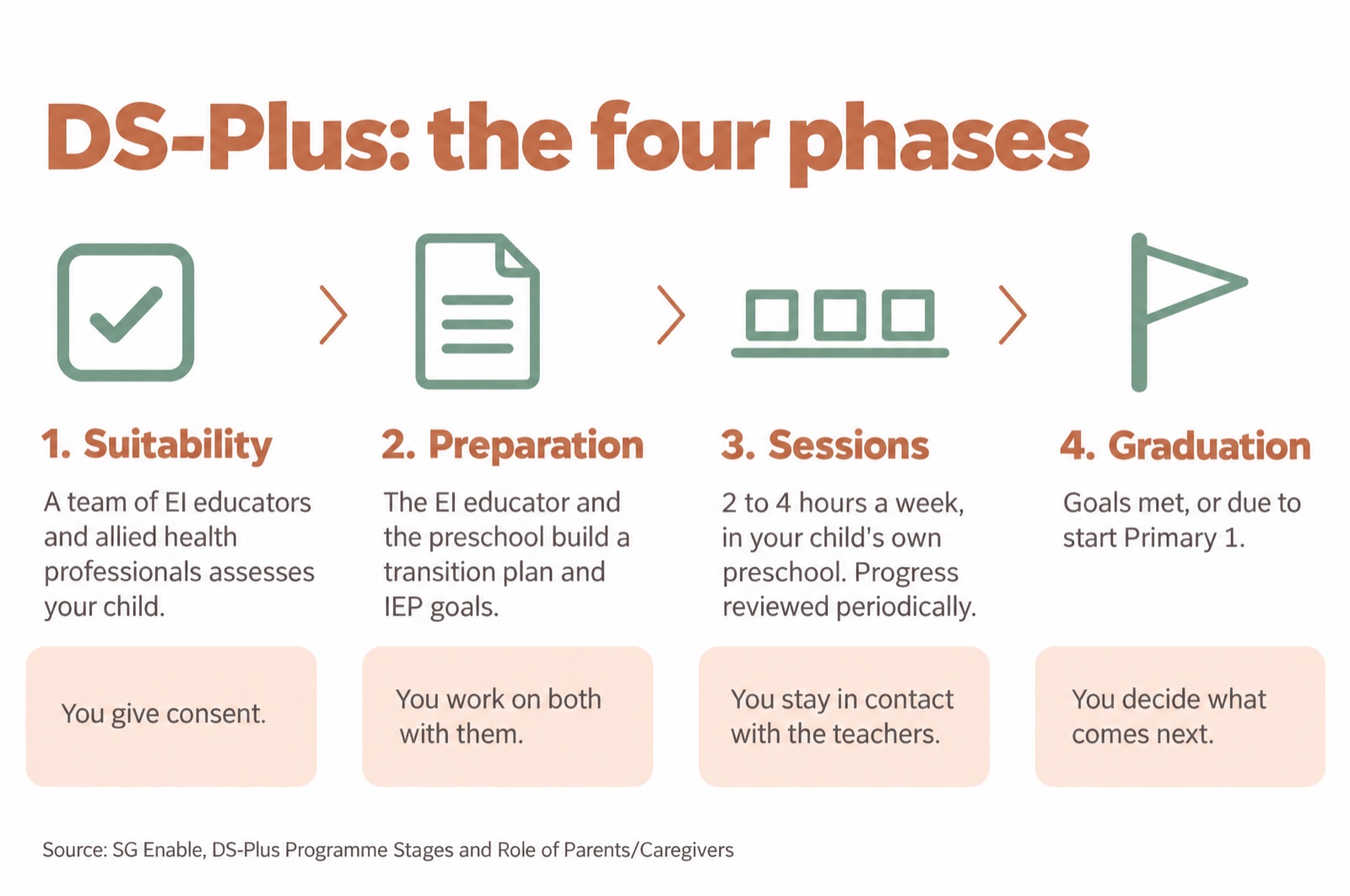
SG Enable publishes a short document setting out the four stages of DS-Plus and what the parent does in each. It is written around the move from an EIPIC centre: phase two’s own title is “Preparing your child for the transition from the EIPIC centre to the preschool”. Here are the four in order.
Text version
- 1. Suitability. A team of EI educators and allied health professionals assesses your child. You give consent.
- 2. Preparation. The EI educator and the preschool build a transition plan and IEP goals. You work on both with them.
- 3. Sessions. 2 to 4 hours a week, in your child’s own preschool. Progress reviewed periodically. You stay in contact with the teachers.
- 4. Graduation. Goals met, or due to start Primary 1. You decide what comes next.
Source: SG Enable, DS-Plus Programme Stages and Role of Parents/Caregivers.
The first phase is the decision. A transdisciplinary team, meaning EI educators and allied health professionals working as one group rather than passing your child between them, assesses whether DS-Plus suits your child. Your job there is consent.
The second is preparation. The EI educator writes a transition plan and the Individualised Educational Plan goals, the written targets for your child, together with the preschool. Your job is to work on both with them.
The third is the sessions themselves, two to four hours a week, with progress and goals “reviewed periodically”. Your job is the least glamorous and the most useful: staying in contact with the teachers and the EI educator so that everyone is working on the same thing.
The fourth is the exit, and it has two doors. SG Enable states that a child “graduates from DS-Plus after either having met his/her intervention goals or when your child is due for transition to primary school”. So the run can end because the goals were met, or simply because your child is due to start Primary 1. Your job at that point is the decision about what comes next.
DS-Plus and DS-LS are not the same thing
Both run inside a preschool, and DS-LS is really two different packages wearing one name. SG Enable publishes the official side-by-side, and it is worth seeing whole.
| DS-LS: Learning Support | DS-LS: Development Support | DS-Plus | |
|---|---|---|---|
| Who it is for | Children with learning needs | Children with mild developmental needs | Children with mild to moderate developmental needs |
| What it covers | Literacy, language, fine motor and social skills | Occupational therapy, speech and language therapy, educational support, psychology | Speech and language, social communication, fine and gross motor, language and literacy, self-help skills |
| How much | One-hour sessions, a package of 8 to 14 of them | One-hour sessions, a package of 8 to 14 of them | 2 to 4 hours, over at least six months |
| Who delivers it | Learning Support Educators | Learning Support Educators, therapists and other EI professionals | EI educators, therapists and other EI professionals |
Read the bottom two rows together and the real difference shows up. DS-LS is a block of sessions that ends; DS-Plus is a run of at least six months. Of the three, only the Learning Support package is a single-role team; Development Support brings in therapists and other EI professionals, as DS-Plus does. The ages differ too: DS-LS is for K1 and K2 children only, while DS-Plus starts at two. The fees are close but not identical, and ECDA’s DS-LS figures are S$5 to S$130 a month for Learning Support and S$5 to S$290 for Development Support for Singapore Citizen children (as of July 2026).
If what you actually want is to place your child against all three tiers at once, that is a different question and it has its own page: our comparison of EIPIC, DS-Plus and DS-LS sets them side by side on support level, setting, ages, entry and cost. There is also a fourth programme that page does not cover: the Inclusive Support Programme (InSP), for children aged three to six who need medium levels of support, which is a higher level than DS-Plus and is also delivered in a preschool.
What a place in DS-Plus does not tell you
It does not predict where your child goes to school. SG Enable states this directly, and the sentence is worth keeping: “placement into a particular EI programme does not entail a guarantee or recommendation for either mainstream or special education school, as children’s developmental needs may change over time, and each child responds differently to EI”.
One more gap is worth naming, and it sits on ECDA’s own EIPIC page. If your child is in EIPIC and you go looking for what happens after, that page will not tell you. It describes EIPIC and lists DS-Plus only as a link in its side menu, with nothing in its text about children moving across. The step is documented from the DS-Plus side and in SG Enable’s FAQ, not from the side you are already standing on. You are not missing it by reading carelessly.
What to do next
Ask the question out loud at your next appointment. Say the name: ask your child’s early intervention centre or paediatrician whether DS-Plus is the right tier now, and ask them to review the referral. Asking is the lever a parent has inside this system, and it is a real one, because the whole system runs on a professional putting your child forward.
If you are not sure which tier your child belongs in at all, start with the three tiers compared side by side instead. And if you just want the short version to show someone, the one-paragraph definition lives in our SG Autism Dictionary entry for DS-Plus.
Common questions
Can I apply for DS-Plus myself?
No, and you do not need to. ECDA states there is no application. A paediatrician or an EI professional refers eligible children. What you can do is ask: raise DS-Plus by name with your child’s paediatrician or EI centre and ask whether your child should be assessed for it.
Can my child be in DS-Plus and another funded programme at the same time?
No. One of ECDA’s five admission criteria is that the child is not concurrently enrolled in another MSF-funded early intervention programme, and it names DS-LS as the example. The DS-LS page carries the same rule in reverse.
How long does it take to start?
SG Enable states about two months or less from the day you give consent. If the preschool needs longer to prepare, your child keeps being supported at the EI centre in the meantime.
Will my child be pulled out of class?
No. SG Enable states the preschool routine will not be affected, because the EI professional works within the existing schedule and builds the intervention into the class activities, co-teaching alongside the preschool teacher.
What does DS-Plus cost for a Permanent Resident child?
ECDA does not publish a range for PR children on its DS-Plus page; the S$2 to S$290 band is stated for Singapore Citizen children only. Ask your child’s EI centre for the PR figure.
Is moving from EIPIC to DS-Plus a step down?
It is a step to less intensive support, and ECDA’s own definition is that it covers children assessed to have made sufficient progress in EIPIC. The hours drop because the need dropped, and the setting changes from a centre to your child’s own classroom.
Sources
- ECDA, Development Support-Plus (DS-Plus), last updated 21 April 2026. Eligibility, the no-application rule, the fee range.
- SG Enable, FAQs for EIPIC and DS-Plus (PDF), last updated 1 September 2025. The weekly hours, the direct referral footnote, the two-month timeline, the preschool routine.
- SG Enable, DS-Plus Programme Stages and Role of Parents/Caregivers (PDF). The four phases and the two exits.
- SG Enable, FAQs for the DS-LS Programme (PDF), updated as of 1 July 2025. The DS-LS and DS-Plus comparison table.
- ECDA, Development Support and Learning Support Programme (DS-LS), last updated 1 July 2026. DS-LS ages and fees.
- ECDA, Inclusive Support Programme (InSP), last updated 13 August 2026. The InSP age range and support level.