Dictionary: ASD · NUH CDU · KKH DCD · Visual schedule
Is picky eating a sign of autism?
Not on its own. Fussy eating is common in all young children. KKH says it is reported by up to half the parents of children aged one to ten in Singapore, and that most children outgrow it by school-going age.
Turning away new foods is normal too, and KKH says it peaks between 18 and 36 months.
What differs in autistic children is how often a narrow way of eating shows up. A 2019 study of 1,462 young people, cited in a 2021 scoping review in the journal Autism, found eating patterns such as a short list of preferred foods, or wanting only one brand, in 70.4% of the autistic children. The same was true of 13.1% of children with other conditions and 4.8% of children in the general population.
| Group of children | Share with narrow eating patterns (%) |
|---|---|
| Autistic children | 70.4% |
| Other conditions | 13.1% |
| General population | 4.8% |
So a short list of foods is one thing a doctor may ask about, among many. If you are wondering whether your child is autistic, our guide to the early signs of autism in Singapore shows what those signs look like day to day.
Why many autistic children eat only certain foods
Often the reason is how a food feels to your child, not a wish to be difficult. Three reasons come up again and again.
Texture, smell and look. In one study in the review, autistic children refused more foods than other children and for more reasons. Texture was the most common reason in both groups, given for 77.4% of the autistic children and 36.2% of the others.
Another study found refusals based on colour, texture and type of food. KKH’s occupational therapy service lists picky eating among the common difficulties linked to sensory processing, which is how the brain takes in and sorts what the body senses. Our guide to reading your child’s sensory signals covers the senses beyond the plate.
Sameness. A third study found autistic children had more mealtime behaviours tied to insistence on sameness, such as the same spoon or the same way of cooking a dish. So the nugget from a new shop, or rice from a different pot, may read to your child as a new food.
A body reason. Eating can also be hard because something hurts or does not work well. KKH names reflux and allergies among the medical issues a paediatrician rules out, and gagging or trouble chewing among the feeding skill problems.
NUH’s feeding clinic lists constipation and poor sleep among the conditions that can affect appetite. This is why the doctor comes before any home plan.
If you would rather watch than read, this short video from the Child Mind Institute, a US organisation, talks about autism and picky eating.
Watch on YouTube: Autism and Picky Eating, by Child Mind Institute.
It comes from the US, so take the general picture from it and the Singapore doors from this page.
Picky eating, a feeding problem and ARFID: the difference
These are three points on one line, not three boxes your child must fit.
Picky eating is the everyday word; researchers also say selective eating or food selectivity. It means a child eats a narrow range of foods and turns down new ones. Many children go through it, and in autistic children it is far more common, as the study above shows.
A feeding problem is when eating itself is hard work. NUH’s feeding clinic lists the kinds it sees: poor weight gain, coughing, choking or gagging at meals, frequent vomiting, trouble chewing, a narrow range of accepted foods, fears about eating, and mealtime behaviour that upsets the whole meal. A feeding problem is a reason to see a doctor, whatever its cause.
ARFID, or Avoidant/Restrictive Food Intake Disorder, is a diagnosis. It was added in 2013 to the DSM-5, the American Psychiatric Association’s diagnostic manual, which also defines autism. A 2018 review in Current Opinion in Psychiatry describes the three reasons behind it: the senses (taste, texture, smell), fear of what eating might bring, such as choking or vomiting, or little interest in food.
The review also names autism among the conditions that can come with ARFID. That does not make every autistic child who eats a short list of foods a child with ARFID.
This page cannot tell you which side of the line your child is on, and no checklist can. That is a question for a doctor who can watch your child eat and check their growth.
When to worry about your child’s eating
KKH’s advice is plain: if fussy eating has been a concern every day for two weeks or more, see a doctor in the community. The table puts KKH’s and NUH’s signs side by side, so you can see which column your week looks like.
| Often ordinary fussy eating | Worth a doctor’s look | |
|---|---|---|
| The foods | Turns down new foods and vegetables or fruit; prefers sweet and fatty foods | Fewer than 20 foods, which KKH calls a restrictive diet, or a whole food group gone |
| Growth | Still growing well, with an appetite that goes up and down from day to day | Weight loss, poor weight gain or slow growth |
| At the table | Eats slowly | Coughing, choking or gagging; frequent vomiting; trouble chewing; fears about eating; mealtime behaviour that upsets the whole meal |
| How long | KKH says most children outgrow it by school-going age | A concern every day for two weeks or more |
Normal growth does not rule a feeding problem out. A Singapore study published in December 2025 looked at 132 children aged one to seven at NUH’s child development unit, 54.5% of them autistic. Over half (53.0%) had feeding difficulties on a questionnaire their caregivers filled in, yet most had a weight in the normal range, and the authors note that feeding problems “may be overlooked as growth tends to be preserved”.
The same study found that the kind of diagnosis made no clear difference, while more repetitive behaviours went with more feeding difficulty. Its authors suggest doctors ask whether a child eats from every food group, because there is evidence that leaving out whole groups is common, especially among autistic children. So bring that up yourself if the doctor does not.
If your child chokes and cannot breathe, or cannot keep any fluids down, do not wait for an appointment. Go to an emergency department.
Who helps with feeding in Singapore
First, your family doctor, polyclinic or paediatrician
KKH’s route starts in the community. A family doctor or polyclinic doctor can assess your child and refer them to a paediatrician, who rules out medical causes such as reflux or allergies. If the usual home advice has not helped much, KKH says the next referral may be to a dietitian or a therapist.
Bring your child’s health booklet and a list of the foods your child eats now. If chewing seems to hurt, ask about the teeth too; our guide to an autism-friendly dentist in Singapore covers where to go.
At KKH
KKH says it provides assessment, therapy and support for children’s nutrition, feeding skills, and the strain feeding puts on a family. A doctor refers a child to its General Paediatrics Service. KKH’s own advice on fussy eating was written by three of its staff: a dietitian, a speech therapist who works with complex feeding and swallowing problems, and an occupational therapist who specialises in children with fussy eating.
At NUH
NUH runs an Interdisciplinary Feeding and Nutrition Clinic at the Khoo Teck Puat-National University Children’s Medical Institute, Level 8, 5 Lower Kent Ridge Road. Its team is paediatricians, dietitians, speech therapists and psychologists, and it says feeding difficulties may stem from “medical, developmental, sensory or behavioural issues”.
At the first visit, you meet the paediatrician, the dietitian and a speech and swallowing therapist, plus a psychologist when suitable. The team watches your child eat, and NUH says the visit takes about two hours.
The clinic’s page also has a resource to help preschoolers and children with special needs get ready for the visit. Ask your child’s doctor whether a referral to this clinic suits your child.
Who does what
The paediatrician looks for anything medical that affects your child’s growth and eating, including conditions such as constipation or poor sleep that affect appetite. NUH’s paediatricians also diagnose and treat nutrient shortages.
The dietitian tracks your child’s growth, checks whether their food is enough to grow on, and suggests ways to meet those needs through food or, where needed, supplements.
The speech therapist works on chewing and swallowing. Singapore’s law puts the “assessment, diagnosis, and management of feeding” and swallowing disorders within speech-and-language therapy.
The occupational therapist works on the skills and the senses of eating. KKH says speech and occupational therapists support feeding skills with oro-motor therapy, which works on the mouth’s movements, and with sensory-based approaches.
The psychologist, in NUH’s team, works on routines and mealtime behaviour, and supports the parents too.
If your child already sees a speech therapist or occupational therapist, tell them about meals as well. Our page on the autism therapies Singapore parents get offered explains each one, and our guide to choosing an autism therapist shows how to check a private therapist’s registration.
Home steps that respect your child’s senses
These steps come from KKH’s and NUH’s advice for fussy eaters, shaped for a child whose senses run strong. They are things you can do at home while you wait for an appointment, or alongside one. None of them comes with a promise about what your child will eat, and none replaces the doctor’s check.
- Keep a safe food on every plate. A safe food is one your child reliably eats. KKH advises offering both preferred and non-preferred foods at every meal, so the meal never depends on the new one.
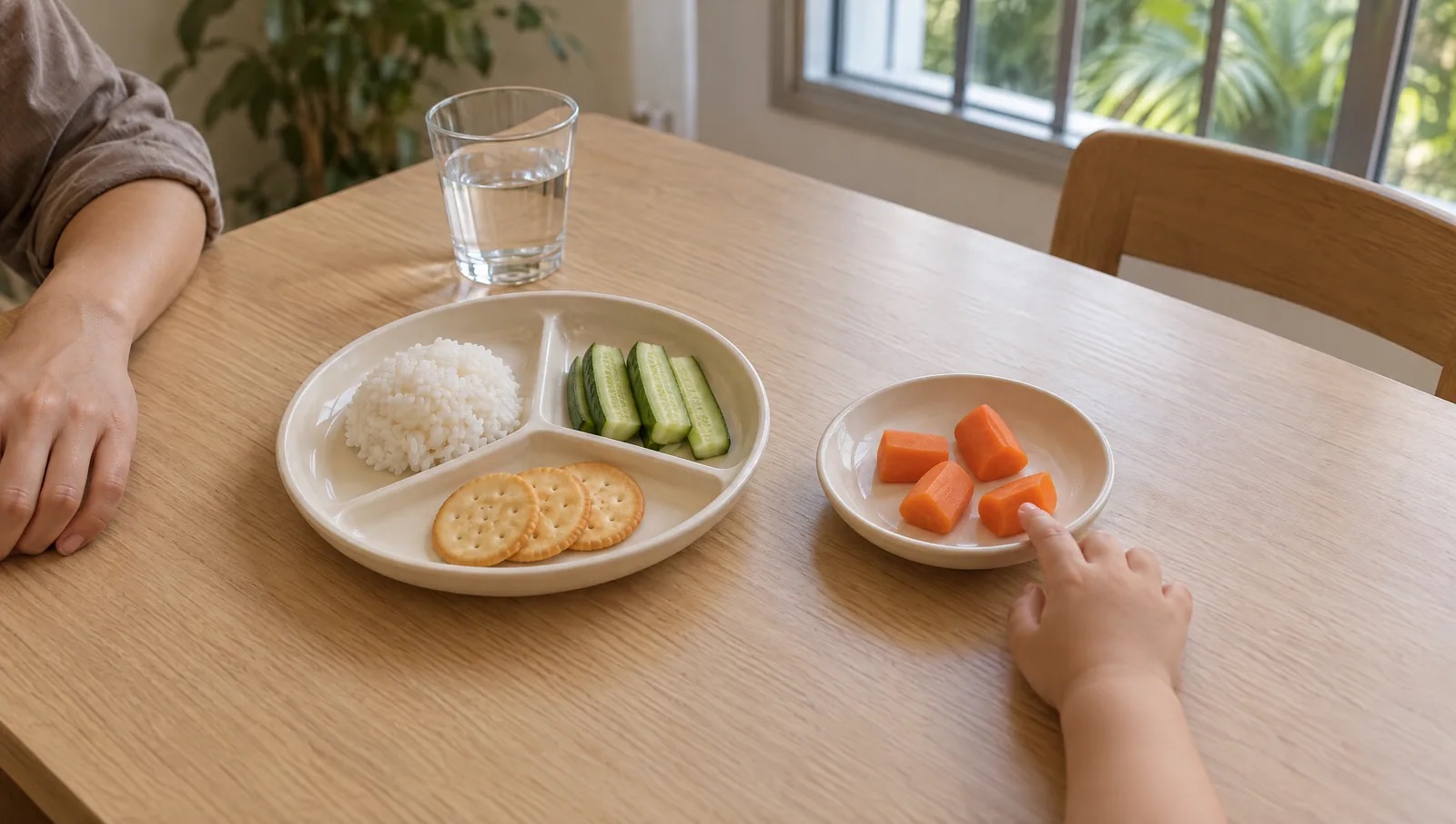
- Put a new food beside, not on. A small separate saucer next to the plate lets the new food sit near your child without touching what they trust.
- Count looking, smelling and touching as progress. NUH says children may need 10 to 20 occasions to explore a food, moving through stages of tolerating it, interacting with it, smelling, touching and then tasting it.
- Change one thing at a time. The same brand in a new shape, or the same dish on a new plate. For a child who likes sameness, a small change to a food they already eat may be easier than a new food all at once.
- Take the pressure off. KKH warns that force feeding, distraction, punishment and bribes can make a child resist more and keep the fussy eating going. Keep screens and toys away from the table, and sit down at set times.
- Leave a gap before meals. KKH suggests no snacks, high-energy foods or milk in the two hours before a meal, so your child comes to the table hungry.
- Eat together, and let your child help. KKH suggests family meals, and jobs such as washing vegetables or setting the table, so food becomes familiar away from the plate.

Keep everyone on the same plan. In a 2012 survey of 407 Singapore caregivers, letting a helper or another carer feed the child was one of the ways families coped with picky eating. If a helper or grandparent feeds your child on some days, walk them through the safe foods, the saucer and the no-pressure rule, so your child meets the same meal whoever is at the table.
A routine your child can see may help too. Our guide to visual schedules for autistic children shows how to make one, and a short first-then strip for the meal is a simple place to start. Our guide to everyday autism parenting covers the rest of the day, from sleep to meltdowns.
Feeding a child who eats very little is hard on a parent. KKH lists stress around feeding among the family concerns its staff help with, so say so at the appointment.
What to do next
For one ordinary week, write down every food and drink your child accepts, with the brand and how it was cooked. Take that list to your child’s paediatrician or polyclinic doctor, and ask one question: does my child need a feeding assessment? The list shows the doctor in a minute what a week of meals looks like, and it gives you both the same starting point.
If you want these guides in your inbox as we write them, the newsletter form is at the foot of this page.
Common questions
Will my autistic child grow out of picky eating?
No one can promise that for one child. KKH says most children outgrow ordinary fussy eating by school-going age, but narrow eating is far more common in autistic children, so do not count on that age as a deadline. What you can do is watch for the signs in the table above and see a doctor if any of them appear.
Should I give my child vitamins or a nutrition drink?
Ask first. KKH says a dietitian can check whether your child’s diet is enough and suggest how to meet their needs through food or supplements. Needing nutrition drinks to get enough is also one of the costs that point towards ARFID, so it is worth telling the doctor if you already rely on them.
Is ARFID the same as autism?
No. Autism is a developmental condition that shapes how a child communicates and takes in the world. ARFID is an eating diagnosis, made only when restricted eating harms growth, nutrition or daily life. A 2018 review names autism among the conditions that can come with ARFID, but a short list of foods on its own is not ARFID.